Skip to content

Ashwagandha Complete Guide: KSM-66 Evidence and Protocols

Reading time

5 min read · 922 words

Updated

October 12, 2026

Fact-checked

Health Secrets Editorial Team

Sources

21 citations, listed at the end

ಸಂಬಂಧಿತ ಉಲ್ಲೇಖ | This article may contain affiliate links to products we trust. If you choose to buy through them, we may earn a small commission at no extra cost to you. Full disclosure

ಚಿಕಿತ್ಸಾತ್ಮಕ ನಿರಾಕರಣ | ಮಾಹಿತಿಯನ್ನು ಮಾತ್ರ. ವೃತ್ತಿಪರ ವೈದ್ಯಕ ಸಲಹೆಯನ್ನು ಬದಲಾಯಿಸುವುದಿಲ್ಲ. ಪೂರ್ಣ ನಿರಾಕರಣವನ್ನು 읽ಿ

Ashwagandha root, powder, and KSM-66 capsules for comprehensive adaptogen supplementation

Ashwagandha (Withania somnifera) is the most evidence-backed adaptogen available, with clinical trials showing 23–32% cortisol reduction, 44–69% anxiety improvement, testosterone support, improved sleep quality, and enhanced exercise performance. This complete Supplements pillar guide covers KSM-66 vs Sensoril, dosing for every use case, cycling protocols, and important contraindications.

M
10
82%
5 922 ord

ಪ್ರಮುಖ ಅಂಶಗಳು

Ashwagandha is classified as an adaptogen — it normalizes stress responses without causing sedation or stimulation [17].
KSM-66 (root extract, 5% withanolides, 300–600 mg/day) has the broadest evidence for anxiety, cortisol, testosterone, sleep, and cognition [2] [5] [11] [13].
Sensoril (root + leaf, 10% withanolides, 125–250 mg/day) has strong evidence for stress resilience, energy, and cardiovascular markers [4].
Clinical evidence: 23–32% cortisol reduction, 44–69% anxiety reduction, 15–17% testosterone increase in men, improved sleep onset and quality, 1–3% increase in VO2 max.
Works through HPA axis modulation (cortisol), GABAergic activity (calming), serotonin modulation (mood), and anti-inflammatory effects (neuroinflammation).
Contraindications: Thyroid medication (increases T3/T4), pregnancy, autoimmune diseases, liver disease, surgery (stop 2 weeks before).
Cycling recommended: 8–12 weeks on, 2–4 weeks off — prevents potential thyroid overstimulation.
Avoid generic, non-standardized ashwagandha powder — without standardized withanolide content, clinical evidence doesn't apply.

Free download

The Breathing Cards

7 pages · PDF

Four cut-out breathing patterns with exact counts and the moment each fits, a ten-session log that averages your before-and-after tension, and when breathwork is the wrong tool.

Plus one sourced idea a week. Unsubscribe anytime. Privacy

The e-book for this topic

Stress Recovery Micro-Habits Workbook

Seven short practices of 1 to 10 minutes, one page each, a chart that tells you which one to use, and a 30-day log that shows what works for you.

$27 One payment · 31 pages
PDF + online edition · 60-day guarantee
See inside

Ashwagandha has earned its place as the most popular adaptogen in the Western supplement market — and unlike most trending supplements, it has the clinical evidence to back the hype [19]. Multiple randomized, double-blind, placebo-controlled trials demonstrate meaningful benefits for stress, anxiety, cortisol, testosterone, sleep, exercise performance, and cognitive function [1].

This comprehensive Supplements pillar guide covers everything: how ashwagandha works, the complete KSM-66 vs Sensoril comparison, dosing protocols for every use case, cycling strategies, contraindications, and which products deliver what the research actually tested. [6] [8]

Related reading: Ashwagandha for Anxiety · Natural Anxiety Relief · Best Natural Sleep Aid [10] [12]

What Is Ashwagandha and How Does It Differ from Other Supplements?

Ashwagandha (Withania somnifera) is a nightshade family herb used in Ayurvedic medicine for 3,000+ years [3] [9] [14] [15]. Its name means "smell of the horse" in Sanskrit, referring both to its distinct smell and the traditional belief it imparts the strength of a horse. The active compounds are withanolides — steroidal lactones that modulate multiple stress-related pathways.

What makes ashwagandha unique among supplements is its adaptogenic classification: it normalizes physiological responses to stress rather than pushing them in one direction. If cortisol is too high, it helps lower it. If energy is too low, it helps raise it. This bidirectional activity is why it benefits both anxiety (calming) and performance (energizing). [16] [18]

The Breathing Cards
7 Pages • Free PDF
Free card set 7 pages • fillable PDF

The Breathing Cards

Four cut-out breathing patterns with exact counts and the moment each fits, a ten-session log that averages your before-and-after tension, and when breathwork is the wrong tool.

The PDF opens in a new tab. Unsubscribe from our emails at any time.

How Does Ashwagandha Work in the Body?

Ashwagandha modulates four key pathways: HPA axis (cortisol reduction of 23–32%), GABA-A receptor activation (direct calming), serotonin receptor modulation (mood stability), and NF-κB inhibition (neuroinflammation reduction). This multi-target approach explains its broad clinical benefits across anxiety, sleep, performance, and cognition.
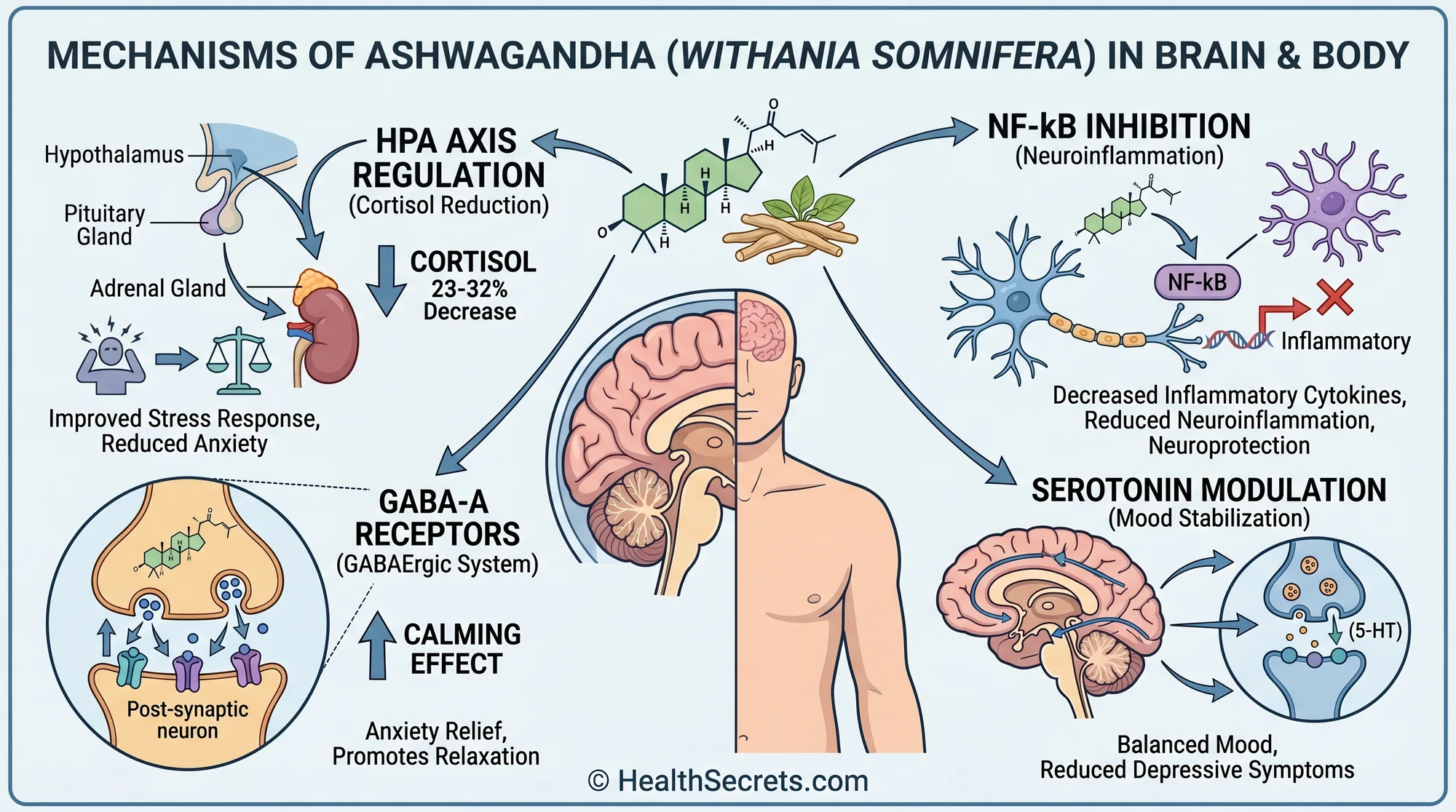
Diagram of ashwagandha's four mechanisms of action including HPA axis GABA serotonin and inflammation
[20] [21]

KSM-66 vs Sensoril: The Definitive Extract Comparison

KSM-66 — ⭐ Most Studied, Broadest Evidence

  • Root-only extract, 5% withanolides
  • 300–600 mg daily
  • Best for: Anxiety, cortisol, testosterone, sleep, cognition, exercise
  • 24+ clinical trials

Sensoril — Strong for Stress + Energy

  • Root + leaf extract, 10% withanolides
  • 125–250 mg daily (higher concentration = lower dose)
  • Best for: Stress resilience, energy, cardiovascular markers
  • 10+ clinical trials

Both are legitimate, well-researched extracts. KSM-66 has more total studies and broader applications. Sensoril requires a lower dose due to higher withanolide concentration.
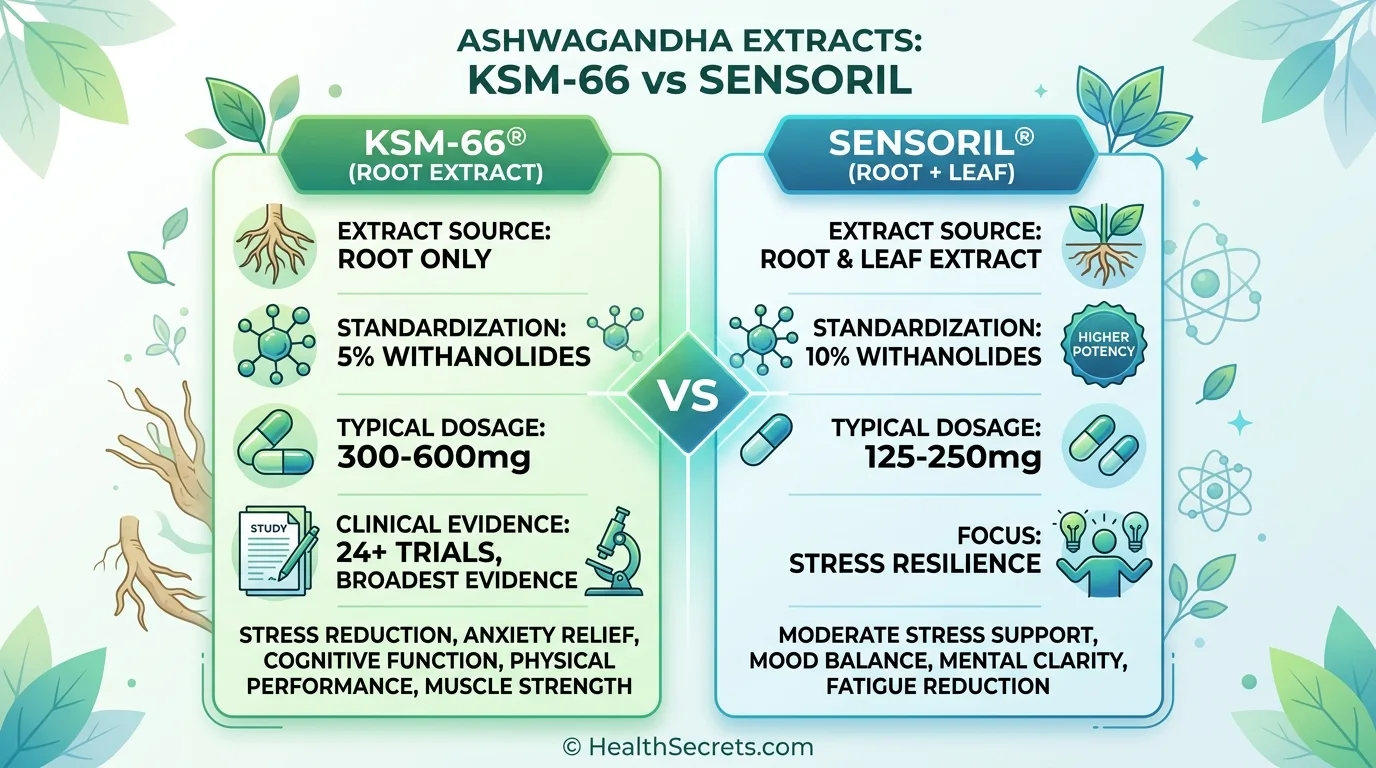
Detailed comparison of KSM-66 versus Sensoril ashwagandha extracts with evidence and dosing

How to Dose Ashwagandha for Every Use Case

  • For anxiety/stress: KSM-66 300 mg 2x/day (600 mg total) or Sensoril 250 mg 1x/day
  • For sleep: KSM-66 300–600 mg 1–2 hours before bed
  • For testosterone (men): KSM-66 600 mg daily for 8–12 weeks
  • For exercise performance: KSM-66 300–600 mg daily, taken consistently (not acutely)
  • For cortisol reduction: KSM-66 300 mg 2x/day or Sensoril 250 mg daily
  • For cognition: KSM-66 300 mg 2x/day
  • Cycling: 8–12 weeks on, 2–4 weeks off. This prevents potential thyroid overstimulation and allows you to assess ongoing need.
  • Timeline: Subtle effects in 1–2 weeks. Significant improvement at 4–8 weeks. Full benefit at 8–12 weeks.
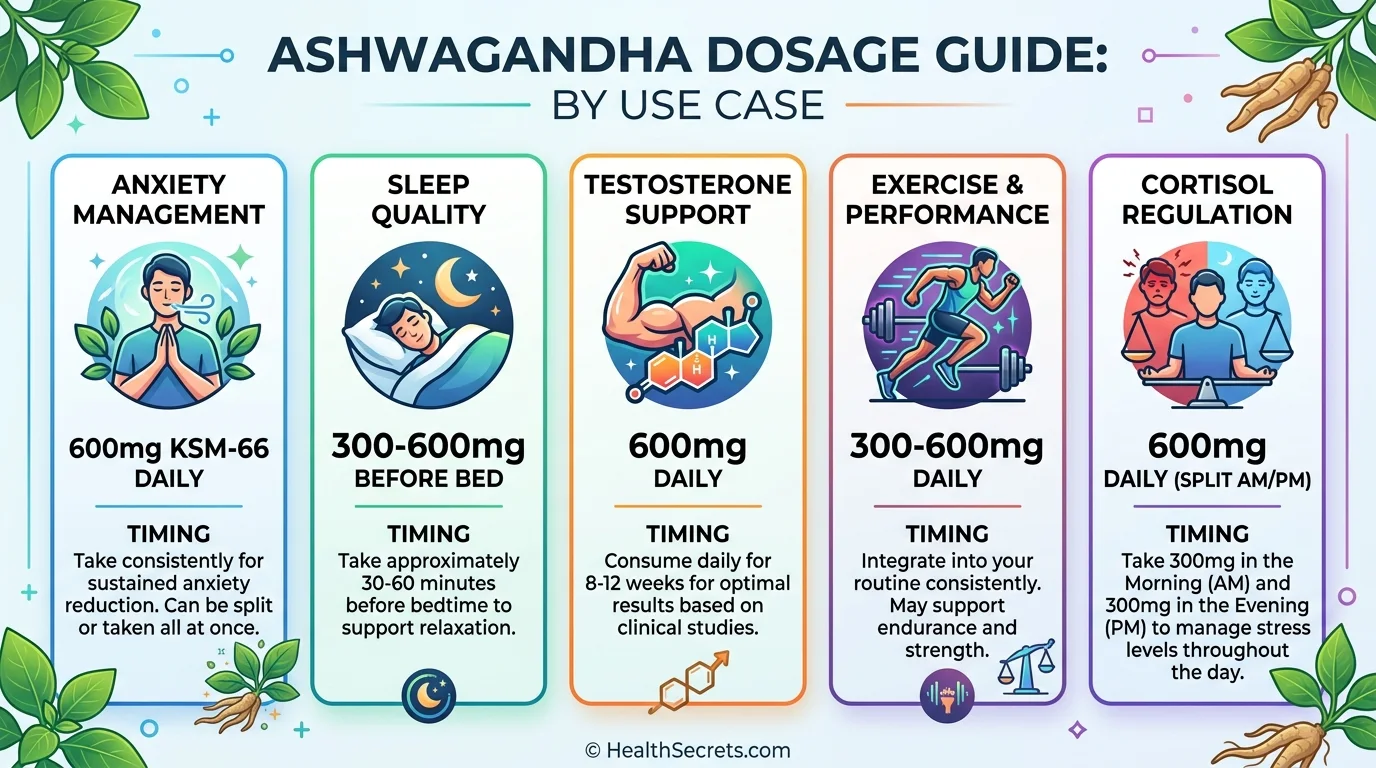
Ashwagandha dosing guide by use case including anxiety, sleep, testosterone, and exercise
Ashwagandha effects timeline from week 1 through 12 weeks including cycling protocol

Can You Get Ashwagandha from Food?

Ashwagandha root powder can be consumed in traditional preparations ("moon milk": warm milk + ashwagandha + honey + spices), but raw powder is not standardized for withanolide content. For reliable clinical effects, standardized extracts (KSM-66 or Sensoril) in capsule form are necessary.

Ashwagandha Safety: Contraindications and Drug Interactions

Who should NOT take ashwagandha:

  • People on thyroid medication (may increase T3/T4 levels)
  • Pregnant or breastfeeding women
  • People with autoimmune conditions (may stimulate immune activity)
  • People with liver disease (rare hepatotoxicity reports)
  • People scheduled for surgery (stop 2 weeks before)

Drug interactions: Thyroid hormones, benzodiazepines/sedatives, immunosuppressants, diabetes medications, blood pressure medications.

Common side effects (mild, dose-dependent): GI discomfort, drowsiness, headache. Start at 300 mg and increase gradually.
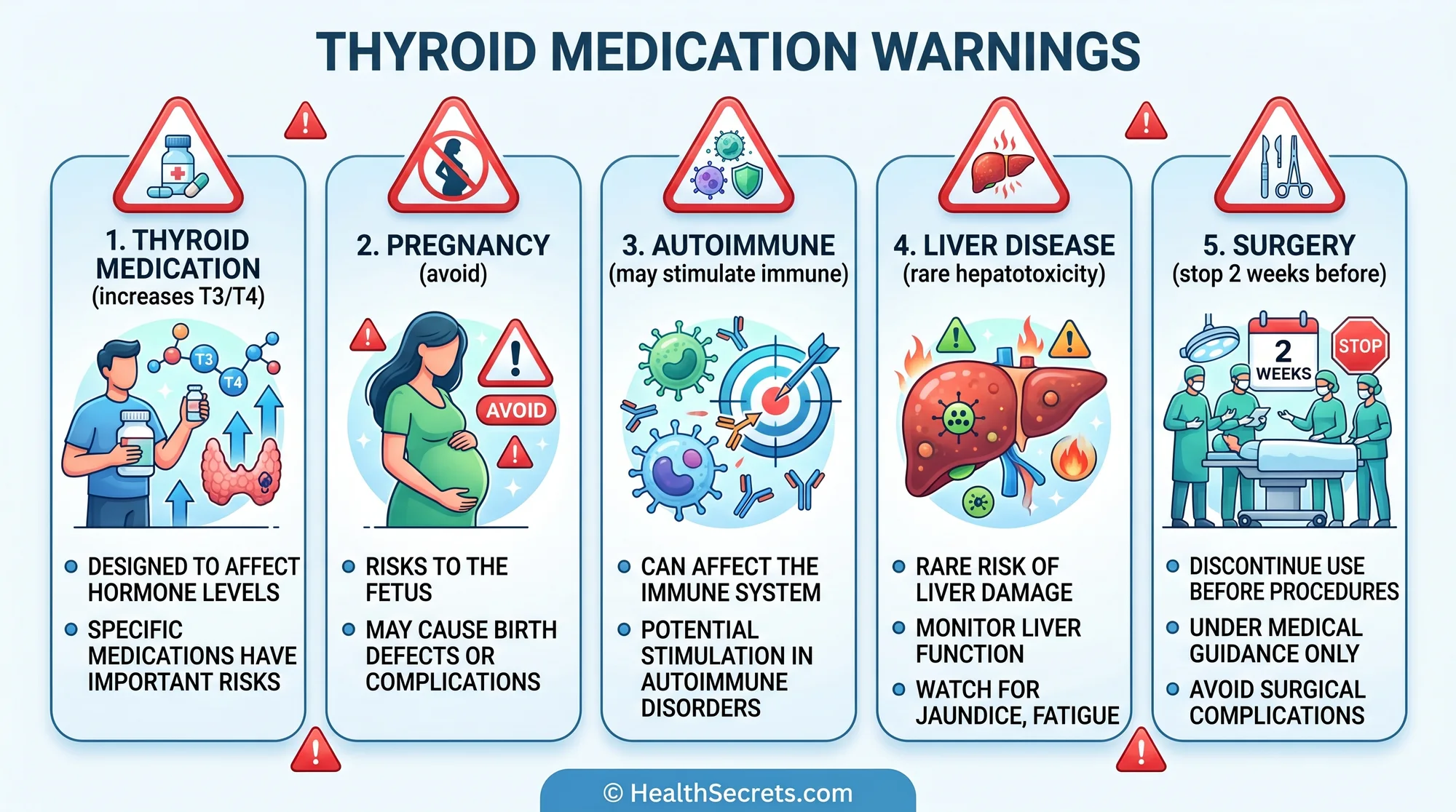
Ashwagandha contraindications including thyroid medication, pregnancy, and autoimmune conditions

What Can Ashwagandha Actually Do?

  • Effective for: Chronic stress-driven anxiety, elevated cortisol, stress-related insomnia, mild-moderate generalized anxiety, exercise performance and recovery, testosterone support in men, cognitive function under stress [7].
  • NOT effective for: Acute panic attacks (too slow-acting), severe anxiety disorders (complement, not replace therapy), PTSD or OCD as standalone treatment.
  • vs Magnesium: Ashwagandha targets cortisol; magnesium targets GABA. Complementary, not competitive.
  • vs L-theanine: L-theanine works faster (30–60 min); ashwagandha is more potent but takes weeks.

ಕ್ರಿಯೆಯ ಯೋಜನೆ

What Should You Do First?

ಕೆಳಗಿನ ಕ್ರಮವನ್ನು ಅನುಸರಿಸಿ, ಪ್ರತಿ ಹಂತವನ್ನು ಕ್ರಮಬದ್ಧವಾಗಿ ಪೂರೈಸಿ, ಮತ್ತು ನಿಮ್ಮ ಪ್ರಾಯೋಗಿಕ ಅನುಷ್ಠಾನ ಮಾರ್ಗದರ್ಶಿಯಾಗಿ ಪರಿಶೀಲನಾ ಪಟ್ಟಿಯನ್ನು ಬಳಸಿ.

ಹಂತ-ಹಂತವಾಗಿ

This Week:

  • Purchase KSM-66 ashwagandha (300 mg capsules)
  • Start 300 mg in the evening with dinner
  • Track anxiety, sleep, and energy daily as baseline

Month 1–2:

  • Increase to 600 mg daily (300 mg 2x/day) at week 2
  • Add magnesium glycinate (200–400 mg before bed) for complementary GABA support
  • Assess improvement at 4 and 8 weeks

Month 3+:

  • Cycle: 2–4 weeks off after 8–12 weeks on
  • Monitor thyroid if sensitive

ಶ್ರೇಷ್ಠ ಶಿಫಾರಸು ಮಾಡಲಾದ ಉತ್ಪನ್ನಗಳು

8 ವಸ್ತುಗಳು
  1. 1 Editor's Choice Doctor's Best Magnesium Glycinate 200mg Complementing ashwagandha's cortisol reduction with GABA enhancement
  2. 2 Best for Brain Inflammation Nordic Naturals Ultimate Omega Reducing neuroinflammation alongside ashwagandha's anti-inflammatory withanolides
  3. 3 Best for Hormone Support Thorne Zinc Picolinate 30mg Supporting testosterone production alongside ashwagandha's testosterone-boosting effects
  4. 4 Best for Racing Thoughts NOW Foods NAC 600mg Modulating glutamate alongside ashwagandha's cortisol and GABA effects
  5. 5 Best for Gut-Brain Axis Renew Life Ultimate Flora Extra Care 50 Billion Supporting gut serotonin and GABA production that influences stress through the vagus nerve
  6. 6 Best for Gut-Stress Connection NOW Foods L-Glutamine Powder 1lb Supporting gut lining integrity under chronic stress that ashwagandha addresses
  7. 7 Best for Adrenal Energy Doctor's Best Ubiquinol CoQ10 200mg (Kaneka) Supporting adrenal mitochondrial function depleted by chronic stress
  8. 8 Best for Mood and Hormone Baseline Thorne Vitamin D/K2 Liquid Supporting the vitamin D-cortisol-testosterone axis alongside ashwagandha

ಮುಂದಿನ ಓದಿಗೆ

ಮುಂದಿನ ಓದಿಗೆ

"The Adrenal Reset Diet"

ಅವರಿಂದ Alan Christianson

Cortisol rhythm science; dietary protocols; adaptogen guidance including ashwagandha; sleep optimization

ಇದು ಏಕೆ ಇಲ್ಲಿ ಮೌಲ್ಯವನ್ನು ನೀಡುತ್ತದೆ

Ashwagandha's primary mechanism is HPA axis modulation. This book provides the complete cortisol management context.

ಉತ್ತಮವಾದದ್ದು: Understanding the cortisol dysregulation ashwagandha addresses

ಪುಸ್ತಕದ ವಿವರಗಳನ್ನು ನೋಡಿ

Free download

The Breathing Cards

7 pages · PDF

Four cut-out breathing patterns with exact counts and the moment each fits, a ten-session log that averages your before-and-after tension, and when breathwork is the wrong tool.

Plus one sourced idea a week. Unsubscribe anytime. Privacy

AEO FAQ

ಪದೇ ಪದೇ ಕೇಳಲಾಗುವ ಪ್ರಶ್ನೆಗಳು

11 common questions answered

KSM-66 has broader evidence (24+ trials) across more use cases (anxiety, cortisol, testosterone, sleep, cognition, exercise). Sensoril is excellent for stress resilience and energy with a lower dose requirement. For most people, KSM-66 is the recommended first choice.

Yes — it can increase T3 and T4 levels and decrease TSH. This is beneficial for subclinical hypothyroidism but potentially dangerous for those on thyroid medication or with hyperthyroidism. Monitor thyroid levels with long-term use and cycle (8–12 weeks on, 2–4 off).

Subtle calming: 1–2 weeks. Significant anxiety/stress reduction: 4–8 weeks. Full cortisol normalization and testosterone effects: 8–12 weeks. Don't judge before 4 weeks.

Yes, 8–12 weeks on, 2–4 weeks off is recommended due to thyroid-stimulating and immune-modulating properties. Cycling prevents potential overstimulation and lets you assess ongoing need.

Yes, in men. The Wankhede 2015 study (KSM-66, 600 mg/day, 8 weeks) showed 15–17% testosterone increase alongside significant strength and muscle gains in resistance-trained men. Effects are modest but clinically meaningful.

Yes for most women. It's been studied for stress, anxiety, and sexual health in women. Avoid during pregnancy and breastfeeding. Use cautiously with thyroid medication and estrogen-sensitive conditions.

Yes, daily use is both safe and necessary for full benefits — ashwagandha's adaptogenic effects are cumulative, not acute. However, cycling is recommended: take it daily for 8–12 weeks, then take a 2–4 week break. This prevents potential thyroid overstimulation and lets your body recalibrate. Most people resume after the break with the same positive effects.

Yes, through multiple mechanisms. Ashwagandha contains triethylene glycol (TEG), which promotes sleep onset independently of withanolides. KSM-66 at 300–600 mg taken 1–2 hours before bed has been shown in clinical trials to improve sleep onset, sleep quality, sleep efficiency, and next-morning alertness. It's particularly effective for stress-related insomnia where cortisol prevents sleep initiation.

For sleep and stress: take in the evening with dinner (300–600 mg). For cortisol management: split dose morning and evening (300 mg each). For exercise performance: take daily consistently — timing relative to workout is less important than daily consistency. For testosterone support: any time with food. Taking with food improves absorption and reduces GI side effects.

In rare cases, yes. Some people experience paradoxical stimulation — particularly if they are sensitive to nightshade plants, start at too high a dose, or have undiagnosed hyperthyroidism. If ashwagandha increases anxiety, reduce the dose to 150–300 mg/day, take it with food, and use it only in the evening. If symptoms persist, discontinue and consult a healthcare provider.

No — they are completely different herbs with different mechanisms. Ashwagandha (Withania somnifera) is an Ayurvedic adaptogen that primarily modulates cortisol, GABA, and the HPA axis. Ginseng (Panax or Siberian) primarily acts through HPA axis stimulation and has more stimulating properties. Ashwagandha is generally better for anxiety and stress, while ginseng is better for energy and cognitive performance in non-anxious individuals.

Put this guide into practice

Stress Recovery Micro-Habits Workbook

Seven short practices of 1 to 10 minutes, one page each, a chart that tells you which one to use, and a 30-day log that shows what works for you.

$27 One payment · 31 pages
PDF + online edition · 60-day guarantee
See inside
🌿

ನಿಮ್ಮ ಜ್ಞಾನವನ್ನು ಪರೀಕ್ಷಿಸಿ

Take our Natural Remedies Quiz and see how much you really know about natural remedies.

ರಸಪ್ರಶ್ನೆ ತೆಗೆದುಕೊಳ್ಳಿ

ಈ ಲೇಖನವು ಉಪಯುಕ್ತವಾಗಿದೆಯೇ?

ಸಂಶೋಧಿಸಿ ಸತ್ಯ-ಪರಿಶೀಲಿಸಲಾಗಿದೆ

HS

ಲೇಖಕ

Health Secrets Editorial Team

The Health Secrets editorial team researches, writes and fact-checks every guide against the primary studies and clinical guidelines it cites.

HS

ಸತ್ಯ-ಪರಿಶೀಲಕರು

Health Secrets Editorial Team

ಎಲ್ಲ ವಿಷಯವೂ ಪುರಾವೆ-ಆಧಾರಿತವಾಗಿದ್ದು, ಪೀರ್-ರಿವ್ಯೂ ಮಾಡಲಾದ ಸಂಶೋಧನೆಯ ವಿರುದ್ಧ ಪರಿಶೀಲಿಸಲಾಗಿದೆ ಮತ್ತು ನಿಯಮಿತವಾಗಿ ನವೀಕರಿಸಲಾಗುತ್ತದೆ. ನಮ್ಮ ಸಂಪಾದಕೀಯ ತಂಡವು ನಿಖರತೆ ಮತ್ತು ಪಾರದರ್ಶಕತೆಗಾಗಿ ಕಠಿಣ ಮಾರ್ಗಸೂಚಿಗಳನ್ನು ಅನುಸರಿಸುತ್ತದೆ.

ಉಲ್ಲೇಖಗಳು & ಸೂಚನೆಗಳು

21 ಉಲ್ಲೇಖಿಸಲಾದ ಮೂಲಗಳು

1
Chandrasekhar K, et al. A prospective, randomized double-blind, placebo-controlled study of safety and efficacy of KSM-66 ashwagandha root extract. Indian J Psychol Med. 2012;34(3):255-262.
PubMed: 23439798 Vis back
2
Salve J, et al. Adaptogenic and Anxiolytic Effects of Ashwagandha Root Extract in Healthy Adults: A Double-Blind, Randomized, Placebo-Controlled Clinical Study. Cureus. 2019;11(12):e6466.
PubMed: 31975562 Vis back
3
Wankhede S, et al. Examining the effect of Withania somnifera supplementation on muscle strength and recovery. J Int Soc Sports Nutr. 2015;12:43.
PubMed: 26609282 Vis back
4
Auddy B, et al. A standardized Withania somnifera extract (Sensoril) reduces stress parameters in chronically stressed humans. JANA. 2008;11(1):50-56.
5
Langade D, et al. Efficacy and Safety of Ashwagandha Root Extract in Insomnia and Anxiety. Cureus. 2019;11(9):e5797.
PubMed: 31728244 Vis back

ಚಿಕಿತ್ಸಾತ್ಮಕ ನಿರಾಕರಣ

This article is for informational purposes only and does not constitute medical advice. Read the full medical disclaimer. Always consult with a qualified healthcare provider before starting any new supplement, treatment, or major dietary change.

Natural Remedies Cornerstone Pillar

ನೈಸರ್ಗಿಕ ಚಿಕಿತ್ಸಾ ಮಾರ್ಗಗಳ ಕೈಪಿಡಿ: ಸಾಕ್ಷ್ಯಾಧಾರಿತ ಪರ್ಯಾಯ ಚಿಕಿತ್ಸಾ ವಿಧಾನಗಳು

<p>ಅರಿಕೆ ಮತ್ತು ಶುಂಠಿಯಿಂದ ಹಿಡಿದು ಎಲ್ಡರ್ಬೆರಿ ಮತ್ತು ವಲೇರಿಯನ್ ರೂಟ್ ವರೆಗೆ, ನೈಸರ್ಗಿಕ ಮನೆಮದ್ದುಗಳನ್ನು ಸಾವಿರಾರು ವರ್ಷಗಳಿಂದ ಬಳಸಿಕೊಂಡು ಬರಲಾಗಿದೆ — ಆದರೆ ಇವುಗಳಲ್ಲಿ ನಿಜವಾಗಿಯೂ ಪ್ರಯೋಜನಕಾರಿ 되는ವು ಯಾವುವು? ಈ ಸಾಕ್ಷ್ಯಾಧಾರಿತ ಮಾರ್ಗಸೂಚಿಯು ಗಿಡಮೂಲಿಕೆಗಳ ಬಗ್ಗೆ ಇರುವ ನಂಬಿಕೆ ಮತ್ತು ವಾಸ್ತವತೆಯನ್ನು ವಿಶ್ಲೇಷಿಸುತ್ತದೆ. ಇದು ಹೆಚ್ಚು ಸಂಶೋಧಿಸಲ್ಪಟ್ಟ ನೈಸರ್ಗಿಕ ಚಿಕಿತ್ಸೆಗಳು, ಅವುಗಳ ಸುರಕ್ಷತೆ, ಔಷಧಿಗಳ ನಡುವಿನ ಪ್ರತಿಕ್ರಿಯೆಗಳು (drug interactions) ಮತ್ತು প্রচলিত ವೈದ್ಯಕೀಯ ಚಿಕಿತ್ಸೆಗಳೊಂದಿಗೆ ಇವುಗಳನ್ನು ಪರಿಣಾಮಕಾರಿಯಾಗಿ ಹೇಗೆ ಬಳಸಿಕೊಳ್ಳಬಹುದು ಎಂಬುದರ ಕುರಿತು ಸಂಪೂರ್ಣ ಮಾಹಿತಿ ನೀಡುತ್ತದೆ.</p>

Read Pillar Guide →

ನಿಮಗೆ ಇಷ್ಟವಾಗಬಹುದು

Evidence-based natural remedies guide showing medicinal herbs, tinctures, and botanical preparations arranged on a natural surface
natural remedies

ನೈಸರ್ಗಿಕ ಚಿಕಿತ್ಸಾ ಮಾರ್ಗಗಳ ಕೈಪಿಡಿ: ಸಾಕ್ಷ್ಯಾಧಾರಿತ ಪರ್ಯಾಯ ಚಿಕಿತ್ಸಾ ವಿಧಾನಗಳು

<p>ಅರಿಕೆ ಮತ್ತು ಶುಂಠಿಯಿಂದ ಹಿಡಿದು ಎಲ್ಡರ್ಬೆರಿ ಮತ್ತು ವಲೇರಿಯನ್ ರೂಟ್ ವರೆಗೆ, ನೈಸರ್ಗಿಕ ಮನೆಮದ್ದುಗಳನ್ನು ಸಾವಿರಾರು ವರ್ಷಗಳಿಂದ ಬಳಸಿಕೊಂಡು ಬರಲಾಗಿದೆ — ಆದರೆ ಇವುಗಳಲ್ಲಿ ನಿಜವಾಗಿಯೂ ಪ್ರಯೋಜನಕಾರಿ 되는ವು ಯಾವುವು? ಈ ಸಾಕ್ಷ್ಯಾಧಾರಿತ ಮಾರ್ಗಸೂಚಿಯು ಗಿಡಮೂಲಿಕೆಗಳ ಬಗ್ಗೆ ಇರುವ ನಂಬಿಕೆ ಮತ್ತು ವಾಸ್ತವತೆಯನ್ನು ವಿಶ್ಲೇಷಿಸುತ್ತದೆ. ಇದು ಹೆಚ್ಚು ಸಂಶೋಧಿಸಲ್ಪಟ್ಟ ನೈಸರ್ಗಿಕ ಚಿಕಿತ್ಸೆಗಳು, ಅವುಗಳ ಸುರಕ್ಷತೆ, ಔಷಧಿಗಳ ನಡುವಿನ ಪ್ರತಿಕ್ರಿಯೆಗಳು (drug interactions) ಮತ್ತು প্রচলিত ವೈದ್ಯಕೀಯ ಚಿಕಿತ್ಸೆಗಳೊಂದಿಗೆ ಇವುಗಳನ್ನು ಪರಿಣಾಮಕಾರಿಯಾಗಿ ಹೇಗೆ ಬಳಸಿಕೊಳ್ಳಬಹುದು ಎಂಬುದರ ಕುರಿತು ಸಂಪೂರ್ಣ ಮಾಹಿತಿ ನೀಡುತ್ತದೆ.</p>

→
Parent applying warm compress to child's ear for natural ear infection pain relief
natural remedies

Remedios Naturales para la Infección de Oído: Alivio del Dolor de Oído

Los remedios naturales para la infección de oído se centran en el alivio del dolor y la prevención, no en tratar la infección subyacente en sí misma. Las opciones respaldadas por la evidencia, como gotas óticas herbales, compresas tibias, xilitol y la observación vigilante, pueden ayudar a manejar el dolor de oído mientras decide si realmente se necesitan antibióticos.

→
Infographic comparing three types of insomnia: sleep onset, maintenance, and early morning awakening with symptoms and treatments
natural remedies

Insomnia Types and Natural Treatments

Insomnia isn't one-size-fits-all. Whether you struggle to fall asleep, stay asleep, or wake far too early, understanding your specific type of insomnia is the first step toward finding treatments that actually work — including CBT-I, the gold standard that outperforms sleeping pills long-term.

→

ಚರ್ಚೆ

0

No comments yet

Be the first to share your thoughts, clinical insights, or questions about this protocol.

ನಿಮ್ಮ ಗೌಪ್ಯತೆಯನ್ನು ನಾವು ಗೌರವಿಸುತ್ತೇವೆ

ನಿಮ್ಮ ಬ್ರೌಸಿಂಗ್ ಅನುಭವವನ್ನು మెరుగుపరಚಲು, ವೈಯಕ್ತಿಕ ವಿಷಯಗಳನ್ನು ನೀಡಲು ಮತ್ತು ನಮ್ಮ ಟ್ರಾಫಿಕ್ ಅನ್ನು ವಿಶ್ಲೇಷಿಸಲು ನಾವು ಕುಕೀಗಳನ್ನು ಬಳಸುತ್ತೇವೆ. "ಎಲ್ಲವನ್ನೂ ಒಪ್ಪಿಕೊಳ್ಳಿ" ಮೇಲೆ ಕ್ಲಿಕ್ ಮಾಡುವ ಮೂಲಕ, ನೀವು ನಮ್ಮ ಕುಕೀ ಬಳಕೆಗೆ ಸಮ್ಮತಿಸುತ್ತೀರಿ.