
Ferment Sauerkraut, Kimchi and Pickles With the Salt Weighed and the Acid Checked
Vegetable ferments are among the safest foods there are for one reason: the brine turns acidic within days. This e-book makes sure it does. It weighs the salt for every batch, checks your pH against the 4.6 safety line on days 5, 7 and 14, sorts every film, smell and color into keep, fix or discard, and walks you through six recipes from the most forgiving to the slowest, with batch logs that do the math. Delivered instantly as a 29-page fillable PDF e-book, with a free bonus: an online edition of the same e-book for any phone or computer.
You are purchasing Fermentation Safety Starter Kit — a downloadable digital publication (29-page fillable PDF e-book, with free bonus access to an online edition of the same e-book). Upon checkout, you will receive instant online access and an immediate download link sent to your email address. This is a 100% digital product. No physical books, binders, jars, or equipment will be shipped to your address.

See the Actual Pages
These are real pages from the 29-page e-book (the free online edition has the same content). Tap any page to see it full size.
Why Most Advice Leaves You More Confused
What’s Inside the Complete System
Every section is authored to provide concrete, fillable tools rather than theoretical filler.
Why It Is Safe
The acid timeline hour by hour, the microbes in the jar, seven safety rules, the equipment, and how ferments differ from vinegar pickles.
Salt, Weighed
A salt calculator for three batches by total weight, pound-to-gram and gram-to-spoon converters, salt by vegetable, spoon weights, jar sizes, worked examples and temperature.
Watching the Jar
Day by day with a temperature log, the pH checker for days 5, 7 and 14, and a 15-sign atlas sorted leave it, fix it, discard, with a jar check that counts the signs.
Six Recipes, Easiest First
Carrot and ginger sticks, classic sauerkraut, napa cabbage kimchi, fermented hot sauce, brined cucumber pickles and garlic in brine, each with checkpoints, storage and a tip.
Beyond the Six
Vegetables A to Z, aromatics, storage times, NCHFP canning times for sauerkraut, health notes, and a first-batch plan that counts itself.
Batch Logs
Six batch logs that work out the salt from your weights and judge the pH on days 5, 7 and 14.
Three Steps, a Few Minutes a Day
Weigh the salt
Enter the vegetables and water in grams; the calculator gives the salt.
Watch and check
Follow the day-by-day guide and enter your pH readings; the checker gives the verdict.
Cook the six in order
Start with carrots, end with garlic, and log every batch.
Your PDF E-Book, Plus a Free Online Edition
The PDF e-book (what you buy)
- 29 A4 pages, ready to print or fill in on screen
- Calculations fill in by themselves in Adobe Acrobat Reader, Chrome, Edge, Firefox and Foxit
- Works offline; keep it forever
Free bonus: the online edition
- The same e-book as an interactive page in any browser on iPhone, Android, tablet or computer
- Every calculator always works, and your entries save automatically on your device
- Add it to your home screen and open it like an app
Is This System Right for You?
- Beginners who want their first jar of sauerkraut or pickles to work.
- Anyone who threw out a batch and was not sure why.
- Home cooks who want to know when a ferment is actually safe, not just guess.
- Gardeners with a glut of cabbage, cucumbers or peppers.
- It is not a guide to selling fermented foods; that needs local food-business approval and a calibrated meter.
- It does not cover fermenting meat, fish or dairy.
- It is not medical advice; people with a weak immune system should ask their care team about live fermented foods.
Clinical Evidence & Scientific Grounding
The pH 4.6 safety line follows FDA 21 CFR 114 and the FDA Bad Bug Book. Salt ratios, fermenting temperatures (70–75°F best for sauerkraut; below 60°F it may not ferment; above 75°F it may soften) and sauerkraut canning times follow the USDA National Center for Home Food Preservation and the USDA Complete Guide to Home Canning. Microbial succession follows Breidt and colleagues and Pederson and Albury; the garlic-in-oil warning follows CDC and St. Louis 1988; health notes cite Wastyk 2021 and the ISAPP consensus.
This publication is an educational and organizational tool. It does not diagnose, treat or cure any condition, and it does not replace advice from your doctor.
Tools and staples mentioned in the e-book: see our recommended gear list.
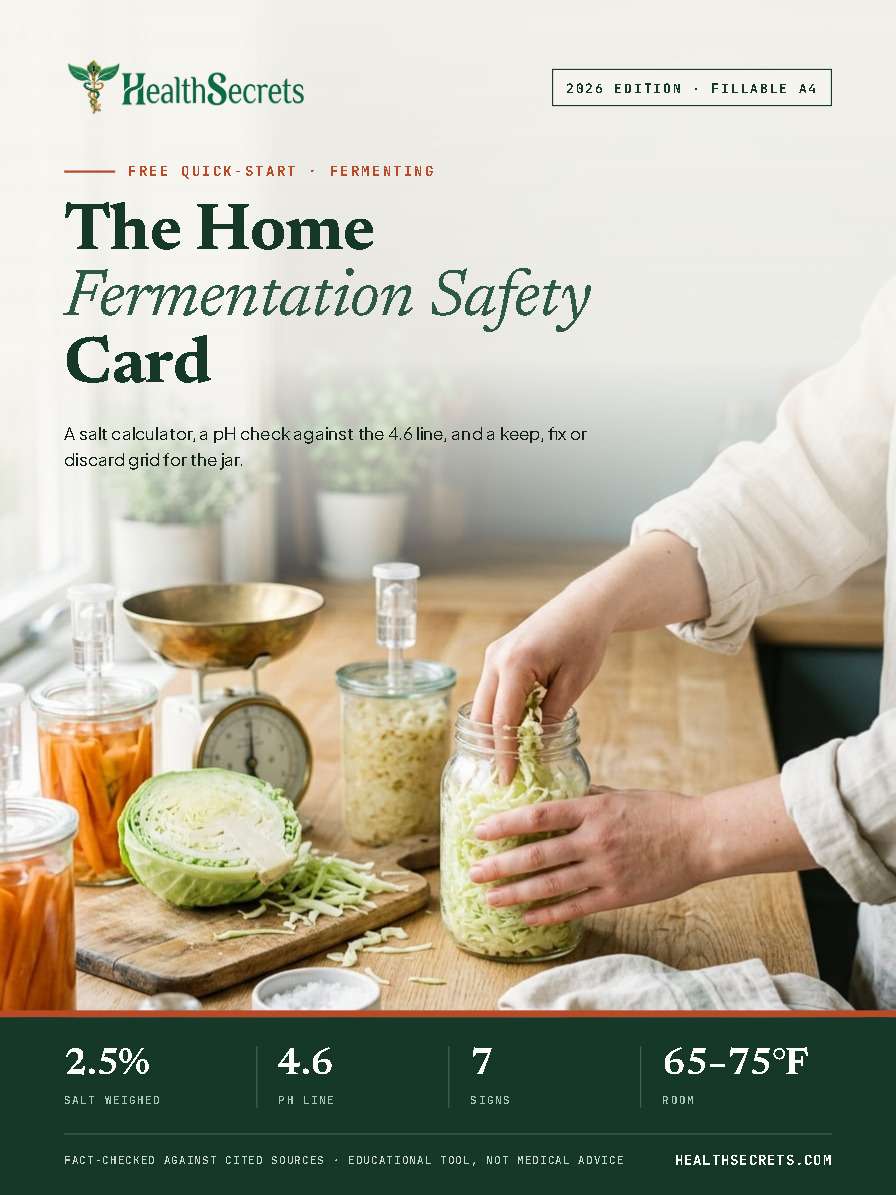
Want a Free Printable Quick-Start?
A salt calculator that weighs it for you, a day-7 pH check against the 4.6 safety line, and a keep, fix or discard grid for every film, smell and color in the jar.
Frequently Asked Questions
Ready to Bring Structure to Your Health?
Instant digital download. Immediate access to your complete printable PDF collection. Fully formatted for A4 home printing or tablet note-taking.