
Quercetin. You've probably never heard of it—or maybe you have, because it sort of exploded onto the supplement scene during the pandemic. But here's the thing: this flavonoid has been hiding in plain sight for decades. It's in onions, apples, berries, green tea. You've been eating it your whole life without knowing.
So what changed? Well, researchers discovered something genuinely fascinating about how quercetin interacts with your immune system defenses. Turns out, it doesn't just sit there being an antioxidant. It actually functions as a zinc ionophore—meaning it opens cellular doors for zinc to enter and do its antiviral work. That's... kind of a big deal.
But—and I think this is important to say upfront—there's a significant catch with quercetin. Your body barely absorbs it. We're talking less than 5% of a standard dose actually making it into your bloodstream. Which means the form you choose matters enormously.
In this guide, you'll learn exactly how quercetin supports immune function, why the zinc connection matters so much, how to solve the bioavailability problem, and what doses actually show results in clinical research. Whether you're looking for seasonal immune support or want to understand this antiviral flavonoid better, we've got the evidence laid out.
For a broader look at natural immune support, check out our complete guide to boosting your immune system naturally. If you're interested in how quercetin pairs with other immune nutrients, our best immune supplements guide covers the full picture.
What Is Quercetin and Why Is It Called the Antiviral Flavonoid?
Quercetin is a naturally occurring plant flavonoid—one of the most abundant polyphenols in the human diet—found in foods like red onions, apples, berries, and green tea. It functions as a potent antioxidant, anti-inflammatory agent, and immune modulator, and has gained significant attention for its antiviral properties, particularly its role as a zinc ionophore that helps zinc enter cells to block viral replication.
Okay, let me break this down a bit. Flavonoids are a class of plant compounds—there are thousands of them—and quercetin happens to be one of the most studied. It belongs to the flavonol subgroup, and its chemical structure gives it four phenolic groups. That's what makes it such a strong free radical scavenger and antioxidant ([2]).
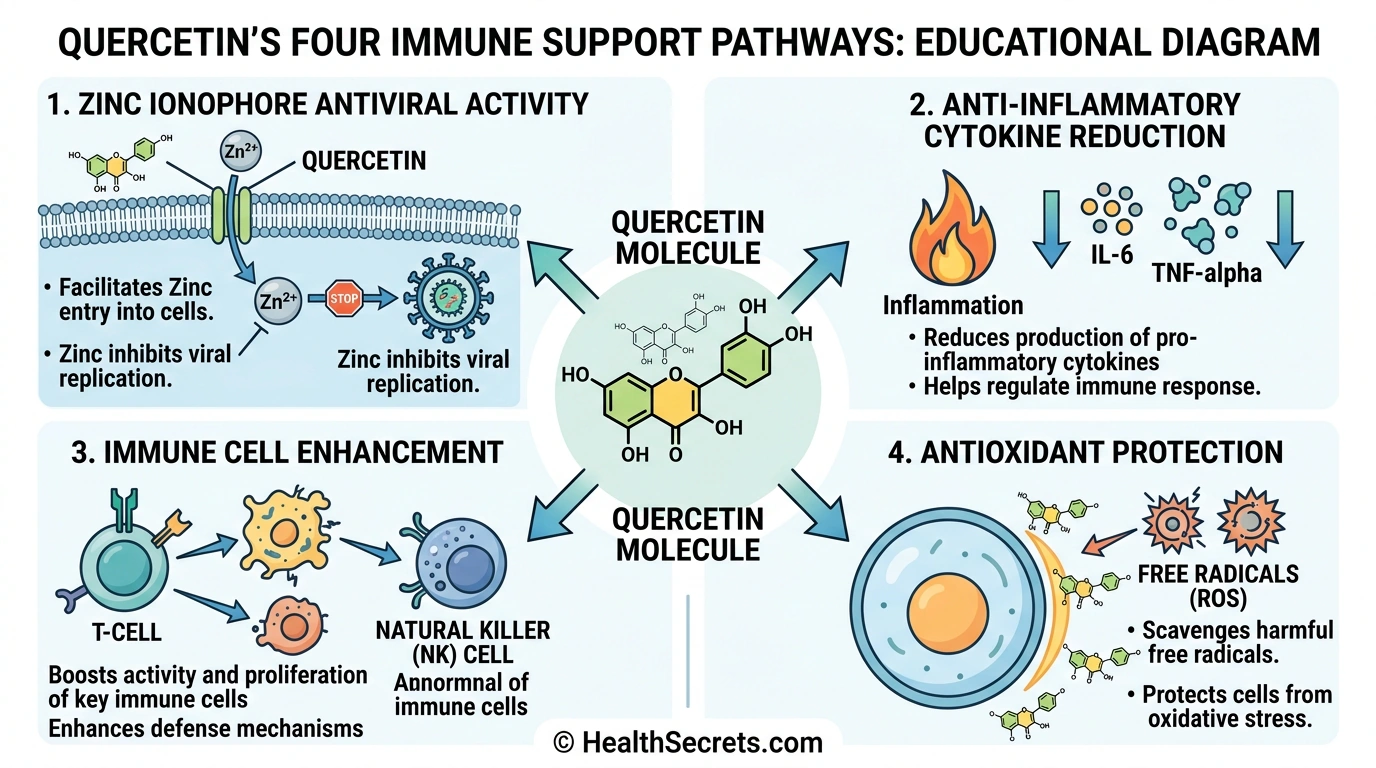
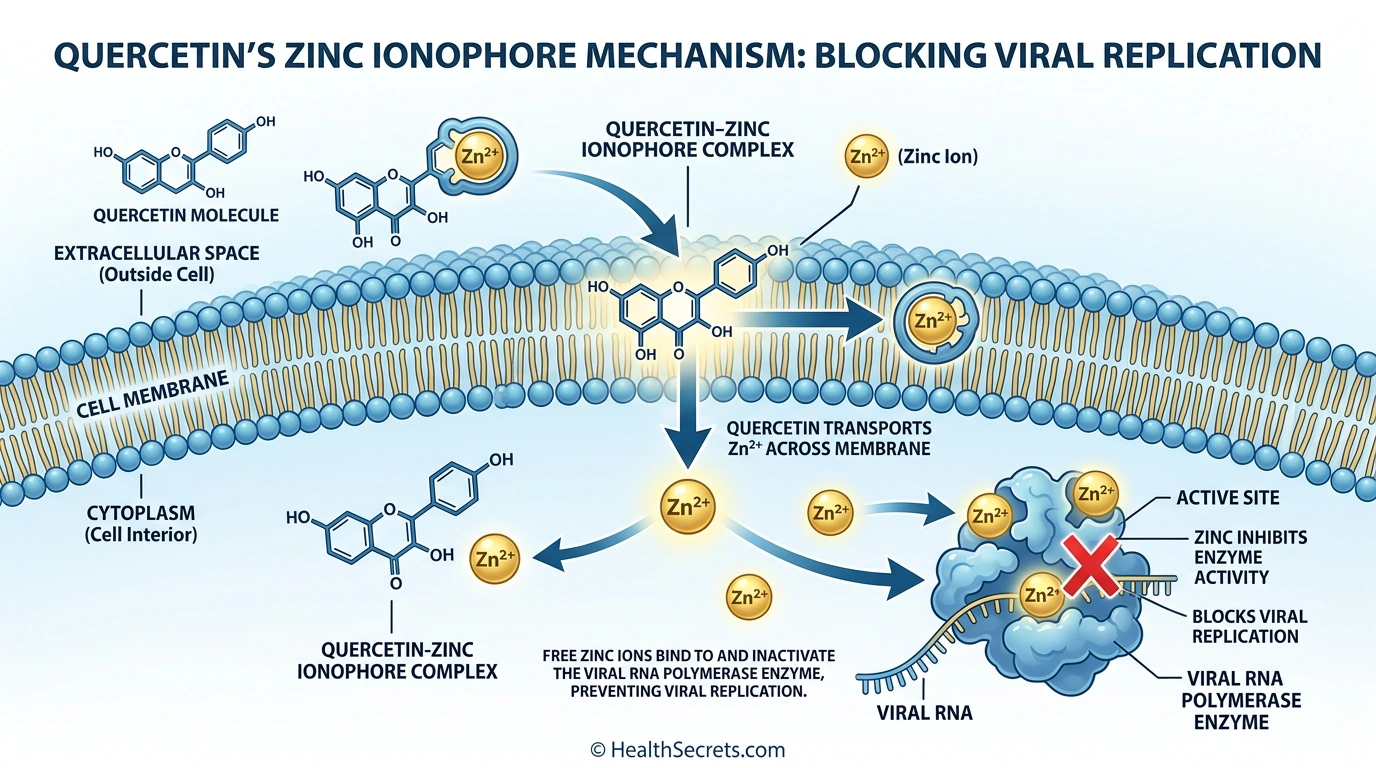
But quercetin isn't just an antioxidant. What really set the research world buzzing was the discovery that quercetin acts as a zinc ionophore. An ionophore is basically a molecular shuttle—it transports ions across cell membranes. In quercetin's case, it grabs zinc ions and carries them into cells ([1]). Why does that matter? Because once inside cells, zinc can directly inhibit viral RNA-dependent RNA polymerase—the enzyme viruses need to replicate.
Traditionally, quercetin has been consumed through diet. Red onions contain roughly 300mg per cup. Apples have around 10mg. Berries contribute 5–10mg per serving. Green tea adds another 10–25mg per cup. These amounts are beneficial for general health, but they're nowhere near the therapeutic doses used in clinical research—which is why supplements exist.

Are You Unknowingly Inflaming Your Body?
Get the free Health Vitals & Nutrient Checklist — the daily guide that shows you which habits and supplements are silently triggering inflammation.
How Does Quercetin Support Your Immune System? (It's More Than Just Antioxidant Activity)
Quercetin supports immune function through multiple mechanisms: it acts as a zinc ionophore to enhance antiviral defense, reduces pro-inflammatory cytokines like IL-6 and TNF-alpha, enhances T-cell and natural killer cell activity, and provides direct antioxidant protection to immune cells. This multi-pathway approach makes it uniquely versatile among natural immune supplements.
How Does Quercetin Work as a Zinc Ionophore Against Viruses?
This is arguably quercetin's most exciting mechanism. Research published in the Journal of Agricultural and Food Chemistry demonstrated that quercetin rapidly increases intracellular zinc levels by transporting zinc cations across cell membranes ([1]). Once zinc accumulates inside cells, it inhibits viral RNA-dependent RNA polymerase—effectively jamming the replication machinery of RNA viruses including influenza, rhinovirus, and coronaviruses.
A 2024 study in ScienceDirect confirmed that quercetin's zinc ionophore activity enhanced anti-influenza effects synergistically—meaning quercetin plus zinc worked better than either compound alone ([10]). The practical takeaway? Always pair quercetin with zinc supplementation.
How Does Quercetin Reduce Inflammation and Prevent Cytokine Storms?
Quercetin inhibits the NF-κB signaling pathway—the master switch for inflammatory gene expression. It reduces production of pro-inflammatory cytokines including IL-6, IL-1β, and TNF-alpha. It also blocks cyclooxygenase (COX) and lipoxygenase (LOX) enzymes, reducing prostaglandins and leukotrienes that drive inflammation ([2]).
This matters for immune health because chronic inflammation actually weakens your immune response. And during acute infections, uncontrolled cytokine release—a cytokine storm—can cause more damage than the virus itself. Quercetin's ability to modulate (not suppress) immune activity means it helps your body fight infection without overreacting ([9]).
How Does Quercetin Enhance Immune Cell Function?
Quercetin directly supports several types of immune cells. It improves the Th1/Th2 balance—critical for appropriate immune responses—and suppresses excessive IgE antibody formation that drives allergic reactions. It stimulates T-cell proliferation, enhances natural killer (NK) cell activity, and supports macrophage function ([2]). Research in animal models showed quercetin reduced susceptibility to influenza infection following stressful exercise ([6]).
Quercetin also increases glutathione levels in the body—your master antioxidant that protects immune cells from oxidative damage during their pathogen-fighting activities ([8]).

Evidence-Based Supplement Organizer & Safety Log
Track your daily intake, verify third-party certifications, and prepare clear questions for your clinician.
How Well Is Quercetin Absorbed? (The Bioavailability Problem You Need to Solve)
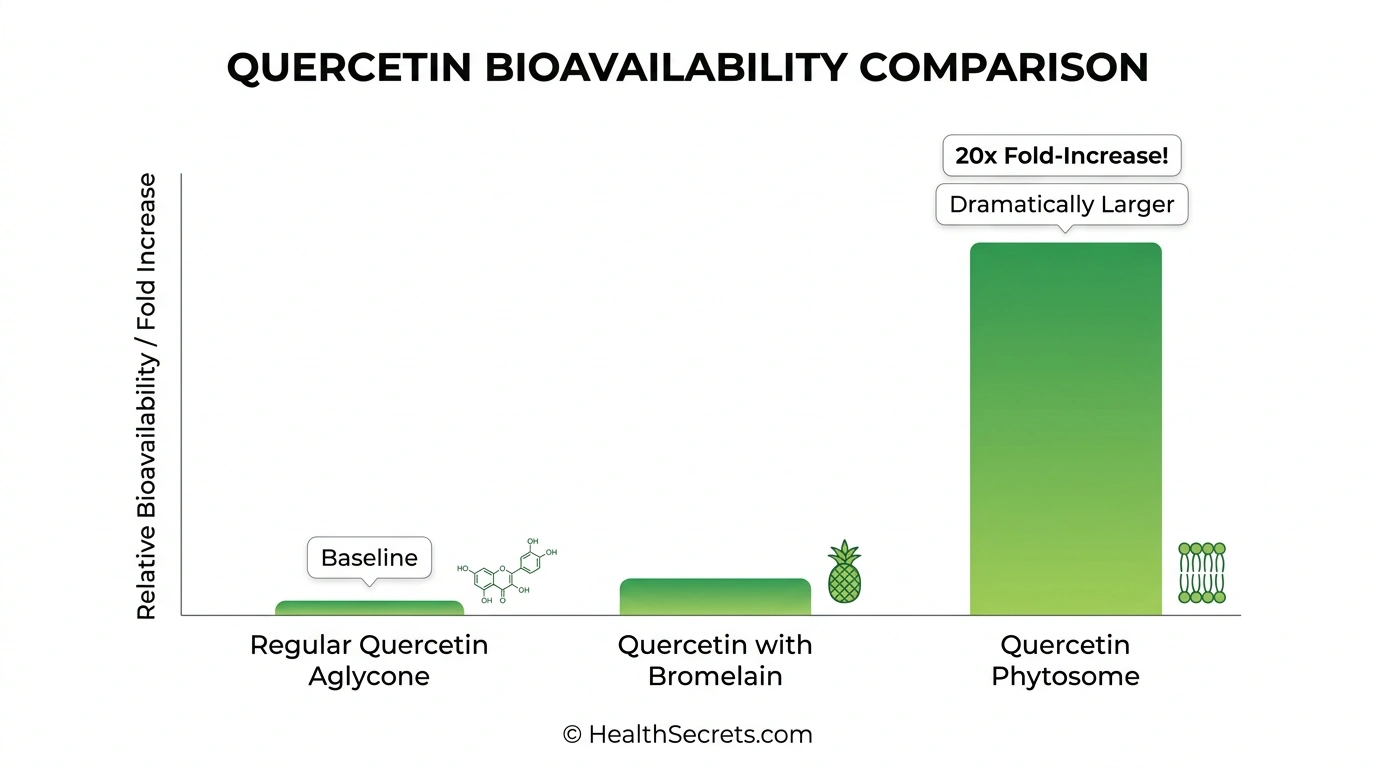
Standard quercetin aglycone has extremely poor oral bioavailability—less than 5% is absorbed, it's rapidly metabolized by the liver, and has a short half-life of just one to two hours. However, quercetin phytosome (lecithin-bound) formulations achieve up to 20 times greater plasma levels, making formulation choice critical for therapeutic benefit.
Honestly, this is where most people waste their money on quercetin. You can swallow 1,000mg of regular quercetin and maybe—maybe—50mg actually reaches your bloodstream. The rest passes through unabsorbed. That's frustrating.
Here's why: quercetin is poorly water-soluble. Your gut can't absorb what it can't dissolve. Plus, whatever does get absorbed gets rapidly conjugated by the liver (glucuronidation, sulfation) and eliminated. Short half-life means it doesn't stick around long enough to accumulate therapeutic levels.
The Solutions:
- Quercetin Phytosome (Lecithin-Bound): This is the gold standard. A clinical study showed Quercetin Phytosome® achieved plasma levels up to 20 times higher than unformulated quercetin in healthy volunteers, with no notable side effects ([4]). The lecithin creates a lipid-compatible complex that dramatically improves intestinal absorption.
- Vitamin C: Quercetin and vitamin C work synergistically. Vitamin C helps regenerate quercetin and may improve its stability and absorption. Researchers have proposed this combination specifically for antiviral prevention and treatment ([5]).
- Bromelain: This pineapple enzyme may enhance quercetin absorption and has its own anti-inflammatory properties.
- Take With Fat: Quercetin is fat-soluble. Taking it with meals containing dietary fat improves absorption significantly compared to an empty stomach.
ಕ್ರಿಯೆಯ ಯೋಜನೆ
How Much Quercetin Should You Take for Immune Support?
ಕೆಳಗಿನ ಕ್ರಮವನ್ನು ಅನುಸರಿಸಿ, ಪ್ರತಿ ಹಂತವನ್ನು ಕ್ರಮಬದ್ಧವಾಗಿ ಪೂರೈಸಿ, ಮತ್ತು ನಿಮ್ಮ ಪ್ರಾಯೋಗಿಕ ಅನುಷ್ಠಾನ ಮಾರ್ಗದರ್ಶಿಯಾಗಿ ಪರಿಶೀಲನಾ ಪಟ್ಟಿಯನ್ನು ಬಳಸಿ.
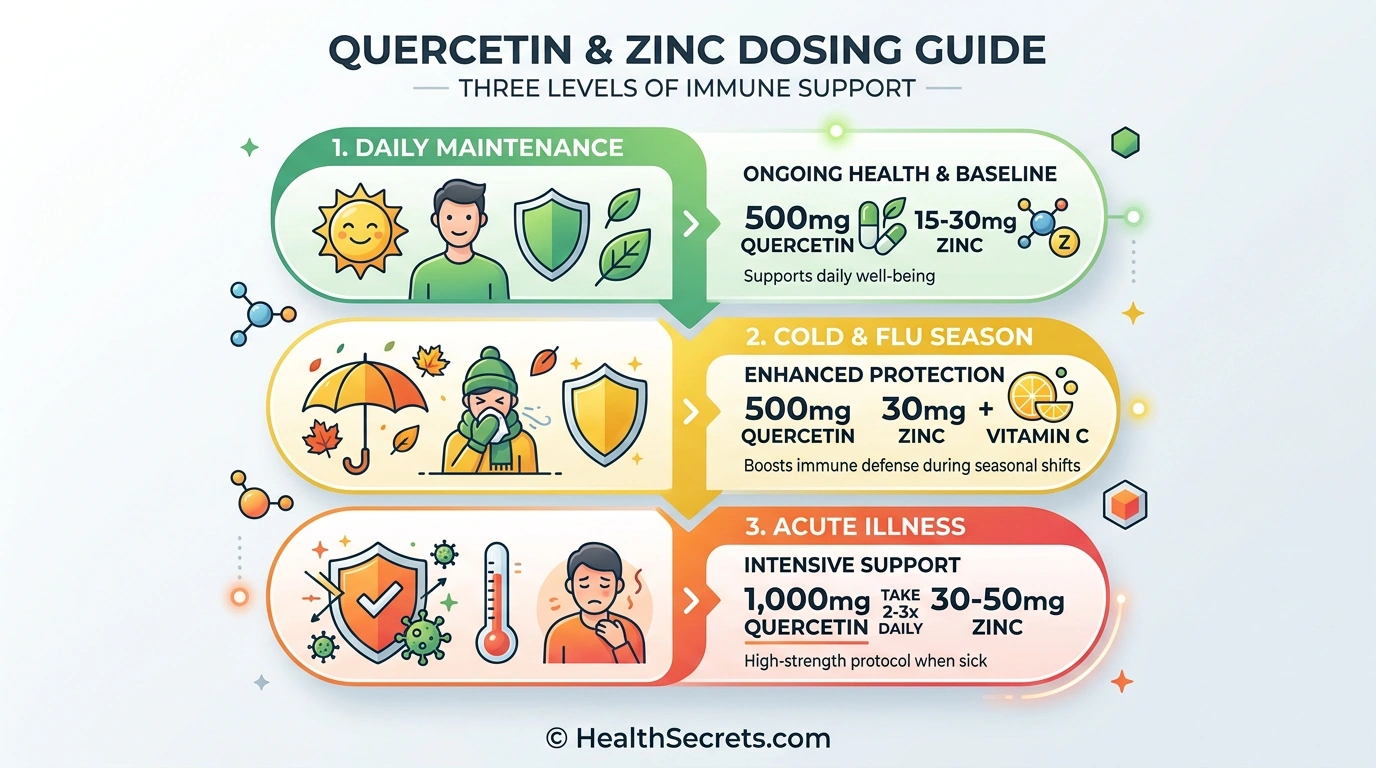
For daily immune maintenance, 500mg of quercetin phytosome with 15–30mg zinc is the most common evidence-based protocol. During acute illness, doses increase to 1,000mg two to three times daily with 30–50mg zinc for the first three to five days. Always take with meals containing fat to maximize absorption.
Prophylactic / Daily Immune Support:
- 500mg quercetin phytosome daily (equivalent to about 200mg pure quercetin in phytosome form)
- 15–30mg zinc (picolinate or bisglycinate)
- 500–1,000mg vitamin C (synergistic partner)
- Take with meals containing fat
- Use during cold and flu season or year-round
Acute Infection Protocol (First Signs of Illness):
- 1,000mg quercetin two to three times daily
- 30–50mg zinc daily (divided doses)
- 1,000mg vitamin C two to three times daily
- Continue for three to five days, then return to maintenance dose
- Take with meals
Important Dosing Notes:
- Divide doses throughout the day (two to three times) rather than taking one large dose—better absorption, more stable blood levels
- Phytosome forms require lower doses for equivalent effect
- Do not exceed 1,000mg daily long-term without medical supervision
- Takes four to eight weeks of consistent use for full immune-modulating benefits
- Effects during acute illness may be noticed within 24–48 hours
Can You Get Enough Quercetin From Food Alone?
While quercetin-rich foods like red onions, apples, berries, and green tea provide meaningful dietary amounts (50–500mg daily depending on diet), therapeutic immune doses of 500–1,000mg require supplementation. A food-plus-supplement approach offers the best of both worlds—dietary quercetin for general antioxidant benefits and supplemental quercetin phytosome for targeted immune support.
| Food | Serving | Quercetin (mg) | Notes |
|---|---|---|---|
| Red onions | 1 cup chopped | ~300mg | Richest common source |
| Capers | 1 tablespoon | ~180mg | Highest per weight |
| Apples (with skin) | 1 medium | ~10mg | Skin contains most |
| Berries (mixed) | 1 cup | 5–15mg | Blueberries, cranberries |
| Green tea | 1 cup brewed | 10–25mg | Also contains EGCG |
The Balanced Approach:
- Eat quercetin-rich foods daily—red onions in cooking, an apple a day, berries, green tea (general antioxidant health)
- Add quercetin phytosome supplement 500mg daily for targeted immune support
- Increase supplement dose during illness (1,000mg two to three times daily, short-term)
- Always pair with zinc and vitamin C for synergistic benefits
Is Quercetin Safe? Side Effects and Drug Interactions You Should Know
Quercetin is generally recognized as safe (GRAS) at supplemental doses up to 1,000mg daily, with minimal reported side effects in clinical trials. The most common issues are mild GI upset and occasional headaches. However, quercetin does interact with certain medications, particularly blood thinners and fluoroquinolone antibiotics, so medical consultation is important.
Common Side Effects (Rare, Mild):
- Headache—one of the more commonly reported effects, usually mild
- GI upset: nausea, stomach discomfort—take with food to minimize
- These are generally dose-dependent and resolve with dose reduction
Drug Interactions:
- Blood thinners (warfarin): Quercetin may increase warfarin's effects and bleeding risk—monitor INR closely (WebMD [15])
- Fluoroquinolone antibiotics (ciprofloxacin, levofloxacin): Quercetin may interfere with absorption—separate by at least two hours
- Immunosuppressants: Quercetin's immune-modulating effects may theoretically counteract these drugs—consult your doctor
- Cyclosporine, everolimus: Quercetin may affect drug metabolism—consult oncologist
Contraindications:
- Pregnancy and breastfeeding: Insufficient safety data for supplemental doses (dietary amounts are fine)
- Kidney disease: Theoretical concern at very high doses (above 1,000mg long-term)—use caution
- Surgery: Stop quercetin one to two weeks before surgery due to potential antiplatelet effects
A comprehensive safety review noted that adverse effects from supplemental quercetin intake have been rarely reported and were mild in nature across numerous human intervention studies ([7]).
What Can Quercetin Actually Do for Your Immune System?
Quercetin can meaningfully support immune function by reducing inflammation, enhancing antiviral defense (especially paired with zinc), and modulating immune cell activity. Clinical evidence suggests it may reduce upper respiratory infection duration by one to two days and symptom severity by 20–30%. It is not a cure or guaranteed prevention—it's a science-backed tool that works best alongside healthy lifestyle habits.
What Quercetin Can Do:
- Reduce chronic low-grade inflammation (measurable CRP reduction in studies)
- Enhance antiviral defense through zinc ionophore activity
- Support immune cell function (T-cells, NK cells, macrophages)
- Potentially reduce duration and severity of colds and flu
- Act as a powerful antioxidant protecting immune cells
What Quercetin Cannot Do:
- Cure viral infections or replace antiviral medications
- Guarantee prevention of any specific illness
- Replace vaccination, hand hygiene, or healthy sleep habits
- Work effectively without addressing bioavailability (regular quercetin barely absorbed)
- Produce immediate results—full immune benefits take four to eight weeks of consistent use
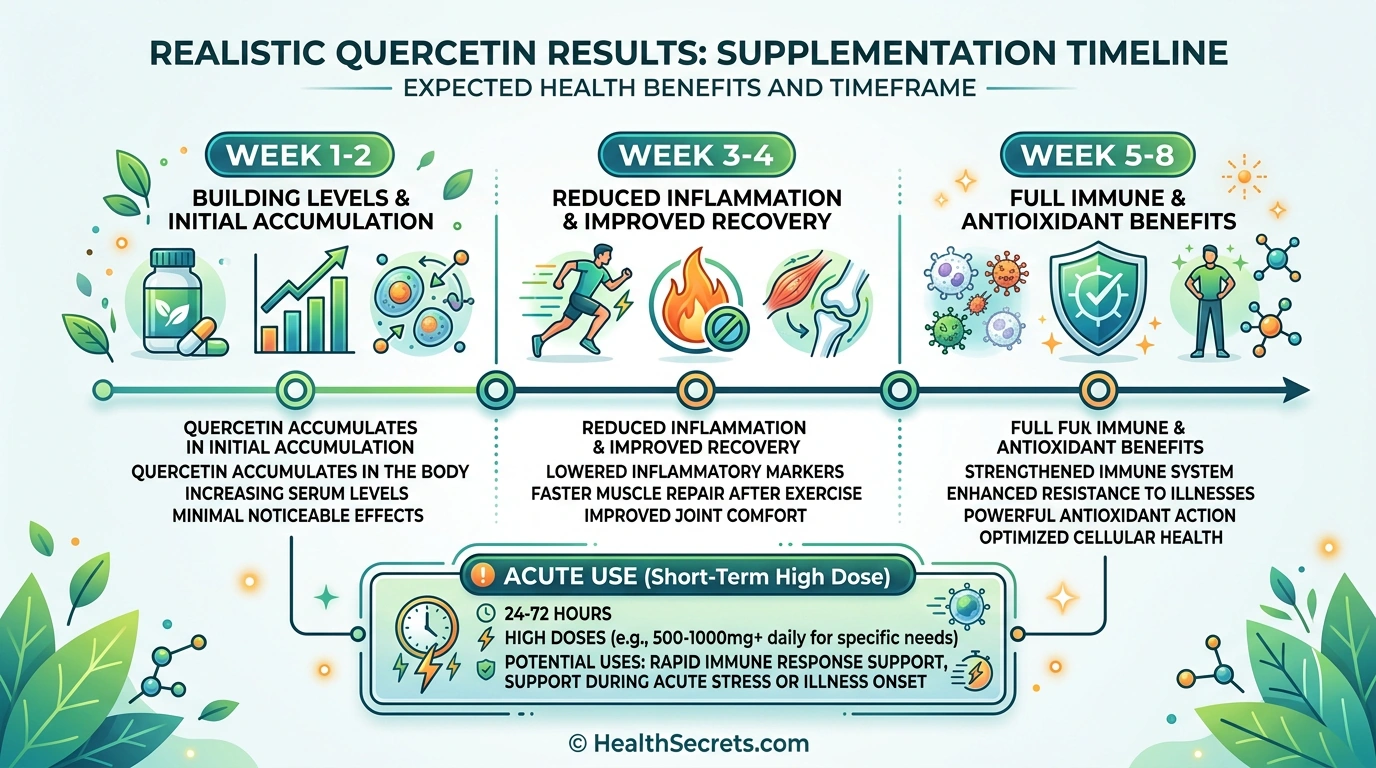
Realistic Timeline:
- Week 1–2: Minimal noticeable effects (building systemic levels)
- Week 3–4: Some may notice reduced inflammation, improved recovery
- Week 5–8: Full immune-modulating benefits established
- During acute use: Effects may be noticed within 24–72 hours (at higher doses with zinc)
The Bottom Line: Quercetin is one of the most researched natural immune-support compounds available. The evidence is promising—especially for the quercetin-plus-zinc combination—but more large-scale randomized controlled trials are needed. Use it as part of a comprehensive approach that includes adequate sleep, balanced nutrition, exercise, and stress management.
ಕ್ರಿಯೆಯ ಯೋಜನೆ
What Should You Do First to Start Using Quercetin for Immune Health?
ಕೆಳಗಿನ ಕ್ರಮವನ್ನು ಅನುಸರಿಸಿ, ಪ್ರತಿ ಹಂತವನ್ನು ಕ್ರಮಬದ್ಧವಾಗಿ ಪೂರೈಸಿ, ಮತ್ತು ನಿಮ್ಮ ಪ್ರಾಯೋಗಿಕ ಅನುಷ್ಠಾನ ಮಾರ್ಗದರ್ಶಿಯಾಗಿ ಪರಿಶೀಲನಾ ಪಟ್ಟಿಯನ್ನು ಬಳಸಿ.
Start with a quercetin phytosome supplement at 500mg daily paired with 15–30mg zinc, taken with a meal containing fat. Add 500–1,000mg vitamin C for synergistic benefit. Increase to 1,000mg quercetin two to three times daily during acute illness. Always choose phytosome formulations over standard quercetin for dramatically better absorption.
Phase 1 — Start Smart (Week 1–2):
- Choose a quercetin phytosome supplement (not regular quercetin)
- Start at 500mg quercetin phytosome daily with breakfast or lunch
- Add zinc 15–30mg daily (picolinate or bisglycinate form)
- Add vitamin C 500–1,000mg daily
- Take all supplements with a meal containing fat
Phase 2 — Build Your Protocol (Week 3–4):
- Assess tolerance—any GI issues? Reduce dose or split into two daily doses
- Increase dietary quercetin—more onions, apples, berries, green tea
- Continue daily supplementation consistently
- Note any improvements in energy, recovery, or inflammation
Phase 3 — Maintain and Adjust (Week 5+):
- Continue 500mg quercetin phytosome daily as maintenance
- Have an acute protocol ready: 1,000mg quercetin 2–3x daily + 30–50mg zinc at first sign of illness
- Restock before cold and flu season begins
- Track any changes in infection frequency or severity over months
When to See a Doctor:
- If taking blood thinners, diabetes medications, or immunosuppressants
- If symptoms worsen despite supplementation
- If you experience unusual bleeding, bruising, or severe GI symptoms
- Before surgery (stop quercetin 1–2 weeks prior)

Thorne Quercetin Phytosome
Editor's ChoiceThorne Quercetin · Maximum absorption quercetin for serious immune support
NOW Foods Quercetin with Bromelain
Best ValueNOW Foods · Budget-friendly quercetin with absorption-enhancing bromelain
Life Extension Bio-Quercetin
Best BioavailabilityLife Extension · Enhanced absorption quercetin at a moderate price point
Jarrow Formulas Quercetin 500mg
Best Budget OptionJarrow Formulas · Affordable daily quercetin supplementation

Thorne Zinc Picolinate 30mg
Best Zinc PartnerThorne Zinc · Pairing with quercetin for synergistic antiviral immune support
Quercetin + Zinc + Vitamin C Immune Complex
Best All-in-OneQuercetin + · Conveniencia: quercetina, zinc y vitamina C en un solo suplemento
NOW Foods Vitamina C-1000 con escaramujo
最佳维生素 C 搭档NOW Foods · Pairing with quercetin for synergistic antioxidant and immune support
Organic Red Onion Powder (Bulk)
Best Food SourceOrganic Red · Adding quercetin-rich flavor to daily cooking
ಯಾವುದೇ ರೀಟೇಲರ್ ಲಿಂಕ್ ಅನ್ನು ತೆರೆಯುವ ಮೊದಲು ಕೆಳಗಿನ ವಿವರವಾದ ವಿಮರ್ಶಾ ಕಾರ್ಡ್ಗಳನ್ನು ಓದಿ
ಮೇಲಕ್ಕೆ ಶಿಫಾರಸು ಮಾಡಿದ ಉತ್ಪನ್ನಗಳು
Thorne Quercetin
Thorne Quercetin Phytosome
Thorne's phytosome technology delivers dramatically more quercetin to your bloodstream than standard formulations, making it the most effective option for immune support.
ಲಾಭಗಳು
- + Best-in-class absorption
- + NSF certified
- + trusted brand
- + clean formulation
ನಷ್ಟಗಳು
- - Higher price per bottle
- - lower mg number can be misleading (phytosome is more bioavailable)
ನಾವು ಅದನ್ನು ಸೇರಿಸಿದ್ದೇಕೆ: Thorne's phytosome technology delivers dramatically more quercetin to your bloodstream than standard formulations, making it the most effective option for immune support.
ವ್ಯಾಪಾರಿ ಸಂಪರ್ಕವು ಪರಿಶೀಲನ ವಿವರಣೆಗಳ ಮೇಲೆ ಅಮ್ಯಾಜಾನ್ನಲ್ಲಿ ತೆರೆಯುತ್ತದೆ
NOW Foods
NOW Foods Quercetin with Bromelain
Para quienes tienen un presupuesto limitado, NOW Foods ofrece una dosis sólida de quercetina con bromelina para ayudar a la absorción: un suplemento inmunológico diario, eficaz y económico.
ಲಾಭಗಳು
- + Excelente relación calidad-precio
- + dosis alta
- + la bromelina ayuda a la absorción y añade un beneficio antiinflamatorio
- + marca de confianza
ನಷ್ಟಗಳು
- - forma estándar de quercetina (no fitosoma)
- - requires higher dose for equivalent blood levels
ನಾವು ಅದನ್ನು ಸೇರಿಸಿದ್ದೇಕೆ: For those on a budget, NOW Foods delivers a solid quercetin dose with bromelain to help absorption—a proven, affordable daily immune supplement.
ವ್ಯಾಪಾರಿ ಸಂಪರ್ಕವು ಪರಿಶೀಲನ ವಿವರಣೆಗಳ ಮೇಲೆ ಅಮ್ಯಾಜಾನ್ನಲ್ಲಿ ತೆರೆಯುತ್ತದೆ
Life Extension
Life Extension Bio-Quercetin
Life Extension's bio-enhanced formula bridges the gap between budget standard quercetin and premium phytosome, offering improved absorption at a reasonable price.
ಲಾಭಗಳು
- + Good bioavailability enhancement
- + moderate price
- + reputable brand
- + well-reviewed
ನಷ್ಟಗಳು
- - Not full phytosome technology
- - one-capsule serving convenient but limits dose flexibility
ನಾವು ಅದನ್ನು ಸೇರಿಸಿದ್ದೇಕೆ: Life Extension's bio-enhanced formula bridges the gap between budget standard quercetin and premium phytosome, offering improved absorption at a reasonable price.
ವ್ಯಾಪಾರಿ ಸಂಪರ್ಕವು ಪರಿಶೀಲನ ವಿವರಣೆಗಳ ಮೇಲೆ ಅಮ್ಯಾಜಾನ್ನಲ್ಲಿ ತೆರೆಯುತ್ತದೆ
Jarrow Formulas
Jarrow Formulas Quercetin 500mg
If you're trying quercetin for the first time on a tight budget, Jarrow offers a clean, affordable option—just pair it with zinc and take with a fatty meal.
ಲಾಭಗಳು
- + Very affordable
- + high capsule count
- + reputable brand
- + simple formulation
ನಷ್ಟಗಳು
- - Standard quercetin with poor absorption (<5%)
- - no bioavailability enhancers included
ನಾವು ಅದನ್ನು ಸೇರಿಸಿದ್ದೇಕೆ: If you're trying quercetin for the first time on a tight budget, Jarrow offers a clean, affordable option—just pair it with zinc and take with a fatty meal.
ವ್ಯಾಪಾರಿ ಸಂಪರ್ಕವು ಪರಿಶೀಲನ ವಿವರಣೆಗಳ ಮೇಲೆ ಅಮ್ಯಾಜಾನ್ನಲ್ಲಿ ತೆರೆಯುತ್ತದೆ
Thorne Zinc
Thorne Zinc Picolinate 30mg
Zinc is essential for quercetin's ionophore mechanism. Thorne's picolinate form ensures the zinc actually gets absorbed and into your cells where quercetin can shuttle it.
ಲಾಭಗಳು
- + Highly absorbable zinc form
- + NSF certified
- + trusted brand
- + perfect dose for quercetin pairing
ನಷ್ಟಗಳು
- - Single-mineral supplement (need separate quercetin)
- - 60-count runs out in 2 months
ನಾವು ಅದನ್ನು ಸೇರಿಸಿದ್ದೇಕೆ: Zinc is essential for quercetin's ionophore mechanism. Thorne's picolinate form ensures the zinc actually gets absorbed and into your cells where quercetin can shuttle it.
ವ್ಯಾಪಾರಿ ಸಂಪರ್ಕವು ಪರಿಶೀಲನ ವಿವರಣೆಗಳ ಮೇಲೆ ಅಮ್ಯಾಜಾನ್ನಲ್ಲಿ ತೆರೆಯುತ್ತದೆ
Quercetin +
Quercetin + Zinc + Vitamin C Immune Complex
Para mayor simplicidad, una fórmula todo en uno de quercetina, zinc y vitamina C cubre los tres nutrientes inmunitarios sinérgicos en un solo producto, ideal para el mantenimiento diario.
ಲಾಭಗಳು
- + Los tres nutrientes sinérgicos en un solo producto
- + conveniente
- + no es necesario comprar frascos separados
ನಷ್ಟಗಳು
- - Puede tener dosis individuales más bajas que los suplementos independientes
- - menor flexibilidad de dosificación
ನಾವು ಅದನ್ನು ಸೇರಿಸಿದ್ದೇಕೆ: Para simplificar, una fórmula todo en uno de quercetina, zinc y vitamina C cubre los tres nutrientes inmunitarios sinérgicos en un solo producto, ideal para el mantenimiento diario.
ವ್ಯಾಪಾರಿ ಸಂಪರ್ಕವು ಪರಿಶೀಲನ ವಿವರಣೆಗಳ ಮೇಲೆ ಅಮ್ಯಾಜಾನ್ನಲ್ಲಿ ತೆರೆಯುತ್ತದೆ
NOW Foods
NOW Foods Vitamina C-1000 con escaramujo
维生素 C 可以再生槲皮素并增强其稳定性。这种价格实惠、品质优良的选择为槲皮素提供了协同作用的搭档,从而实现最佳的免疫支持。
ಲಾಭಗಳು
- + 性价比极高
- + 高剂量
- + 含有玫瑰果以提供额外的生物类黄酮
- + trusted brand
ನಷ್ಟಗಳು
- - Tablet form may be large for some
- - not buffered (may cause GI upset in sensitive individuals)
ನಾವು ಅದನ್ನು ಸೇರಿಸಿದ್ದೇಕೆ: Vitamin C regenerates quercetin and enhances its stability. This affordable, high-quality option provides the synergistic partner quercetin needs for optimal immune support.
ವ್ಯಾಪಾರಿ ಸಂಪರ್ಕವು ಪರಿಶೀಲನ ವಿವರಣೆಗಳ ಮೇಲೆ ಅಮ್ಯಾಜಾನ್ನಲ್ಲಿ ತೆರೆಯುತ್ತದೆ
Organic Red
Organic Red Onion Powder (Bulk)
For a whole-food approach to daily quercetin intake, organic red onion powder is an easy way to boost your cooking with the richest common dietary source of this flavonoid.
ಲಾಭಗಳು
- + Whole food source
- + easy to add to cooking
- + affordable
- + provides additional antioxidants
ನಷ್ಟಗಳು
- - Quercetin content varies
- - not standardized
- - lower bioavailability than supplements
ನಾವು ಅದನ್ನು ಸೇರಿಸಿದ್ದೇಕೆ: For a whole-food approach to daily quercetin intake, organic red onion powder is an easy way to boost your cooking with the richest common dietary source of this flavonoid.
ವ್ಯಾಪಾರಿ ಸಂಪರ್ಕವು ಪರಿಶೀಲನ ವಿವರಣೆಗಳ ಮೇಲೆ ಅಮ್ಯಾಜಾನ್ನಲ್ಲಿ ತೆರೆಯುತ್ತದೆ
ಮುಂದಿನ ಓದಿಗೆ
ಮುಂದಿನ ಓದಿಗೆ
"Herbal Antivirals: Natural Remedies for Emerging & Resistant Viral Infections"
ಅವರಿಂದ Stephen Harrod Buhner
Detailed antiviral mechanisms of plant compounds; practical protocols for viral infections; evidence-based herbal strategies; quercetin and flavonoid coverage
ಇದು ಏಕೆ ಇಲ್ಲಿ ಮೌಲ್ಯವನ್ನು ನೀಡುತ್ತದೆ
Buhner's work is one of the most referenced guides on natural antiviral compounds, providing the scientific context for understanding how quercetin and similar flavonoids combat viral infections.
ಉತ್ತಮವಾದದ್ದು: Readers wanting comprehensive knowledge of antiviral herbs and flavonoids including quercetin
ಪುಸ್ತಕದ ವಿವರಗಳನ್ನು ನೋಡಿಮುಂದಿನ ಓದಿಗೆ
"The Immunity Fix: Strengthen Your Immune System, Fight Off Infections, Reverse Chronic Disease"
ಅವರಿಂದ James DiNicolantonio, PharmD and Siim Land
Immune system fundamentals; supplement protocols including quercetin and zinc; practical nutrition strategies; evidence-based lifestyle recommendations
ಇದು ಏಕೆ ಇಲ್ಲಿ ಮೌಲ್ಯವನ್ನು ನೀಡುತ್ತದೆ
This book specifically covers the quercetin-zinc immune protocol and provides accessible, science-backed strategies for building robust immunity through natural approaches.
ಉತ್ತಮವಾದದ್ದು: Readers wanting a practical guide to strengthening immunity through nutrition, supplements, and lifestyle
ಪುಸ್ತಕದ ವಿವರಗಳನ್ನು ನೋಡಿAEO FAQ
ಪದೇ ಪದೇ ಕೇಳಲಾಗುವ ಪ್ರಶ್ನೆಗಳು
15 common questions answered
La quercetina es un flavonoide vegetal que se encuentra en las cebollas, las manzanas y las bayas, y que apoya la inmunidad a través de múltiples vías. Actúa como un antioxidante que protege las células inmunitarias, reduce las citocinas inflamatorias, potencia la actividad de las células T y de las células NK, y funciona como un ionóforo de zinc, transportando el zinc al interior de las células donde puede inhibir la replicación viral.
La quercetina actúa como un transportador molecular que traslada los iones de zinc a través de las membranas celulares hacia el interior de la célula. Una vez dentro, el zinc inhibe la ARN polimerasa dependiente de ARN viral, que es la enzima que los virus utilizan para replicarse. Este mecanismo se ha demostrado en estudios celulares y modelos de liposomas, y es la razón por la cual se recomienda combinar la suplementación con quercetina y zinc para el apoyo antiviral.
Para el mantenimiento inmunológico diario, el protocolo estándar es de 500 mg de fitosoma de quercetina con 15–30 mg de zinc. Durante una enfermedad aguda, aumente a 1,000 mg de quercetina dos o tres veces al día con 30–50 mg de zinc durante tres a cinco días. Tómese siempre con alimentos que contengan grasa para una mejor absorción.
Regular quercetin has extremely poor bioavailability—less than 5% is absorbed. Quercetin phytosome uses lecithin to create a lipid-compatible complex that achieves up to 20 times higher blood levels than standard quercetin. This means you get dramatically more active quercetin per dose, making phytosome the preferred supplemental form.
While quercetin-rich foods like red onions (300mg per cup) provide meaningful dietary amounts, therapeutic doses of 500–1,000mg daily are difficult to achieve through food alone. A combined approach—eating quercetin-rich foods for general health plus supplementing with quercetin phytosome for targeted immune support—is the most practical strategy.
Yes, quercetin is generally recognized as safe at doses up to 1,000mg daily with minimal side effects reported in clinical studies. Common but rare effects include mild headache and GI upset. However, consult your doctor if you take blood thinners, fluoroquinolone antibiotics, or immunosuppressants, as interactions are possible.
Clinical evidence suggests quercetin may reduce the duration and severity of upper respiratory infections by approximately 20–30%, particularly when combined with zinc and vitamin C. An animal study showed quercetin reduced susceptibility to influenza after stressful exercise. However, it is not a guaranteed preventive—it supports immune function as part of a healthy lifestyle.
Yes, absolutely. Quercetin's zinc ionophore activity means it helps transport zinc into cells where zinc can inhibit viral replication. Research shows the combination is more effective than either compound alone. A typical pairing is 500mg quercetin with 15–30mg zinc daily for maintenance.
Red onions are the richest common dietary source at approximately 300mg per cup. Capers contain the highest concentration per weight. Other good sources include apples with skin (10mg each), berries (5–15mg per cup), green tea (10–25mg per cup), and broccoli. Cooking with onions regularly is the easiest way to boost dietary quercetin.
Yes, quercetin can interact with several medications. It may enhance the effects of blood thinners like warfarin (increasing bleeding risk), interfere with fluoroquinolone antibiotic absorption, and potentially counteract immunosuppressant drugs. It may also affect metabolism of certain cancer drugs like everolimus. Always consult your doctor before starting quercetin if you take prescription medications.
For acute immune support at higher doses with zinc, some people notice effects within 24–72 hours. For ongoing immune modulation and anti-inflammatory benefits, expect four to eight weeks of consistent daily supplementation before seeing full results. Quercetin's benefits are cumulative—consistency matters more than any single dose.
Some observational studies and clinical investigations suggest quercetin may reduce COVID-19 severity and hospitalization, particularly when combined with zinc and vitamin C. However, the evidence is still emerging, and large-scale randomized controlled trials are needed. Quercetin should not replace vaccination or medical treatment—it may serve as an adjunctive support.
There is insufficient safety data for quercetin supplementation during pregnancy and breastfeeding. Dietary amounts from foods like onions and apples are considered safe. However, concentrated supplemental doses should be avoided unless specifically recommended by your healthcare provider.
Quercetin is the raw flavonoid compound with very poor water solubility and less than 5% oral absorption. Quercetin phytosome is quercetin bound to lecithin (phospholipids), creating a lipid-compatible complex that achieves up to 20 times higher plasma levels. Phytosome is significantly more effective per milligram.
Yes, quercetin is a potent antioxidant that scavenges free radicals and has demonstrated anti-inflammatory, anti-allergic, cardioprotective, and potential senolytic properties (clearing damaged cells). Its broad antioxidant activity supports multiple body systems beyond just immune health, including cardiovascular and cognitive function.
Evidence-Based Supplement Organizer & Safety Log
Track your daily intake, verify third-party certifications, and prepare clear questions for your clinician.
What's Inside This Complete Digital System:
Instant PDF download • Lifetime updates • 60-day money-back guarantee
ನಿಮ್ಮ ಜ್ಞಾನವನ್ನು ಪರೀಕ್ಷಿಸಿ
Take our Supplement Science Quiz and see how much you really know about supplements.
ಈ ಲೇಖನವು ಉಪಯುಕ್ತವಾಗಿದೆಯೇ?
ಸಂಶೋಧಿಸಿ ಸತ್ಯ-ಪರಿಶೀಲಿಸಲಾಗಿದೆ
ಲೇಖಕ
Health Secrets Editorial TeamThe Health Secrets editorial team researches, writes and fact-checks every guide against the primary studies and clinical guidelines it cites.
ಸತ್ಯ-ಪರಿಶೀಲಕರು
Health Secrets Editorial Teamಎಲ್ಲ ವಿಷಯವೂ ಪುರಾವೆ-ಆಧಾರಿತವಾಗಿದ್ದು, ಪೀರ್-ರಿವ್ಯೂ ಮಾಡಲಾದ ಸಂಶೋಧನೆಯ ವಿರುದ್ಧ ಪರಿಶೀಲಿಸಲಾಗಿದೆ ಮತ್ತು ನಿಯಮಿತವಾಗಿ ನವೀಕರಿಸಲಾಗುತ್ತದೆ. ನಮ್ಮ ಸಂಪಾದಕೀಯ ತಂಡವು ನಿಖರತೆ ಮತ್ತು ಪಾರದರ್ಶಕತೆಗಾಗಿ ಕಠಿಣ ಮಾರ್ಗಸೂಚಿಗಳನ್ನು ಅನುಸರಿಸುತ್ತದೆ.
ಉಲ್ಲೇಖಗಳು & ಸೂಚನೆಗಳು
20 ಉಲ್ಲೇಖಿಸಲಾದ ಮೂಲಗಳು
ಚಿಕಿತ್ಸಾತ್ಮಕ ನಿರಾಕರಣ
Este artículo tiene fines informativos únicamente y no constituye asesoramiento médico. Lea el descargo de responsabilidad médico completo. Consulte siempre con un proveedor de atención médica calificado antes de comenzar cualquier suplemento, tratamiento o cambio dietético importante.
The Complete Guide to Supplements
Explore our foundational comprehensive guide covering all clinical protocols, dietary strategies, and evidence for supplements.
ನಿಮಗೆ ಇಷ್ಟವಾಗಬಹುದು
Quercetin for Inflammation: Flavonoid Anti-Inflammatory
Quercetin is a powerful flavonoid found in onions, apples, and berries that fights inflammation through multiple pathways — inhibiting NF-κB, COX-2, and mast cell degranulation. This evidence-based guide covers quercetin's anti-inflammatory mechanisms, bioavailability challenges (and how phytosome solves them), optimal dosing, food sources, and safety.
→Fisetin para la longevidad: Guía del flavonoide senolítico
La fisetina es un flavonoide vegetal que se encuentra en las fresas y ha surgido como uno de los senolíticos naturales más potentes: compuestos que eliminan selectivamente las células zombis que impulsan el envejecimiento. Esta guía cubre la ciencia detrás de la fisetina, cómo elimina las células senescentes, la evidencia de los ensayos clínicos, los protocolos de dosificación, los desafíos de la biodisponibilidad y los consejos prácticos de suplementación.
→ಮ্যাগನೀசியம் ಸಂಪೂರ್ಣ ಮಾಹಿತಿ: ವಿಶ್ರಾಂತಿ ನೀಡುವ ಖನಿಜದ ಸಮಗ್ರ ಮಾರ್ಗದರ್ಶಿ
ಮ್ಯಾಗ್ನೀಷಿಯಮ್ ಮಾನವ ದೇಹದಲ್ಲಿ ನಾಲ್ಕನೇ ಅತಿ ಹೆಚ್ಚು ಸಮೃದ್ಧವಾಗಿರುವ ಖನಿಜವಾಗಿದೆ ಮತ್ತು ದೇಹದಲ್ಲಿ ನಡೆಯುವ 300 ಕ್ಕೂ ಹೆಚ್ಚು ఎంಜೈಮ್ (Enzymatic) ಕ್ರಿಯೆಗಳಲ್ಲಿ ಇದು ಅತ್ಯಗತ್ಯವಾಗಿ ಪಾಲ್ಗೊಳ್ಳುತ್ತದೆ. అయినಾಗ್ಯೂ, ಸುಮಾರು 50-70% ಜನರು ಕೇವಲ ಆಹಾರದ ಮೂಲಕ ಅಗತ್ಯವಿರುವಷ್ಟು ಮ್ಯಾಗ್ನೀಷಿಯಮ್ ಪಡೆಯಲು ಸಾಧ್ಯವಾಗುತ್ತಿಲ್ಲ. ಈ ಸಮಗ್ರ ಮಾರ್ಗಸೂಚಿಯು ಮ್ಯಾಗ್ನೀಷಿಯಮ್ನ આવಶ್ಯಕ ಕಾರ್ಯಗಳು, ವಿವಿಧ ಸಪ್ಲಿಮೆಂಟ್ ರೂಪಗಳ ನಡುವಿನ ಪ್ರಮುಖ ವ್ಯತ್ಯಾಸಗಳು (ಗ್ಲೈಸಿನೇಟ್, ಥ್ರಿಯೋನೇಟ್, ಸೈட் terlebihೂ), ವೈಜ್ಞಾನಿಕವಾಗಿ ಸಾಬೀತಾದ ಡೋಸೇಜ್ ಪ್ರಮಾಣಗಳು, ಆಹಾರದ ಮೂಲಗಳು ಮತ್ತು ನಿಮ್ಮ ಆರೋಗ್ಯದ ಗುರಿಗಳಿಗೆ ಅನುಗುಣವಾಗಿ ಸರಿಯಾದ ಮ್ಯಾಗ್ನೀಷಿಯಮ್ வகೆಯನ್ನು எவ்வாறு ಆಯ್ಕೆ ಮಾಡಿಕೊಳ್ಳುವುದು ಎಂಬುದರ ಬಗ್ಗೆ ಸಂಪೂರ್ಣ ಮಾಹಿತಿ ನೀಡುತ್ತದೆ.
→ಚರ್ಚೆ
0No comments yet
Be the first to share your thoughts, clinical insights, or questions about this protocol.