Skip to content
Pin It
10

Collagen Supplements: Complete Guide for Skin, Joints and Gut

HS
Health Secrets Editorial Team
| ಸತ್ಯ-ಪರಿಶೀಲಿಸಲಾಗಿದೆ | 1,986 ord | 20 ಉಲ್ಲೇಖಗಳು
ಈ ತಿಂಗಳಲ್ಲಿ ಅಪ್‌ಡೇಟ್ ಮಾಡಲಾಗಿದೆ Updated: October 12, 2026

ಇದಕ್ಕೆ ಯಾರು ಅರ್ಹರು?

ವಿಕಲ್ಪಗಳನ್ನು ಹೋಲಿಕೆ ಮಾಡುವ ಮತ್ತು ಆಧಾರಿತ ಒಳನೋಟಗಳನ್ನು ಹುಡುಕುವ ಓದುಗರಿಗೆ ಇದು ಅತ್ಯುತ್ತಮವಾಗಿದೆ.

ಯಾರಿಗೆ ಎಚ್ಚರಿಕೆಯಿಂದ ಇರಬೇಕು?

ಲಕ್ಷಣಗಳು, ಔಷಧಿಗಳು ಅಥವಾ ল্যাব ಸಮಸ್ಯೆಗಳು ಒಳಗೊಂಡಿದ್ದಾಗ ವೈದ್ಯರ ಮಾರ್ಗದರ್ಶನವನ್ನು ಇದು प्रतिস্থাপনಿಸುವುದಿಲ್ಲ.

ಸಂಬಂಧಿತ ಉಲ್ಲೇಖ | This article may contain affiliate links to products we trust. If you choose to buy through them, we may earn a small commission at no extra cost to you. Full disclosure

ಚಿಕಿತ್ಸಾತ್ಮಕ ನಿರಾಕರಣ | ಮಾಹಿತಿಯನ್ನು ಮಾತ್ರ. ವೃತ್ತಿಪರ ವೈದ್ಯಕ ಸಲಹೆಯನ್ನು ಬದಲಾಯಿಸುವುದಿಲ್ಲ. ಪೂರ್ಣ ನಿರಾಕರಣವನ್ನು 읽ಿ

Collagen supplements — the most abundant protein in your body — have strong clinical evidence for improving skin elasticity, reducing joint pain, and supporting gut health. This comprehensive product review covers collagen types, sources (marine vs bovine vs chicken), dosing, essential cofactors like vitamin C, and the 10 best collagen supplements for every goal and budget.

M
36
60%
10 2.0K ord

ಪ್ರಮುಖ ಅಂಶಗಳು

Hydrolyzed collagen peptides have ~90% bioavailability and are the most researched and effective form for daily supplementation.
Marine collagen has the smallest peptide size and is absorbed up to 1.5x more efficiently than bovine, but costs 2–3x more.
Vitamin C is essential — without it, your body literally cannot synthesize collagen (it's the cofactor for the hydroxylation enzymes).
Effective doses range from 2.5–10 g daily for skin, 10–15 g for joints, and 40 mg for UC-II (undenatured Type II) — consistency matters more than timing.
Results require patience: skin improvements in 4–12 weeks, joint benefits in 3–6 months.
Evidence-Based Supplement Organizer & Safety Log
46 Pages
The e-book for this topic PDF e-book + free online edition

Evidence-Based Supplement Organizer & Safety Log

An inventory that adds up the cost, thirty-three supplements graded on the evidence, an upper-limit tally, an interaction screen, a daily schedule and a one-sheet for your clinician.

The Audit and the Label
Thirty-Three Supplements, Graded
Is It What It Says?
$37$14.80 one payment
See the e-book 60-day money-back guarantee

Collagen is the most abundant protein in the human body, making up roughly 30% of your total protein and 70% of the protein in your skin. It's the structural scaffolding that holds together your skin, bones, tendons, ligaments, cartilage, blood vessels, and gut lining — providing the strength, elasticity, and resilience that keeps everything functioning.

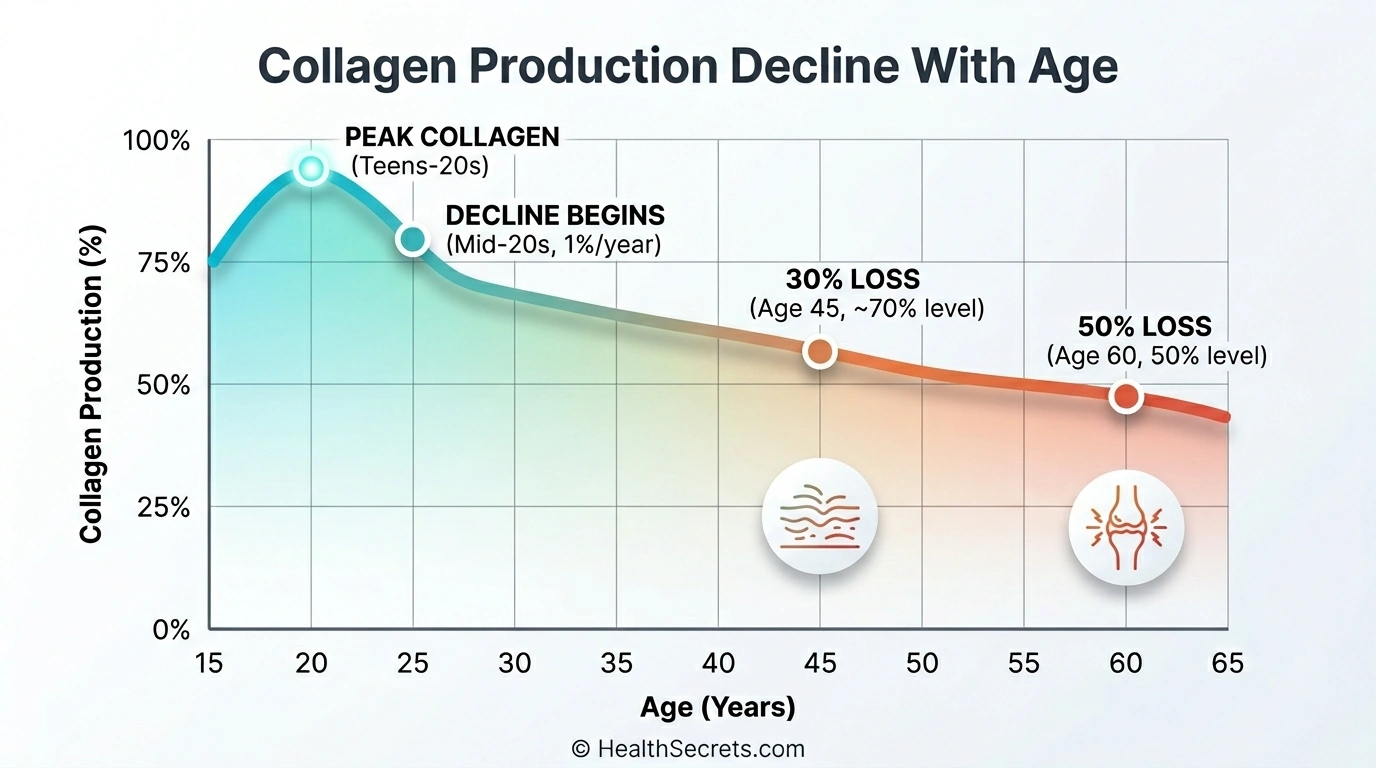
But here's the problem: your body's collagen production peaks in your teens and early twenties, then declines approximately 1% per year starting in your mid-twenties. By age 45, you've lost roughly 30% of your collagen. By 60, that number approaches 50%. The visible signs — wrinkles, sagging skin, joint stiffness, slower wound healing — are all downstream effects of this progressive collagen loss.

The collagen supplement market has exploded into a $4+ billion industry, and unlike many supplement trends, this one actually has substantial clinical evidence behind it. A 2026 umbrella review of 113 trials involving nearly 8,000 participants confirmed that collagen supplements provide legitimate skin and joint benefits when taken consistently [1]. Multiple meta-analyses show improvements in skin hydration, elasticity, wrinkle depth, and joint pain [2][3].

But not all collagen supplements are equal. Source, type, processing method, peptide size, and cofactors all matter significantly. In this guide, we'll cut through the marketing noise and give you the evidence-based framework for choosing the right collagen supplement for your specific goals — whether that's anti-aging skin support, joint pain relief, gut healing, or comprehensive health.

  • Collagen is the body's most abundant protein (30% of total), declining ~1% per year after age 25 — supplementation can help offset this loss.

  • A 2026 umbrella review of 113 trials confirmed collagen supplements improve skin elasticity, hydration, and reduce joint pain and stiffness [1].

Type I/III collagen (bovine or marine) is best for skin, bones, and gut;

Type II (chicken-derived UC-II, 40 mg) is best for joint pain specifically.
Line graph showing natural collagen production decline from peak in early twenties to 50 percent loss by age 60

What Should You Look for When Buying a Collagen Supplement?

The most important factors when choosing a collagen supplement are the collagen type matching your health goal, hydrolyzed processing for maximum absorption, source quality (grass-fed, wild-caught), and third-party testing for purity. Getting these four factors right eliminates 90% of the low-quality products on the market.

Which Collagen Type Do You Need for Your Goal?

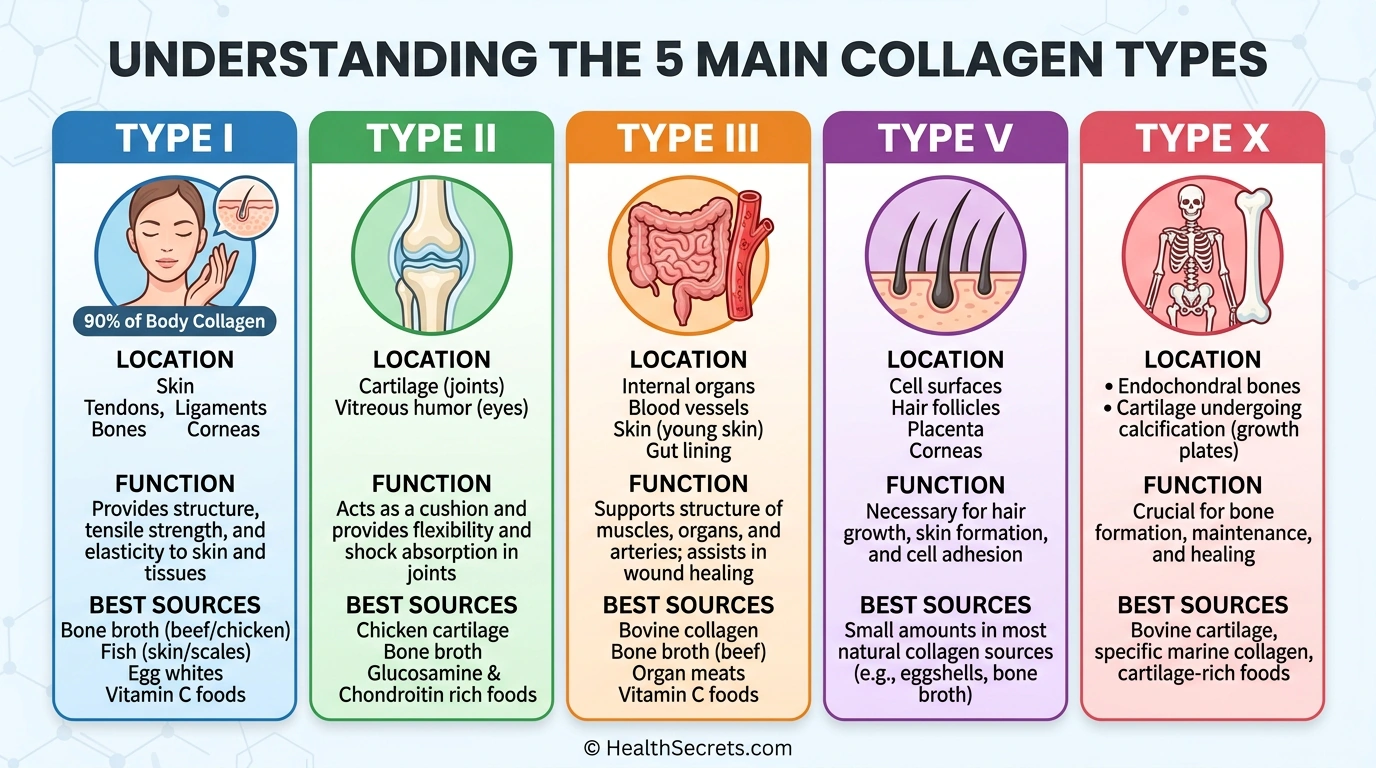
There are 28 identified collagen types, but five matter for supplementation. Choosing the right type for your goal is the single most important decision.

Type Location Best For Source Dose
Type I (90% of body's collagen) Skin, bones, tendons, organs Skin anti-aging, bone density, wound healing Bovine, marine 5–10 g/day
Type II Cartilage, joints Joint pain, osteoarthritis, cartilage Chicken sternum 40 mg/day (UC-II)
Type III Skin, blood vessels, gut Gut health, cardiovascular, skin (with Type I) Bovine 5–10 g/day
Type V Hair, placenta, cell surfaces Hair health Multi-collagen blends Part of blend
Type X Growth plates, bone cartilage Bone formation, fracture healing Multi-collagen blends Part of blend
Quick decision guide:
  • Skin and anti-aging → Type I (marine or bovine)
  • Joint pain → Type II (UC-II undenatured chicken collagen, 40 mg)
  • Gut health → Type I + III (bovine)
  • Comprehensive → Multi-collagen blend (Types I, II, III, V, X)
  • Bones → Type I + vitamin D + calcium
Infographic comparing five main collagen types showing their locations in the body and primary functions
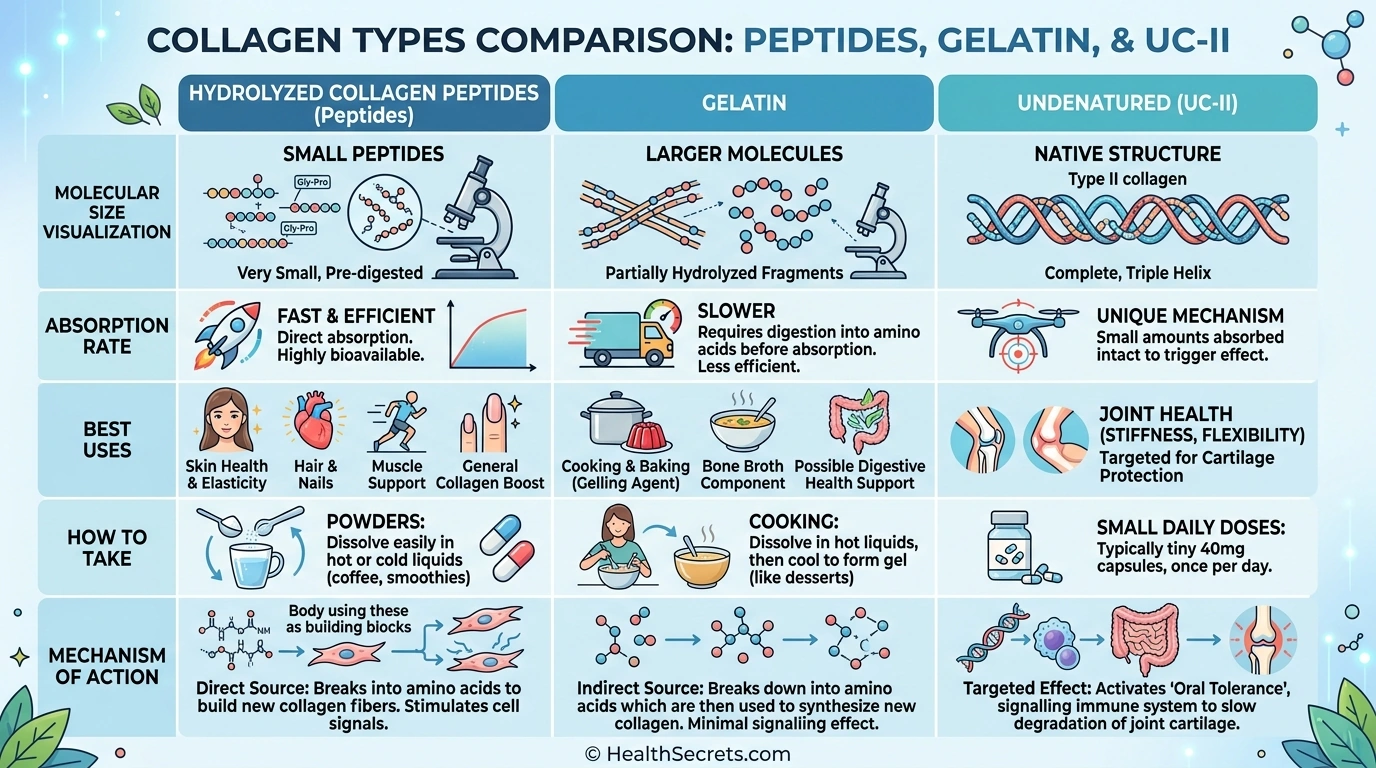
Comparison of hydrolyzed collagen peptides, gelatin, and undenatured UC-II collagen showing differences in form and function

How Do Collagen Sources Compare?

Source Types Best For Absorption Cost
Marine (fish skin/scales) I, III Skin, anti-aging Excellent (1.5x bovine) $$$$
Bovine (cow hide/bones) I, III General health, gut, skin Very good (90%+)
Chicken (sternum cartilage) II Joints, cartilage Good
Eggshell membrane I, V, X Joints + glucosamine Good $$$$
Multi-blend I, II, III, V, X Comprehensive Very good $$$
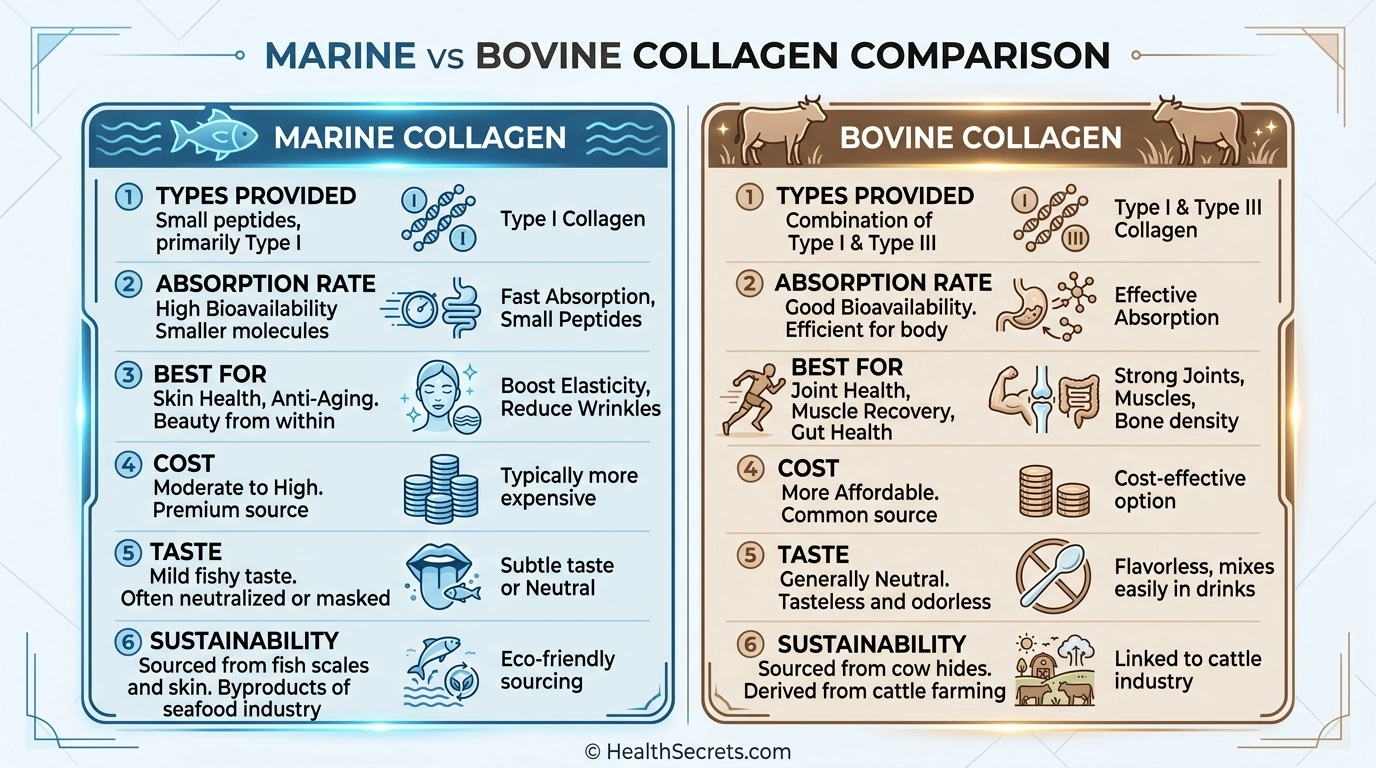
Marine collagen has the smallest peptide size and is absorbed up to 1.5 times more efficiently than bovine collagen, making it the premium choice for skin-focused goals [4].

Bovine collagen is the most versatile and affordable option, providing both Type I and III.

Chicken-derived UC-II works through a completely different mechanism (immune modulation rather than building blocks) and requires only 40 mg daily [5].

Side-by-side comparison of marine collagen versus bovine collagen showing absorption, types, cost, and best uses

What Quality Markers Matter Most?

  • Hydrolyzed (peptides): Essential for absorption — molecular weight 2,000–5,000 Daltons
  • Source quality: Grass-fed bovine, wild-caught marine, pasture-raised chicken
  • Third-party testing: NSF, Informed Choice, or independent lab verification for heavy metals and contaminants
  • Transparent labeling: Collagen types, source country, peptide size disclosed
  • Minimal additives: Pure collagen peptides; avoid proprietary blends that hide amounts
  • Certifications: GMP, Non-GMO, and any relevant dietary certifications (Paleo, Keto, Halal, Kosher)

Red flags to avoid: Very cheap pricing, no source information, unrealistic claims ("reverse aging"), no third-party testing, and proprietary blends.
The Supplement Seal Verifier
7 Pages • Free PDF
Free verifier 7 pages • fillable PDF

The Supplement Seal Verifier

What six certification programs each test, the label claims that test nothing, and a ten-bottle audit sheet that counts your verified products.

The PDF opens in a new tab. Unsubscribe from our emails at any time.

How Did We Evaluate These Collagen Supplements?

We evaluated collagen supplements using a rigorous methodology that prioritizes clinical evidence, ingredient quality, third-party verification, and real-world value. Our goal was to identify the best product for each specific use case rather than ranking products on a single scale.

Evaluation criteria:

  1. Clinical evidence (30%): Does the specific collagen type and dose match what clinical trials used? We prioritized products using doses and forms validated in peer-reviewed research.
  2. Source quality (25%): Grass-fed, pasture-raised, or wild-caught sourcing. Country of origin transparency. Processing method (enzymatic hydrolysis preferred).
  3. Third-party testing (20%): Independent verification for heavy metals (lead, mercury, cadmium, arsenic), contaminants, and potency. NSF, Informed Choice, or equivalent certifications.
  4. Value and practicality (15%): Cost per serving, serving size convenience, taste/mixability for powders, capsule count for capsule products.
  5. Formulation quality (10%): Inclusion of synergistic cofactors (vitamin C, hyaluronic acid), absence of unnecessary fillers, and appropriate peptide size.

We cross-referenced ingredient lists, verified ASINs, checked third-party testing claims, and consulted registered dietitian reviews from multiple independent sources [6].

How Do You Use Collagen Supplements Effectively?

For maximum benefit, take hydrolyzed collagen peptides consistently at the right dose for your goal, paired with vitamin C to support collagen synthesis. Consistency matters far more than timing — the key is taking it daily for at least 8–12 weeks before expecting visible results.

What's the Right Dose for Your Goal?

Goal Type Daily Dose Duration Evidence
Skin (wrinkles, elasticity) I/III hydrolyzed 2.5–10 g 8–12 weeks Strong [2][3]
Joint pain (OA) II (UC-II) 40 mg 3–6 months Strong [5][7]
Joint pain (general) I/III hydrolyzed 10–15 g 3–6 months Moderate
Bone density I hydrolyzed 5–10 g 12+ months Moderate [8]
Gut health I/III hydrolyzed 10–20 g 8–12 weeks Emerging [9]

When and How Should You Take Collagen?

  • Hydrolyzed collagen (peptides): Can be taken anytime — with or without food. Mix in coffee, smoothies, water, oatmeal, or soups.
  • UC-II (undenatured Type II): Take on an empty stomach for the immune-modulation mechanism to work.
  • Best times: Morning coffee, post-workout shake, or before bed (glycine in collagen may support sleep quality).
  • Consistency over timing: Daily intake matters more than when you take it.
Collagen dosing guide showing recommended daily amounts for skin, joint, bone, and gut health goals

Why Is Vitamin C Essential for Collagen?

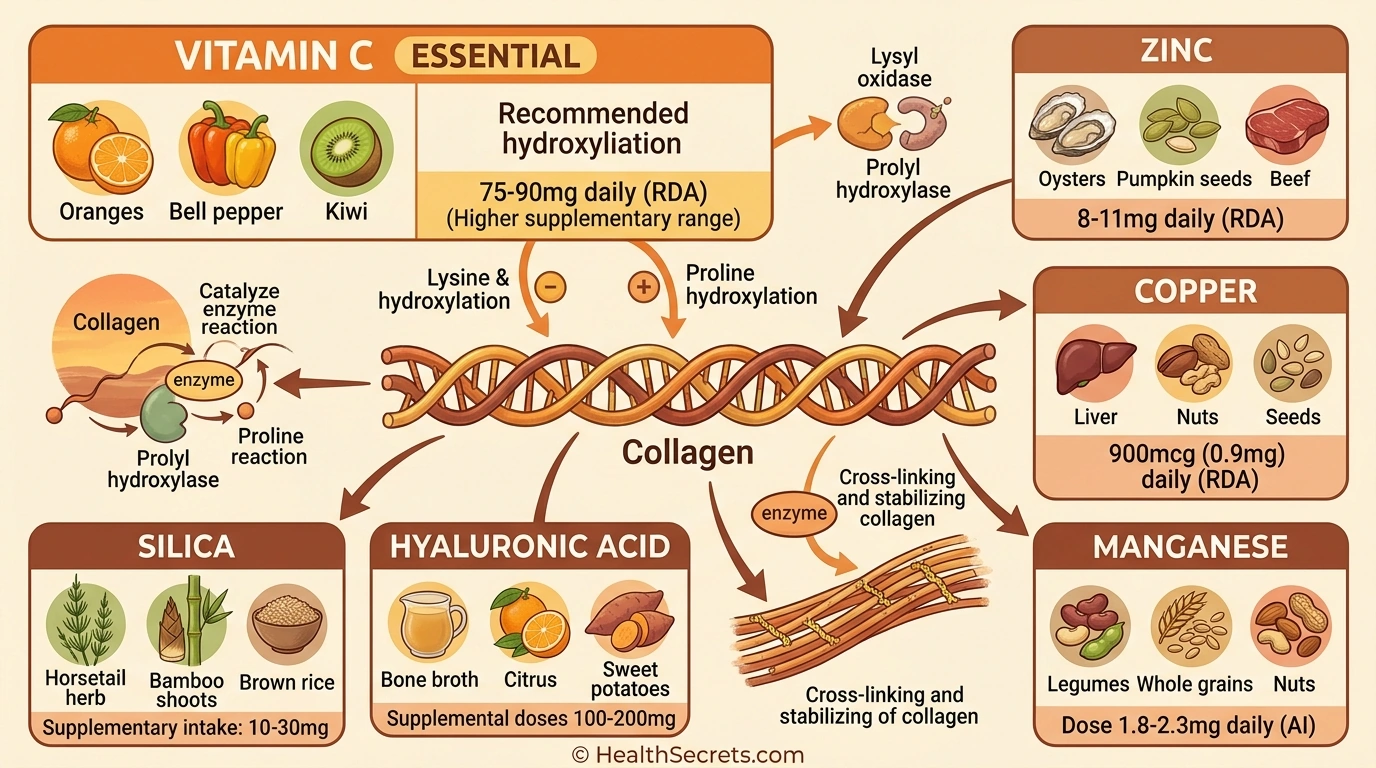
Vitamin C is the required cofactor for the enzymes (prolyl hydroxylase and lysyl hydroxylase) that stabilize collagen's triple-helix structure. Without adequate vitamin C, your body literally cannot form functional collagen — this is the biochemical basis of scurvy [10]. Take 500–1,000 mg of vitamin C daily with your collagen, or eat vitamin C-rich foods (citrus, berries, bell peppers, broccoli).

Other important cofactors:

  • Copper (1–2 mg): Required for collagen cross-linking
  • Zinc (15–30 mg): Supports collagen synthesis and wound healing
  • Silica (10–40 mg): Supports collagen and bone health
  • Hyaluronic acid (100–200 mg): Complements collagen for skin hydration
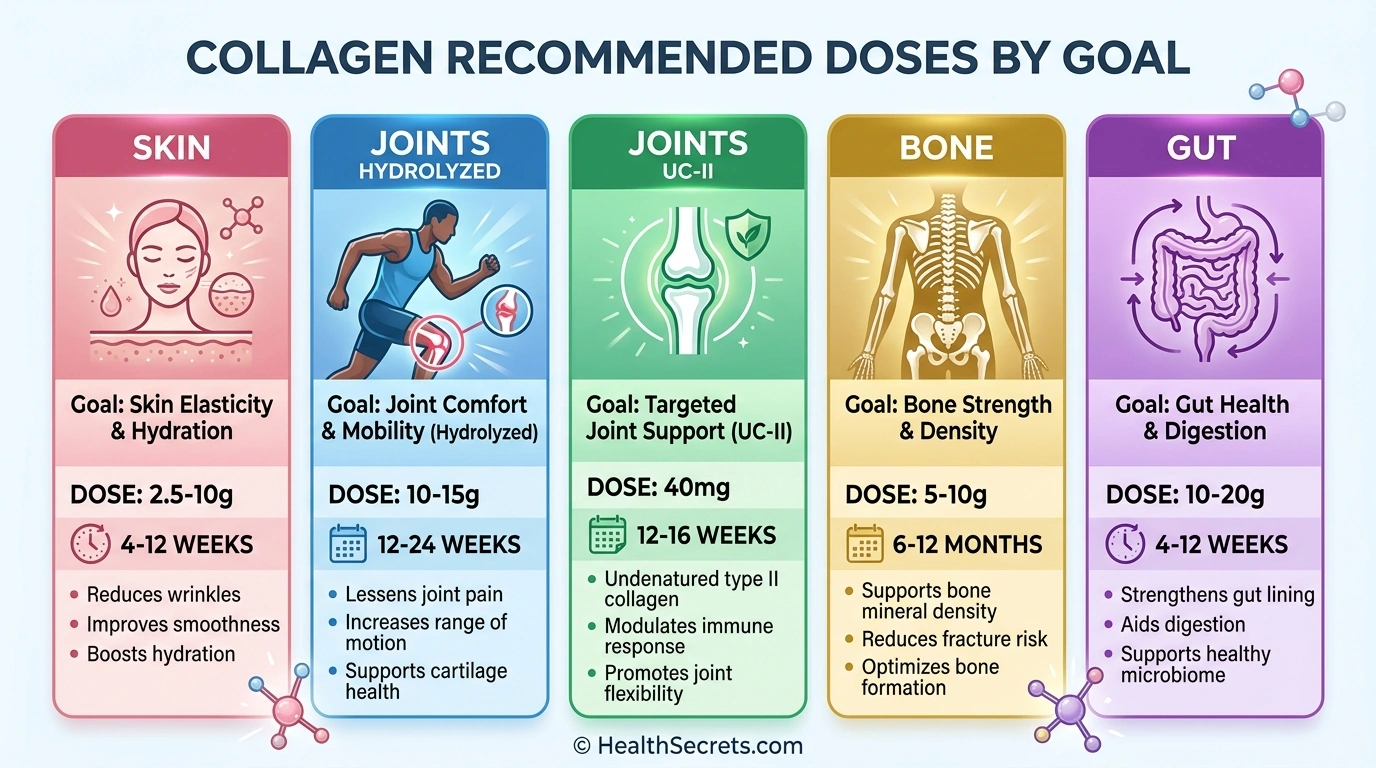
Illustration of essential cofactors for collagen synthesis including vitamin C, zinc, copper, and silica
Flat-lay arrangement of collagen-boosting foods including bone broth, salmon, citrus fruits, and vitamin C-rich vegetables

Are There Any Safety Concerns with Collagen Supplements?

Collagen supplements have an excellent safety profile with minimal side effects at standard doses. The most common issues are mild digestive discomfort (bloating, fullness) and a lingering aftertaste with some marine collagen products. Serious adverse events are extremely rare in clinical trials [1][7].

Common side effects (mild, dose-dependent):

  • Bloating or feeling of fullness (especially at higher doses)
  • Mild digestive discomfort
  • Aftertaste (particularly marine collagen)
  • Rarely: headache or skin rash

Allergy considerations:

  • Fish/shellfish allergy: Avoid marine collagen
  • Beef allergy: Avoid bovine collagen
  • Egg allergy: Avoid eggshell membrane collagen
  • Chicken allergy: Avoid chicken-derived collagen

Who should consult a doctor first:

  • People with kidney disease (high protein intake may be contraindicated)
  • Those with a history of calcium kidney stones (limited concern)
  • Pregnant or breastfeeding individuals (generally considered safe, but consult provider)
  • Anyone on medications that affect protein metabolism

Who should NOT worry:

  • Collagen supplements do not contain common allergens like gluten, dairy, or soy (check labels)
  • No drug interactions have been identified at standard doses
  • No hormonal effects have been documented
  • Safe for long-term daily use based on current evidence

ಕ್ರಿಯೆಯ ಯೋಜನೆ

What Should You Do First Before Starting Collagen?

ಕೆಳಗಿನ ಕ್ರಮವನ್ನು ಅನುಸರಿಸಿ, ಪ್ರತಿ ಹಂತವನ್ನು ಕ್ರಮಬದ್ಧವಾಗಿ ಪೂರೈಸಿ, ಮತ್ತು ನಿಮ್ಮ ಪ್ರಾಯೋಗಿಕ ಅನುಷ್ಠಾನ ಮಾರ್ಗದರ್ಶಿಯಾಗಿ ಪರಿಶೀಲನಾ ಪಟ್ಟಿಯನ್ನು ಬಳಸಿ.

ಹಂತ-ಹಂತವಾಗಿ

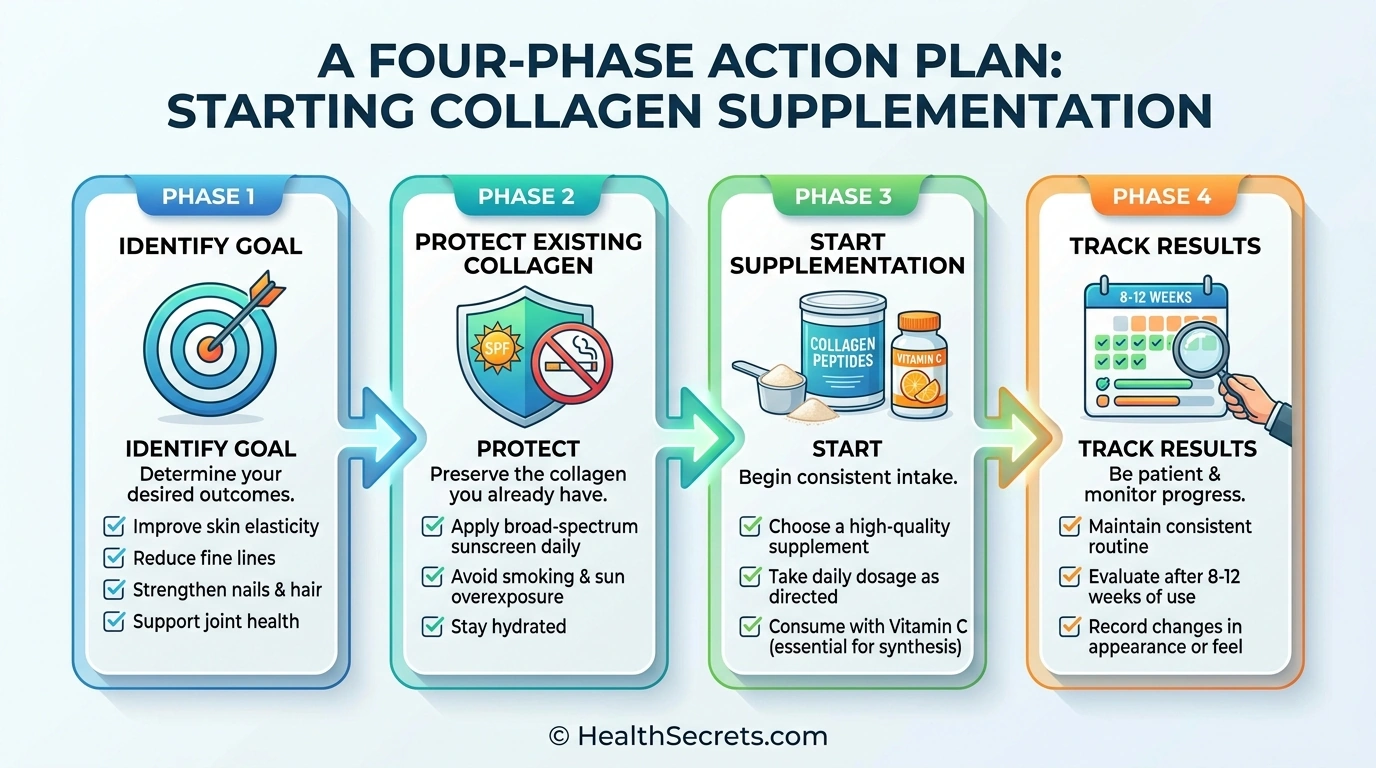
Before investing in collagen supplements, identify your primary goal, choose the right type and source, ensure you have the essential cofactors covered, and commit to consistent daily use for the minimum duration needed to see results.

Phase 1: Identify Your Goal and Choose Your Type

  • Determine primary goal: skin, joints, gut, bones, or comprehensive
  • Match goal to collagen type: Type I/III (skin/gut/bones) or Type II UC-II (joints)
  • Choose source: marine (premium skin), bovine (versatile/affordable), or multi-collagen
  • Set your daily dose based on the dosing guide above

Phase 2: Protect Your Existing Collagen

  • Use daily SPF 30+ sunscreen (UV radiation is the #1 cause of collagen breakdown)
  • Reduce or eliminate smoking (accelerates collagen destruction)
  • Minimize high-sugar foods (glycation damages collagen fibers)
  • Manage chronic inflammation through diet and lifestyle

Phase 3: Start Supplementation + Cofactors

  • Choose a quality collagen product from the recommendations below
  • Add vitamin C (500–1,000 mg daily) if not included in your product
  • Ensure adequate zinc, copper, and vitamin D intake
  • Establish a daily routine (e.g., collagen in morning coffee or smoothie)

Phase 4: Track and Adjust (8–12 Weeks)

  • Take baseline photos (skin) or note baseline pain levels (joints)
  • Be consistent — daily intake for minimum 8 weeks (skin) or 3 months (joints)
  • Reassess at 12 weeks for skin goals, 6 months for joint goals
  • If no improvement, try a different source or increase dose within recommended range
  • Continue long-term for sustained benefits — collagen gains reverse when you stop
Four-phase action plan for starting collagen supplementation from goal identification to tracking results
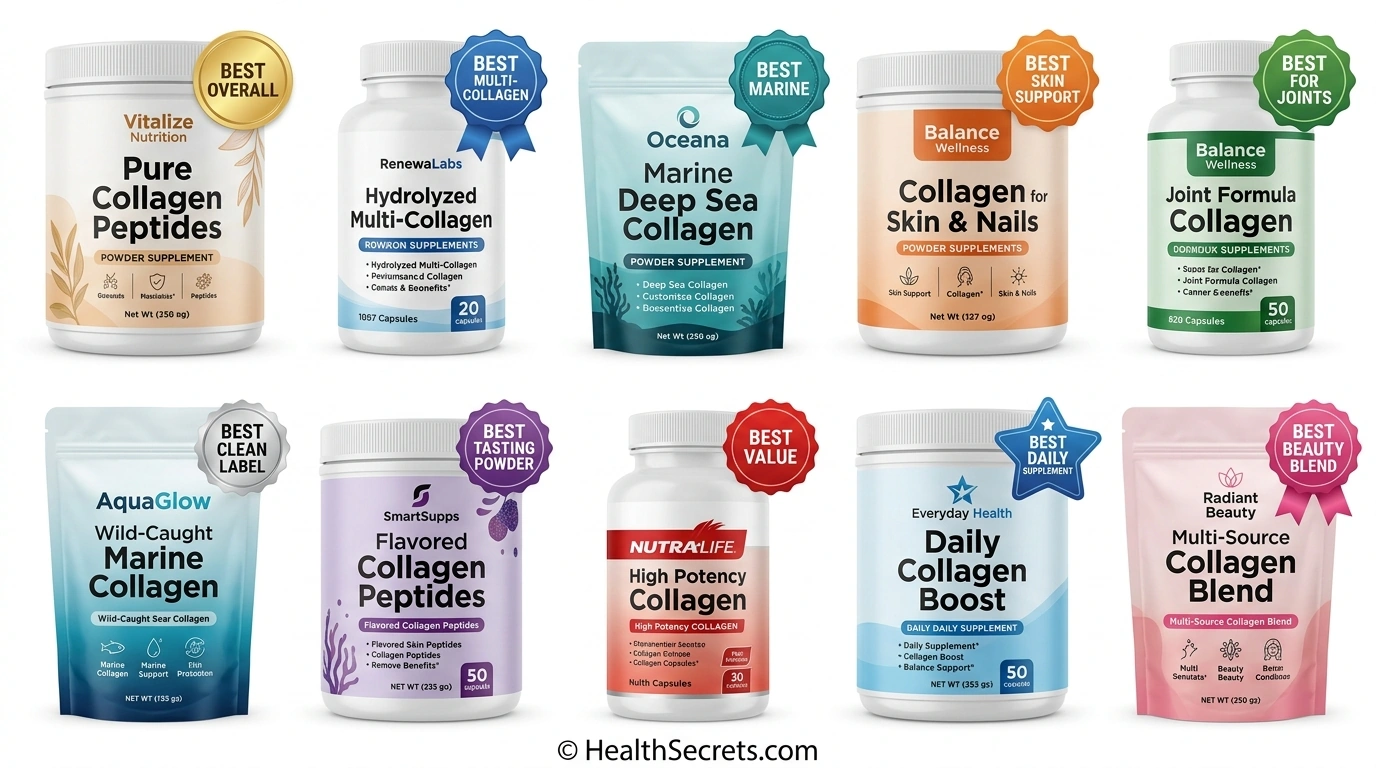
Product showcase of the 10 best collagen supplements including powders, capsules, and marine collagen options

ಶ್ರೇಷ್ಠ ಶಿಫಾರಸು ಮಾಡಲಾದ ಉತ್ಪನ್ನಗಳು

ಮಾರ್ಗಸೂಚಿಯನ್ನು ಬಿಡುವ ಮೊದಲು ಪರಿಶೀಲಿಸಲು ಹೋಲಿಕೆ ಮಾಡಿದ ಪಟ್ಟಿಯ ಕಿರುಪಟ್ಟಿ

10 ವಸ್ತುಗಳು
01

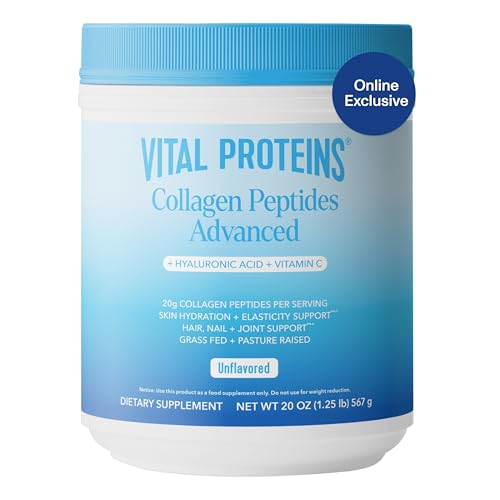
Vital Proteins Collagen Peptides 20 oz

Vital Proteins · Daily comprehensive collagen support with added vitamin C and hyaluronic acid

ವಿವರಗಳನ್ನು ಹೋಲಿಸಿ
02

Sports Research Collagen Peptides

Sports Research · Budget-conscious daily users who want certified quality without paying premium

ವಿವರಗಳನ್ನು ಹೋಲಿಸಿ
03

Garden of Life Grass Fed Collagen Peptides

Garden of · People who prioritize organic, sustainably sourced ingredients and clean-label products

ವಿವರಗಳನ್ನು ಹೋಲಿಸಿ
04

Ancient Nutrition Multi Collagen Protein Powder

Ancient Nutrition · People who want all five collagen types (I, II, III, V, X) from multiple sources in one product

ವಿವರಗಳನ್ನು ಹೋಲಿಸಿ
05

Further Food Premium Marine Collagen Peptides

Further Food · Skin-focused users who want the highest-absorption collagen from sustainable wild-caught fish

ವಿವರಗಳನ್ನು ಹೋಲಿಸಿ
06

Sports Research UC-II Joint Collagen

Sports Research · People with osteoarthritis or exercise-related joint pain who want clinically proven joint support

ವಿವರಗಳನ್ನು ಹೋಲಿಸಿ
07

NeoCell Super Collagen + C

NeoCell Super · People who want collagen and its most essential cofactor (vitamin C) in a single affordable product

ವಿವರಗಳನ್ನು ಹೋಲಿಸಿ
08

Orgain Collagen Peptides (Chocolate)

Orgain Collagen · People who dislike unflavored supplements and want collagen that tastes good in smoothies or milk

ವಿವರಗಳನ್ನು ಹೋಲಿಸಿ
09

NOW Foods UC-II Type II Collagen

NOW Foods · Cost-conscious users with joint pain seeking the clinically validated UC-II form

ವಿವರಗಳನ್ನು ಹೋಲಿಸಿ
10

Great Lakes Wellness Collagen Hydrolysate

Great Lakes · Long-term daily users who want quality grass-fed collagen at the lowest cost per serving

ವಿವರಗಳನ್ನು ಹೋಲಿಸಿ

ಯಾವುದೇ ರೀಟೇಲರ್ ಲಿಂಕ್ ಅನ್ನು ತೆರೆಯುವ ಮೊದಲು ಕೆಳಗಿನ ವಿವರವಾದ ವಿಮರ್ಶಾ ಕಾರ್ಡ್‌ಗಳನ್ನು ಓದಿ

ಮುಂದಿನ ಓದಿಗೆ

ಮುಂದಿನ ಓದಿಗೆ

"The Collagen Diet: A 28-Day Plan for Sustained Weight Loss, Glowing Skin, Great Gut Health, and a Younger You"

ಅವರಿಂದ Dr. Josh Axe, DNM, DC, CNS

28-day meal plan built around collagen-rich foods; detailed explanation of collagen types and sources; recipes for bone broth and collagen-boosted meals; guidance on combining collagen with intermittent fasting; supplement selection framework

ಇದು ಏಕೆ ಇಲ್ಲಿ ಮೌಲ್ಯವನ್ನು ನೀಡುತ್ತದೆ

Dr. Axe provides both the scientific foundation and the practical meal-by-meal guide for maximizing collagen benefits through diet and supplementation together.

ಉತ್ತಮವಾದದ್ದು: Anyone who wants a comprehensive, practical guide to incorporating collagen into diet and lifestyle

ಪುಸ್ತಕದ ವಿವರಗಳನ್ನು ನೋಡಿ

ಮುಂದಿನ ಓದಿಗೆ

"Glow: The Dermatologist's Guide to a Whole Foods Younger Skin Diet"

ಅವರಿಂದ Dr. Rajani Katta, MD

Research-based dietary strategies for skin health and collagen protection; understanding of how UV, sugar, and inflammation damage collagen; practical food recommendations for supporting natural collagen production; guidance on supplements including collagen peptides

ಇದು ಏಕೆ ಇಲ್ಲಿ ಮೌಲ್ಯವನ್ನು ನೀಡುತ್ತದೆ

Dr. Katta's expertise as a dermatologist-researcher provides the medical perspective on how collagen supplementation fits into a comprehensive skin health strategy.

ಉತ್ತಮವಾದದ್ದು: People focused on skin anti-aging who want a dermatologist's evidence-based perspective on nutrition for skin health

ಪುಸ್ತಕದ ವಿವರಗಳನ್ನು ನೋಡಿ

AEO FAQ

ಪದೇ ಪದೇ ಕೇಳಲಾಗುವ ಪ್ರಶ್ನೆಗಳು

15 common questions answered

Yes, collagen supplementation has strong clinical evidence. A 2026 umbrella review of 113 trials involving ~8,000 participants confirmed legitimate benefits for skin elasticity, hydration, and joint pain reduction [1]. However, a 2026 meta-analysis noted that industry-funded studies showed stronger results than independent ones, suggesting benefits may be more modest than some marketing claims [11]. The evidence is real but not miraculous.

Marine collagen has a slight edge for skin due to smaller peptide size and up to 1.5x higher bioavailability compared to bovine [4]. Both primarily contain Type I collagen, which is the dominant skin collagen. Marine is the premium choice if budget allows; bovine is effective and significantly more affordable.

For skin (wrinkles, elasticity, hydration), most studies show measurable improvements in 4–12 weeks of daily use [2][3]. For joint pain, improvements typically take 3–6 months. For bone density, 12+ months. Nail improvements can appear in 3–4 months. Consistency is essential — sporadic use will not produce results.

Bone broth contains collagen but in much lower, highly variable amounts compared to supplements. You would need to drink very large quantities daily to reach therapeutic doses (5–20 g). Supplements provide consistent, measured doses of hydrolyzed peptides optimized for absorption. Bone broth is a good dietary complement but not a reliable substitute for targeted supplementation.

True collagen only comes from animal sources. "Vegan collagen" products are actually collagen precursors — amino acids, vitamin C, and other nutrients that support your body's own collagen production. They may help, but they are not the same as providing pre-formed collagen peptides and lack the clinical evidence that hydrolyzed animal collagen has.

No. Collagen peptides are protein (roughly 35–40 calories per 10 g serving) and are more likely to support satiety than cause weight gain. Some collagen products contain added sugars or flavoring that add calories, so check labels. Pure collagen peptides are a lean protein source.

This is a common myth. Hydrolyzed collagen peptides are already broken down into small fragments (2,000–5,000 Daltons) that survive digestion and are absorbed intact into the bloodstream. Radioactive-labeled studies have confirmed that collagen peptides reach the skin and accumulate there for up to two weeks after ingestion [4][12].

Yes — vitamin C is the essential cofactor for the enzymes that stabilize collagen's structure. Without adequate vitamin C, collagen synthesis is impaired regardless of how much collagen you supplement. Some products include vitamin C; if yours doesn't, take 500–1,000 mg separately or eat vitamin C-rich foods with your collagen [10].

Both come from collagen, but hydrolyzed collagen (peptides) has been broken into much smaller fragments for better absorption (~90% bioavailability). Gelatin is partially broken down, forms a gel in cold liquids, and has lower absorption. Hydrolyzed collagen is preferred for daily supplementation; gelatin is better for cooking (gummies, thickening).

Collagen supplements are generally considered safe during pregnancy and breastfeeding since collagen is a natural protein. However, clinical studies specifically in pregnant populations are limited. Consult your OB/GYN before starting, and choose products free of additives, heavy metals, and contaminants (third-party tested).

You can, but take them separately. Type I/III hydrolyzed collagen works as building blocks and can be taken with or without food. Type II (UC-II) works through immune modulation and should be taken on an empty stomach. Taking them at different times of day ensures each works through its intended mechanism.

Collagen provides amino acids (particularly proline) used in keratin synthesis, the protein that makes up hair. Some studies show improved hair thickness and reduced breakage, though evidence is more limited than for skin. Collagen may support hair health as part of a comprehensive approach but is not a standalone hair growth treatment.

UV radiation from sun exposure is the #1 destroyer of collagen, followed by smoking, high-sugar diets (glycation), chronic inflammation, and oxidative stress. Protecting your existing collagen (daily SPF, not smoking, limiting sugar) is just as important as supplementing with new collagen.

For skin anti-aging benefits (wrinkle reduction, elasticity, hydration), clinical trials typically used 2.5–10 g daily of hydrolyzed collagen peptides. Most dermatologists recommend 5–10 g daily for optimal skin results. Higher doses (15–20 g) have not shown proportionally better skin results and are better suited for joint or gut goals.

No significant drug interactions have been identified for collagen supplements at standard doses. However, people taking anticoagulants should note that some marine collagen products may have mild antiplatelet properties. Always inform your healthcare provider about all supplements you take, especially before surgery.

The e-book for this topic
Sources cited inside
Evidence-Based Supplement Organizer & Safety Log
46 pages • fillable PDF

Evidence-Based Supplement Organizer & Safety Log

An inventory that adds up the cost, thirty-three supplements graded on the evidence, an upper-limit tally, an interaction screen, a daily schedule and a one-sheet for your clinician.

What is inside:

✓ The Audit and the Label: Why cabinets need auditing, the three questions every bottle must answer, a 20-product inventory that adds up the monthly and yearly cost, how to read a Supplement Facts panel, and label math that converts compounds to elemental doses and IU to mcg.
✓ Thirty-Three Supplements, Graded: From the multivitamin and vitamin D to berberine, ashwagandha and red yeast rice: forms, usual doses, upper limits, what the trials found, safety, what each stacks with and the test that goes with it, graded A to D.
✓ Is It What It Says?: USP, NSF, ConsumerLab, BSCG and Informed Sport compared; which seal for which need; six label claims that test nothing; how to read a certificate of analysis; and the recalls that shaped the rules.
✓ Adding It Up: Sixteen upper limits and where the extra comes from, a tally that adds every source of twelve nutrients and labels each one under, near or over the limit, and six real cabinets worked through.
$37$14.80 one payment

PDF e-book + free online edition • 60-day money-back guarantee

💊

ನಿಮ್ಮ ಜ್ಞಾನವನ್ನು ಪರೀಕ್ಷಿಸಿ

Take our Supplement Science Quiz and see how much you really know about supplements.

ರಸಪ್ರಶ್ನೆ ತೆಗೆದುಕೊಳ್ಳಿ

ಈ ಲೇಖನವು ಉಪಯುಕ್ತವಾಗಿದೆಯೇ?

ಸಂಶೋಧಿಸಿ ಸತ್ಯ-ಪರಿಶೀಲಿಸಲಾಗಿದೆ

HS

ಲೇಖಕ

Health Secrets Editorial Team

The Health Secrets editorial team researches, writes and fact-checks every guide against the primary studies and clinical guidelines it cites.

HS

ಸತ್ಯ-ಪರಿಶೀಲಕರು

Health Secrets Editorial Team

ಎಲ್ಲ ವಿಷಯವೂ ಪುರಾವೆ-ಆಧಾರಿತವಾಗಿದ್ದು, ಪೀರ್-ರಿವ್ಯೂ ಮಾಡಲಾದ ಸಂಶೋಧನೆಯ ವಿರುದ್ಧ ಪರಿಶೀಲಿಸಲಾಗಿದೆ ಮತ್ತು ನಿಯಮಿತವಾಗಿ ನವೀಕರಿಸಲಾಗುತ್ತದೆ. ನಮ್ಮ ಸಂಪಾದಕೀಯ ತಂಡವು ನಿಖರತೆ ಮತ್ತು ಪಾರದರ್ಶಕತೆಗಾಗಿ ಕಠಿಣ ಮಾರ್ಗಸೂಚಿಗಳನ್ನು ಅನುಸರಿಸುತ್ತದೆ.

ಉಲ್ಲೇಖಗಳು & ಸೂಚನೆಗಳು

20 ಉಲ್ಲೇಖಿಸಲಾದ ಮೂಲಗಳು

1
Collagen supplements provide legitimate skin and joint benefits — 2026 umbrella review of 113 trials involving ~8,000 participants. BBC News summary.
2
Pu, S. Y., et al. (2023). Effects of oral collagen for skin anti-aging: a systematic review and meta-analysis. Nutrients, 15(9), 2080.
PubMed: 37432180 Vis back
3
de Miranda, R. B., et al. (2021). Collagen supplements for aging and wrinkles: a paradigm shift in the fields of dermatology and cosmetics. Nutrients, 14(2), 399.
PubMed: 35223163 Vis back
4
Geahchan, S., et al. (2022). Hydrolyzed marine collagen: emerging evidence of benefits via the oral route. Clinical, Cosmetic and Investigational Dermatology, 15, 2305–2318.
5
Lugo, J. P., et al. (2016). Undenatured type II collagen (UC-II) for joint support: a randomized, double-blind, placebo-controlled study in healthy volunteers. Journal of the International Society of Sports Nutrition, 13, 14.
PubMed: 27274671 Vis back

ಚಿಕಿತ್ಸಾತ್ಮಕ ನಿರಾಕರಣ

This article is for informational purposes only and does not constitute medical advice. Read the full medical disclaimer. Always consult with a qualified healthcare provider before starting any new supplement, treatment, or major dietary change.

Supplements Cornerstone Pillar

Supplements Guide: Complete Evidence-Based Reference

With thousands of dietary supplements on the market, choosing the right ones can feel overwhelming. This evidence-based supplements guide breaks down the science behind vitamins, minerals, and popular supplements — helping you make informed decisions about what actually works, what to avoid, and how to build a safe, effective supplement routine.

Read Pillar Guide →

ನಿಮಗೆ ಇಷ್ಟವಾಗಬಹುದು

supplements

Suplementos para la energía: cómo combatir la fatiga de forma natural

Los suplementos para la energía pueden ayudar a combatir la fatiga persistente cuando los adecuados se dirigen a su deficiencia específica. Las vitaminas del grupo B, el hierro, la CoQ10, el magnesio y los adaptógenos como la rhodiola se encuentran entre las opciones con mayor respaldo científico; sin embargo, es fundamental analizar sus niveles primero para evitar el desperdicio de dinero o causar daños.

→
supplements

Supplements for Joint Health: Complete Guide

Joint pain affects over 90 million Americans, and the right supplements can reduce inflammation, protect cartilage, and improve mobility. This complete guide reviews the best joint health supplements — including glucosamine, turmeric, collagen, and boswellia — with evidence-based dosing, safety guidance, and tested product recommendations.

→
supplements

ಪ್ರೋಟೀನ್ ಸಪ್ಲಿಮೆಂಟ್‌ಗಳು: ಆರೋಗ್ಯ ಮತ್ತು ಫಿಟ್‌ನೆಸ್‌ಗಾಗಿ ಸಂಪೂರ್ಣ ಮಾರ್ಗಸೂಚಿ

ನಮ್ಮ ಸಾಕ್ಷ್ಯಾಧಾರಿತ ಮಾರ್ಗದರ್ಶಿಯೊಂದಿಗೆ 2025ರ ಅತ್ಯುತ್ತಮ ಪ್ರೋಟೀನ್ ಸಪ್ಲಿಮೆಂಟ್‌ಗಳನ್ನು (protein supplements) ಕಂಡறியಿರಿ. ನಾವು ವೇ (whey), ಕೇಸಿನ್ (casein) ಮತ್ತು ಸಸ್ಯ ಆಧಾರಿತ ಪ್ರೋಟೀನ್‌ಗಳನ್ನು ಹೋಲಿಕೆ ಮಾಡಿದ್ದೇವೆ; ಶುದ್ಧತೆ ಮತ್ತು ಮೌಲ್ಯದ அடிப்படையில் ಅಗ್ರ 10 ಉತ್ಪನ್ನಗಳನ್ನು ವಿಮರ್ಶಿಸಿದ್ದೇವೆ; ಹಾಗೂ ಪೀರ್-ರಿವ್ಯೂಡ್ ಸಂಶೋಧನೆಗಳ ಆಧಾರದ ಮೇಲೆ ಪ್ರೋಟೀನ್ ಸೇವಿಸುವ ಪ್ರಮಾಣ, ಸಮಯ ಮತ್ತು ಸುರಕ್ಷತೆಯ ಬಗ್ಗೆ ತಜ್ಞರ ಸಲಹೆಗಳನ್ನು ಹಂಚಿಕೊಂಡಿದ್ದೇವೆ.

→

ಚರ್ಚೆ

0

No comments yet

Be the first to share your thoughts, clinical insights, or questions about this protocol.