Skip to content
Pin It
11

Mood-Boosting Supplements: Complete Guide

HS
Health Secrets Editorial Team
| ಸತ್ಯ-ಪರಿಶೀಲಿಸಲಾಗಿದೆ | 2,066 ord | 18 ಉಲ್ಲೇಖಗಳು
ಈ ತಿಂಗಳಲ್ಲಿ ಅಪ್‌ಡೇಟ್ ಮಾಡಲಾಗಿದೆ Updated: October 13, 2026

ಇದಕ್ಕೆ ಯಾರು ಅರ್ಹರು?

ವಿಕಲ್ಪಗಳನ್ನು ಹೋಲಿಕೆ ಮಾಡುವ ಮತ್ತು ಆಧಾರಿತ ಒಳನೋಟಗಳನ್ನು ಹುಡುಕುವ ಓದುಗರಿಗೆ ಇದು ಅತ್ಯುತ್ತಮವಾಗಿದೆ.

ಯಾರಿಗೆ ಎಚ್ಚರಿಕೆಯಿಂದ ಇರಬೇಕು?

ಲಕ್ಷಣಗಳು, ಔಷಧಿಗಳು ಅಥವಾ ল্যাব ಸಮಸ್ಯೆಗಳು ಒಳಗೊಂಡಿದ್ದಾಗ ವೈದ್ಯರ ಮಾರ್ಗದರ್ಶನವನ್ನು ಇದು प्रतिস্থাপনಿಸುವುದಿಲ್ಲ.

ಸಂಬಂಧಿತ ಉಲ್ಲೇಖ | This article may contain affiliate links to products we trust. If you choose to buy through them, we may earn a small commission at no extra cost to you. Full disclosure

ಚಿಕಿತ್ಸಾತ್ಮಕ ನಿರಾಕರಣ | ಮಾಹಿತಿಯನ್ನು ಮಾತ್ರ. ವೃತ್ತಿಪರ ವೈದ್ಯಕ ಸಲಹೆಯನ್ನು ಬದಲಾಯಿಸುವುದಿಲ್ಲ. ಪೂರ್ಣ ನಿರಾಕರಣವನ್ನು 읽ಿ

From St. John's wort and omega-3s to rhodiola and magnesium, the world of mood-boosting supplements is packed with options — but not all are created equal. This evidence-based guide reviews the best supplements for mood support, ranks them by research quality, covers safety and drug interactions, and helps you choose the right ones for your specific needs.

M
11
59%
11 2.1K ord

ಪ್ರಮುಖ ಅಂಶಗಳು

The strongest clinical evidence for mood support exists for St [2] [7]. John's wort, omega-3 fatty acids (EPA), and SAMe — all recommended as first- or second-line treatments in clinical guidelines
St [15]. John's wort is as effective as SSRIs for mild-to-moderate depression but has dangerous drug interactions with birth control, blood thinners, antidepressants, and many other medications
Rhodiola rosea shows anti-depressive potency at 340–680 mg per day and works well in combination with magnesium and B vitamins for stress-related mood issues [9] [10] [12]
Vitamin D deficiency is strongly linked to depression — supplementing with 1,000–4,000 IU daily is safe, inexpensive, and especially effective if you're deficient
5-HTP is a direct serotonin precursor but carries a serious serotonin syndrome risk when combined with antidepressants — never combine them
SAMe is fast-acting (1–2 weeks) but expensive and strictly contraindicated in bipolar disorder due to mania risk
Magnesium glycinate (200–400 mg daily) supports GABA function and is particularly effective for anxiety, stress, and sleep-related mood issues [13]
Most mood supplements take 4–8 weeks to show meaningful effects — patience and consistency are essential
Supplements work best as part of a comprehensive approach including therapy, lifestyle changes, exercise, sleep, and professional mental health care
Always start one supplement at a time to identify what works and what causes side effects before adding another
Stress Recovery Micro-Habits Workbook
31 Pages
The e-book for this topic PDF e-book + free online edition

Stress Recovery Micro-Habits Workbook

Seven five-minute practices with the evidence for each, a chooser for every kind of moment, and a thirty-day log that shows your baseline settle.

The Stress Response, Explained
What Works in Five Minutes
Seven Practices, One Page Each
$27$10.80 one payment
See the e-book 60-day money-back guarantee

If you've ever searched for "natural mood boosters," you know the list is overwhelming. Dozens of supplements claim to lift your spirits, calm your anxiety, or help you feel more like yourself again. Some of those claims hold up under scientific scrutiny. Others? Not so much. [5] [16]

Here's what makes this complicated: mood isn't controlled by a single neurotransmitter or pathway. Serotonin, dopamine, norepinephrine, GABA, inflammation, stress hormones, gut bacteria, and nutrient deficiencies all play interconnected roles. That's why different supplements work through completely different mechanisms — and why no single pill fixes everything. [17] [18]

The good news is that several mood-boosting supplements now have genuine clinical evidence behind them. A 2016 meta-analysis found that St. John's wort extract was as effective as SSRIs for mild-to-moderate depression with significantly fewer side effects [1] [3] [4] [8]. Omega-3 fatty acids and SAMe have been recommended as first- or second-line treatments in clinical practice guidelines [6]. Rhodiola rosea shows anti-depressive potency at doses of 340–680 mg per day. And vitamin D supplementation reduces depressive symptoms, particularly when deficiency is present [11] [14].

But — and this is crucial — some of these same supplements come with serious safety concerns. St. John's wort interacts with dozens of medications including birth control and blood thinners. 5-HTP can trigger serotonin syndrome when combined with antidepressants. SAMe is contraindicated in bipolar disorder.

This guide cuts through the noise to give you an evidence-based ranking of the best mood-boosting supplements, what the research actually shows, how to use them safely, and who should (and shouldn't) try them.

For a broader view of mental wellness strategies, explore our Mental Wellness Complete Guide and our dedicated guides on Omega-3 for Brain Health and SAMe for Depression.

What Should You Look for in a Mood-Boosting Supplement?

Choosing a mood supplement isn't as simple as grabbing the first bottle you see. Quality, standardization, evidence level, and your specific mood profile all matter significantly. The wrong choice can be ineffective — or in some cases, dangerous.

How Do You Match a Supplement to Your Specific Mood Needs?

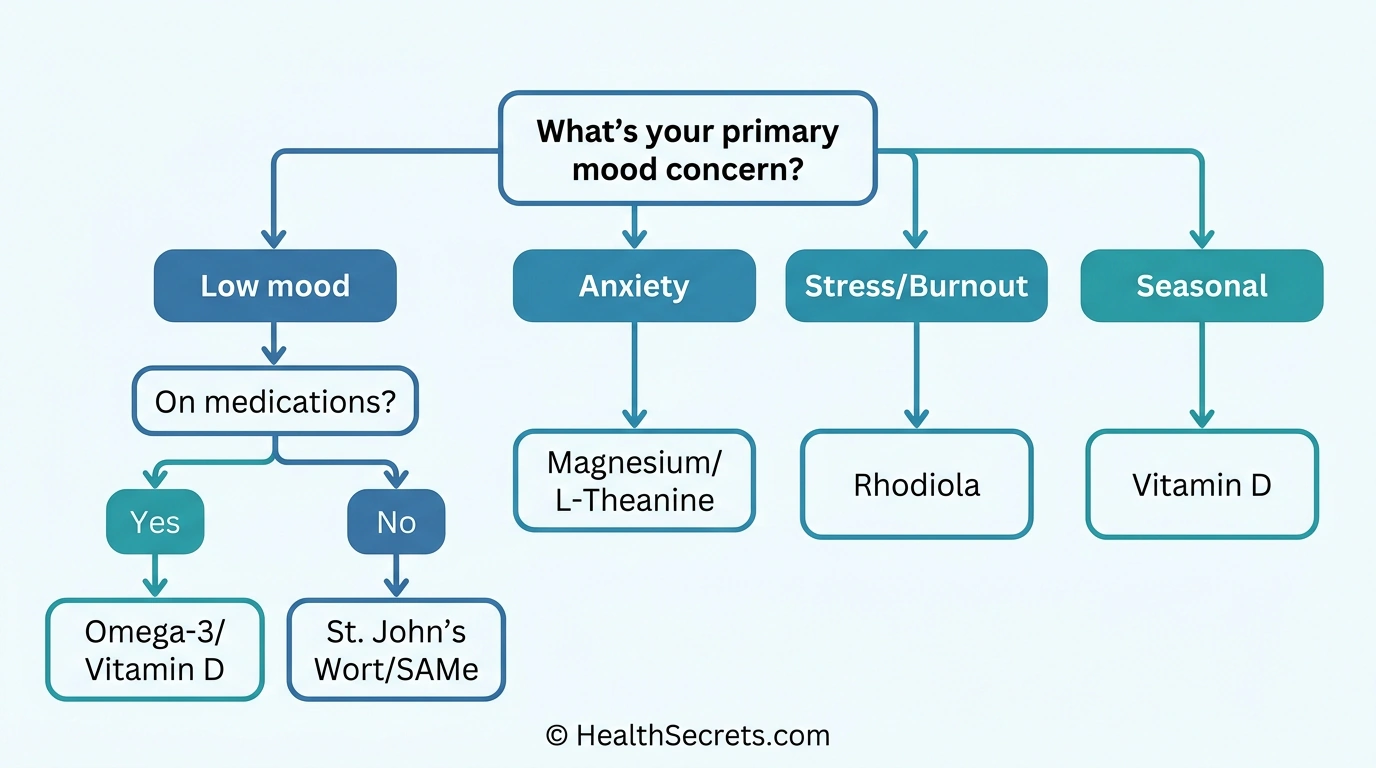
Different mood challenges point to different supplements because they involve different neurotransmitter pathways:

  • Low mood with no energy or motivation → Consider SAMe, rhodiola, or vitamin D (targets dopamine, norepinephrine, and mitochondrial energy)
  • Anxiety and restlessness → Consider magnesium glycinate, L-theanine, or ashwagandha (targets GABA and cortisol)
  • Mild-to-moderate depression → Consider St. John's wort (if not on medications), omega-3s, or SAMe (targets serotonin, dopamine)
  • Stress-related mood issues → Consider rhodiola + magnesium + B vitamins (targets HPA axis and stress response)
  • Seasonal mood changes → Consider vitamin D (targets serotonin synthesis, corrects seasonal deficiency)
  • Gut-related mood issues → Consider targeted probiotics (targets gut-brain axis)
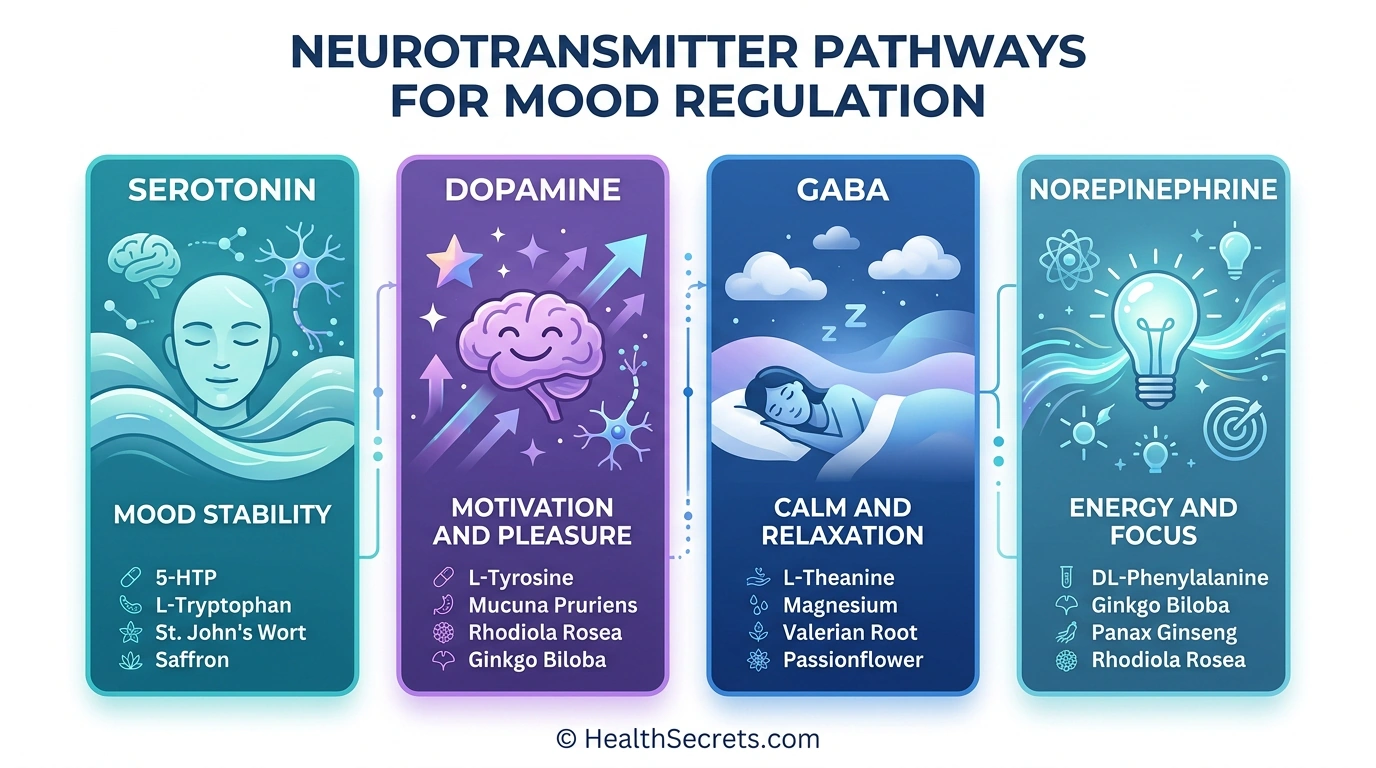
Infographic showing four neurotransmitter pathways involved in mood and which supplements target each pathway
Decision flowchart helping readers choose the right mood supplement based on their primary concern

What Quality Markers Should You Look For?

  • Standardized extracts — St. John's wort standardized to 0.3% hypericin; rhodiola to 3% rosavins and 1% salidroside; saffron to safranal and crocin
  • Third-party testing — USP, NSF, or ConsumerLab verification
  • Active forms — Methylfolate over folic acid, methylcobalamin over cyanocobalamin, magnesium glycinate over oxide
  • Evidence-based dosing — Match the dose to what was used in clinical trials, not marketing claims
  • GMP certification — Ensures consistent manufacturing quality

What Should You Avoid?

  • Proprietary blends that hide individual ingredient amounts
  • Products making disease treatment claims ("cures depression")
  • Mega-dose formulations far exceeding studied amounts
  • Combinations of serotonergic ingredients (5-HTP + St. John's wort in the same product)
  • Products without clear standardization information
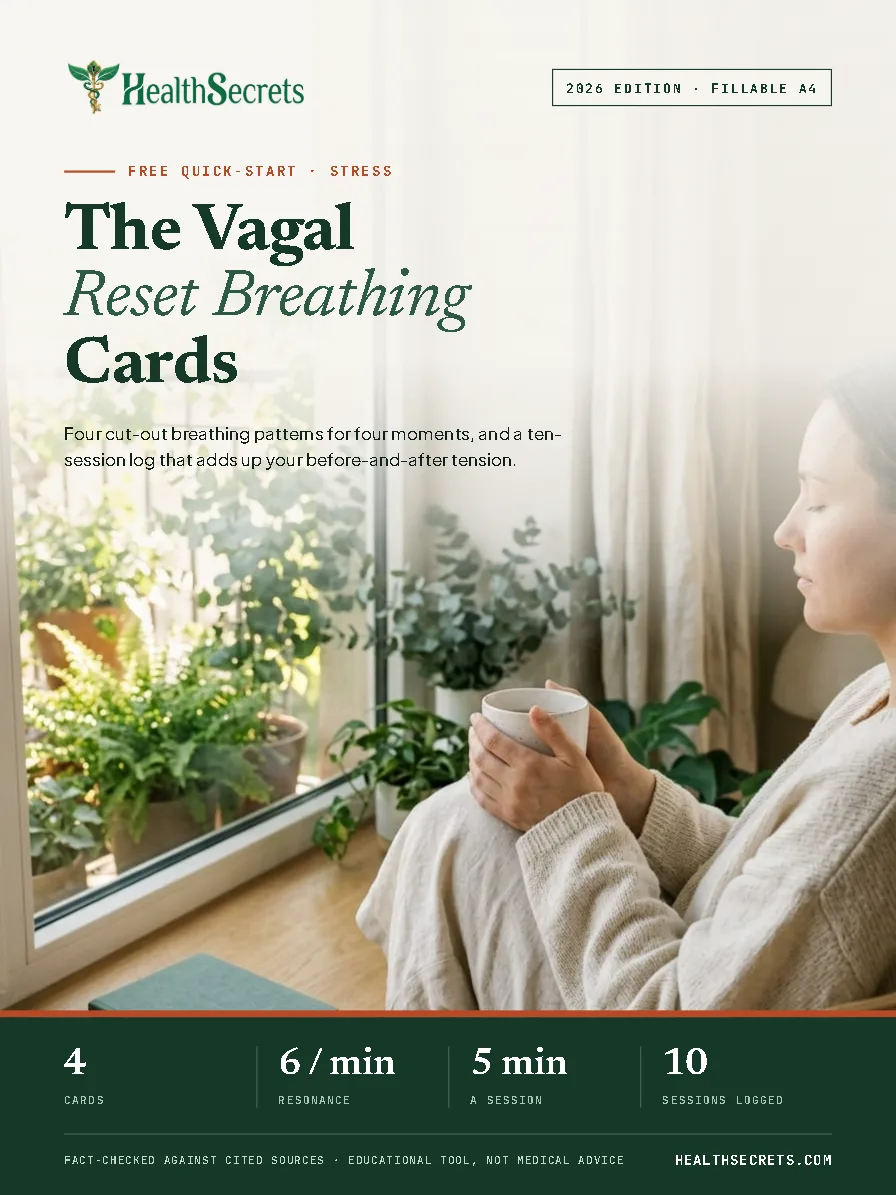
The Vagal Reset Breathing Cards
7 Pages • Free PDF
Free card set 7 pages • fillable PDF

The Vagal Reset Breathing Cards

Four cut-out breathing patterns with exact counts and the moment each fits, a ten-session log that averages your before-and-after tension, and when breathwork is the wrong tool.

The PDF opens in a new tab. Unsubscribe from our emails at any time.

How Did We Evaluate These Mood Supplements?

We ranked supplements using a systematic approach that prioritizes clinical evidence quality, safety profile, accessibility, and real-world practicality. Our evaluation isn't based on marketing claims — it's based on what the peer-reviewed research actually demonstrates.

What Criteria Did We Use?

1. Evidence Quality (40% weight)

  • Number and quality of randomized controlled trials (RCTs)
  • Meta-analyses and systematic reviews available
  • Comparison studies against placebo and active comparators (SSRIs)
  • Consistency of results across studies

2. Safety Profile (25% weight)

  • Severity and frequency of side effects
  • Drug interaction potential
  • Contraindications
  • Long-term safety data

3. Mechanism Clarity (15% weight)

  • Well-understood mechanism of action
  • Targets specific, validated mood pathways
  • Dose-response relationship established

4. Accessibility (10% weight)

  • Cost per month at therapeutic doses
  • Availability and sourcing quality
  • Ease of use and compliance

5. Breadth of Benefit (10% weight)

  • Benefits beyond mood (cognitive, sleep, stress, energy)
  • Complementary effects when combined with other supplements

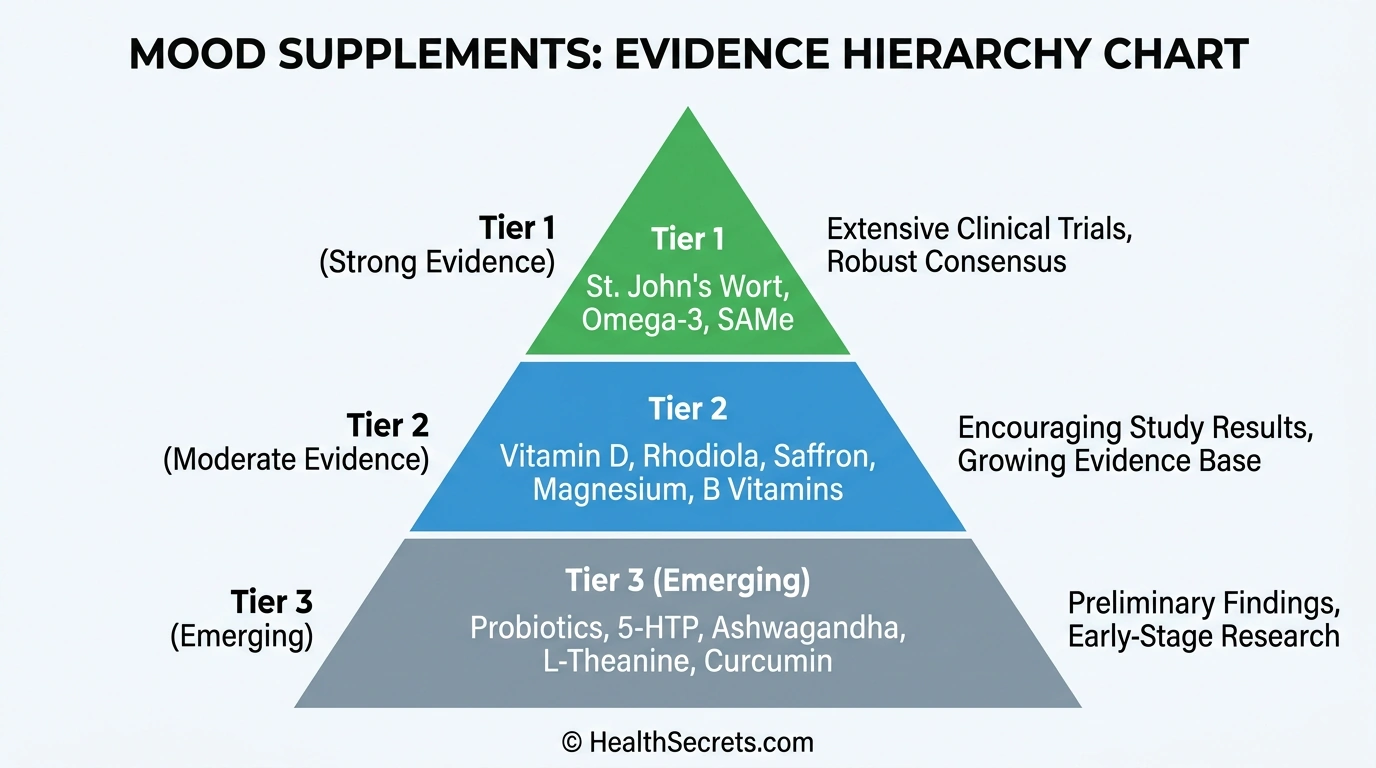
Evidence Tier Rankings

Tier Supplements Evidence Level Key Consideration
Tier 1 (Strong) St. John's Wort, Omega-3 (EPA), SAMe Multiple RCTs, meta-analyses Drug interactions / cost
Tier 2 (Moderate) Vitamin D, Rhodiola, Saffron, Magnesium, B Vitamins Several RCTs, consistent results Best if deficient or stressed
Tier 3 (Emerging) Probiotics, 5-HTP, Ashwagandha, L-Theanine, Curcumin Limited or early-stage RCTs Promising but needs more research
Evidence tier chart ranking mood supplements from strongest to emerging evidence

How Do You Use Mood-Boosting Supplements Effectively?

Even the best-researched supplement won't help if you take it wrong — wrong dose, wrong timing, wrong combination, or unrealistic expectations. Here's how to get the most out of mood supplementation based on what the clinical trials actually used.

What Are the Evidence-Based Doses for Each Supplement?

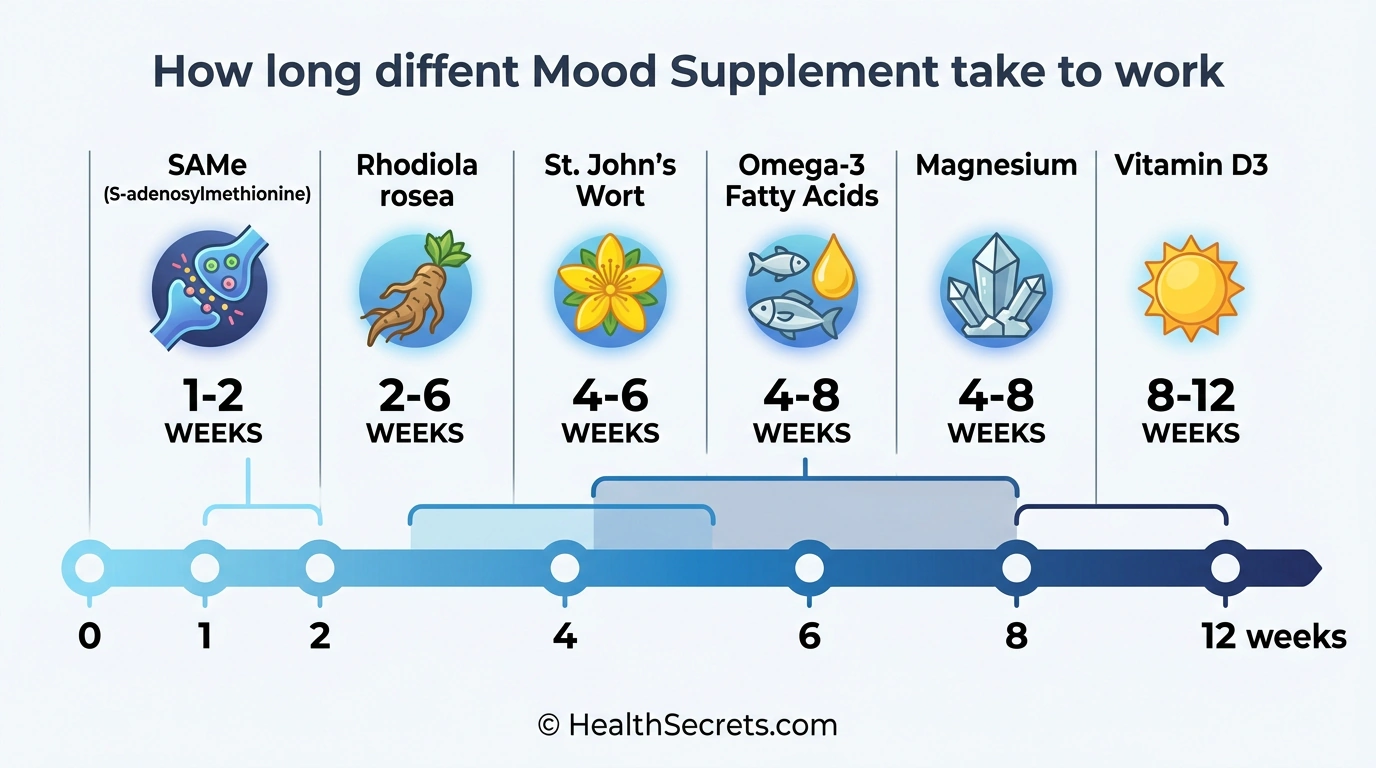
Supplement Daily Dose Timing With Food? Onset
St. John's Wort 900 mg (3×300 mg) Morning, noon, evening Yes 4–6 weeks
Omega-3 (EPA) 1,000–2,000 mg EPA With meals Yes (fat) 4–8 weeks
SAMe 800–1,600 mg Morning, empty stomach No 1–2 weeks
Vitamin D3 1,000–4,000 IU Morning Yes (fat) 8–12 weeks
Rhodiola 200–600 mg Morning, early PM Either 2–6 weeks
Timeline showing how long different mood supplements take to produce effects from 1 week to 12 weeks
### What's the Smart Way to Start?
  1. One supplement at a time — Start a single supplement and use it consistently for 4–6 weeks before evaluating results or adding another
  2. Start at the lower dose — Begin at the low end of the evidence-based range and increase if tolerated and needed
  3. Track your mood — Keep a simple daily rating (1–10) so you can objectively assess changes rather than relying on memory
  4. Respect the timeline — Most supplements take 4–8 weeks for meaningful effects (SAMe is the exception at 1–2 weeks)
  5. Don't stack blindly — Never combine serotonergic supplements (St. John's wort + 5-HTP + antidepressants = serotonin syndrome risk)

Which Combinations Work Well Together?

Evidence-supported combinations:

  • Rhodiola + magnesium + B vitamins (studied together for stress and mood)
  • Omega-3 + vitamin D (different mechanisms, complementary)
  • L-theanine + magnesium (both promote GABA-mediated relaxation)

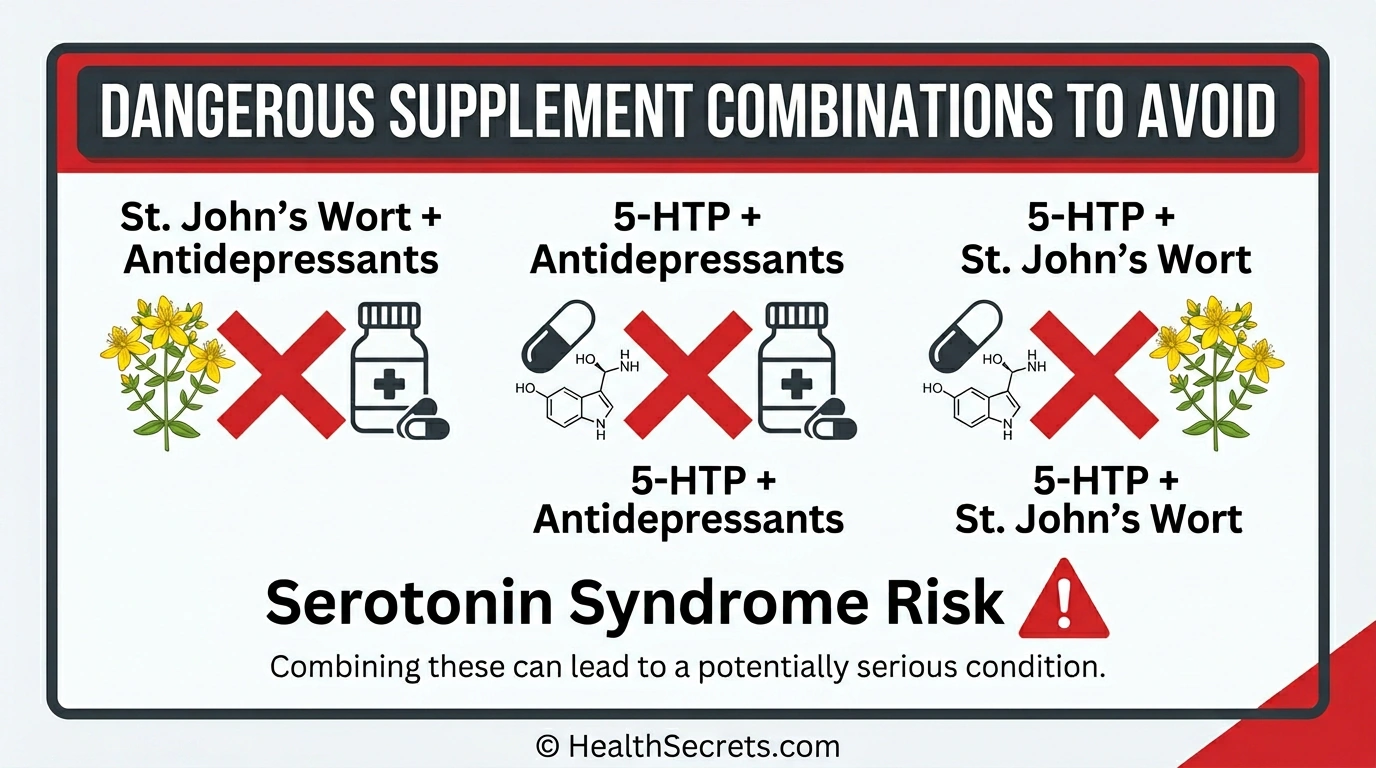
Dangerous combinations to NEVER use:

  • St. John's wort + any antidepressant
  • 5-HTP + any antidepressant
  • 5-HTP + St. John's wort
  • SAMe in bipolar disorder (without psychiatrist supervision)

Are There Safety Concerns with Mood-Boosting Supplements?

Yes — and some of them are serious enough to be life-threatening. While many mood supplements are generally well-tolerated, the safety profile varies dramatically between different options. Understanding drug interactions and contraindications is not optional.

Which Mood Supplements Have the Most Dangerous Interactions?

:::warning[St.

John's Wort — HIGH RISK for drug interactions:] St. John's wort induces CYP3A4 and P-glycoprotein enzymes, which metabolize a huge number of medications. It can reduce the effectiveness of: :::

  • Birth control pills (risk of unintended pregnancy)
  • Blood thinners (warfarin) (increased clotting risk)
  • Immunosuppressants (cyclosporine, tacrolimus) (organ rejection risk)
  • HIV medications (treatment failure)
  • Chemotherapy drugs (reduced efficacy)
  • Antidepressants (serotonin syndrome when combined)
  • Digoxin, statins, alprazolam, and many others

If you take any prescription medication, consult your doctor before using St. John's wort.

5-HTP — MODERATE-HIGH RISK:

  • Serotonin syndrome when combined with SSRIs, SNRIs, MAOIs, or St. John's wort
  • Serotonin syndrome symptoms: agitation, confusion, rapid heart rate, high blood pressure, muscle rigidity — potentially life-threatening

SAMe — CONDITION-SPECIFIC RISK:

  • Contraindicated in bipolar disorder — can trigger manic episodes
  • May increase anxiety in some individuals at high doses
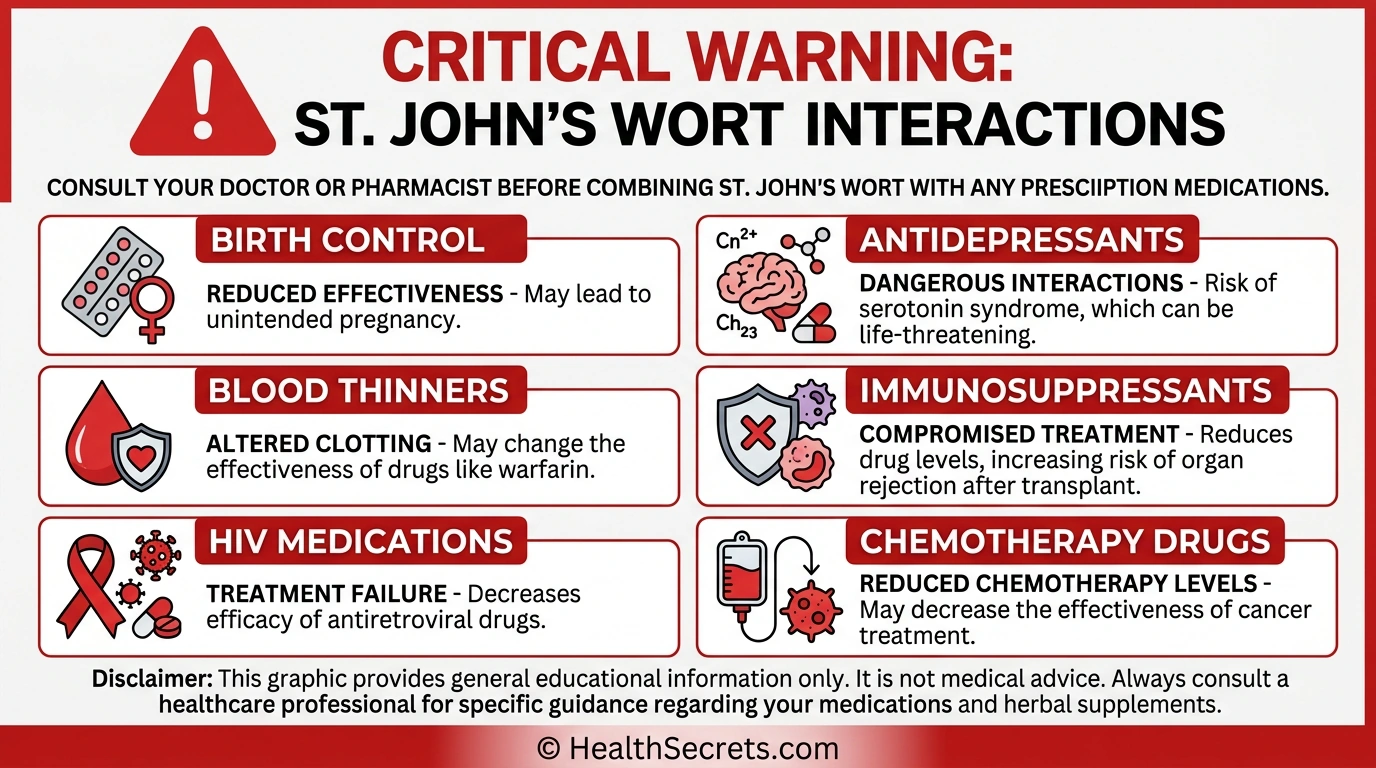
Warning infographic showing major drug interactions with St. John's wort including birth control and antidepressants
Safety graphic showing three dangerous supplement combinations that risk serotonin syndrome

Who Should Avoid Mood Supplements Entirely?

  • Severe depression or suicidal thoughts — Seek immediate professional help. Supplements are not appropriate.
  • Bipolar disorder — SAMe and St. John's wort can trigger mania. Only supplement under psychiatrist supervision.
  • Taking multiple medications — Drug interactions are too complex for self-management.
  • Pregnant or breastfeeding — Insufficient safety data for most mood supplements.
  • Children and adolescents — Most studies are in adults only.

What's the Hierarchy of Care?

Supplements are supportive tools, not primary treatments:

  1. Professional evaluation (rule out medical causes, get proper diagnosis)
  2. Therapy (CBT, other evidence-based approaches)
  3. Lifestyle (exercise, sleep, stress management, nutrition, social connection)
  4. Supplements (supportive, evidence-based options)
  5. Medication (if needed, under doctor supervision)

What's the Best Step-by-Step Plan to Start Mood-Boosting Supplements?

A careful, systematic approach reduces risk and helps you identify what actually works for you. Don't rush — mood supplementation is a process of informed experimentation, not a quick fix.

Phase 1: Assessment (Week 1)

  • Schedule a check-up with your healthcare provider to rule out medical causes of low mood (thyroid, anemia, vitamin deficiencies)
  • Get vitamin D and B12 levels tested — deficiencies are common and easily correctable
  • Review all current medications for potential supplement interactions
  • Establish a mood baseline: rate your mood daily (1–10) for one week before starting anything
  • Identify your primary mood pattern: low energy, anxiety, flat mood, stress-driven, seasonal

Phase 2: Foundation Supplements (Weeks 2–6)

  • Start with the safest, most broadly beneficial options first: vitamin D (if deficient), magnesium glycinate, or a methylated B-complex
  • Take at evidence-based doses consistently for 4 weeks minimum
  • Continue daily mood tracking
  • Address lifestyle fundamentals simultaneously: 30 minutes of movement daily, 7–9 hours of sleep, stress management

Phase 3: Targeted Supplementation (Weeks 7–12)

  • If foundation supplements aren't sufficient, add one targeted option based on your mood profile:
    • Low mood → St. John's wort (if no medication interactions), omega-3 EPA, or SAMe
    • Stress/anxiety → Rhodiola or ashwagandha
    • Seasonal → Increase vitamin D dose (under medical guidance)
  • Continue for 4–6 weeks before evaluating
  • Monitor for side effects and keep your healthcare provider informed

Phase 4: Optimization (Week 13+)

  • Evaluate what's working and discontinue anything that isn't helping
  • Consider evidence-based combinations (rhodiola + magnesium + B vitamins)
  • Re-test vitamin D levels to confirm optimal range (40–60 ng/mL)
  • Integrate with ongoing therapy, lifestyle habits, and professional care
  • Schedule periodic reviews with your healthcare provider

ಶ್ರೇಷ್ಠ ಶಿಫಾರಸು ಮಾಡಲಾದ ಉತ್ಪನ್ನಗಳು

ಮಾರ್ಗಸೂಚಿಯನ್ನು ಬಿಡುವ ಮೊದಲು ಪರಿಶೀಲಿಸಲು ಹೋಲಿಕೆ ಮಾಡಿದ ಪಟ್ಟಿಯ ಕಿರುಪಟ್ಟಿ

8 ವಸ್ತುಗಳು
01

Gaia Herbs St. John's Wort

Gaia Herbs · Adults with mild-to-moderate depression who are NOT taking any prescription medications

ವಿವರಗಳನ್ನು ಹೋಲಿಸಿ
02

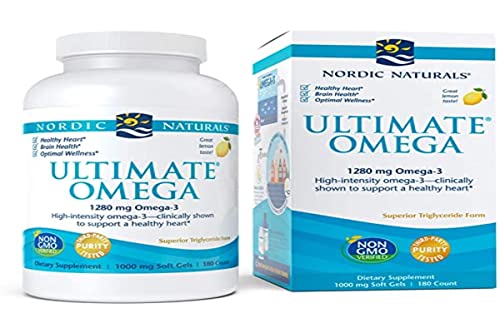
Nordic Naturals Ultimate Omega

Nordic Naturals · Individuals seeking anti-inflammatory mood support with well-researched omega-3 fatty acids

ವಿವರಗಳನ್ನು ಹೋಲಿಸಿ
03

Doctor's Best SAMe 400mg

Doctor's Best · Adults seeking rapid-onset mood support who do NOT have bipolar disorder

ವಿವರಗಳನ್ನು ಹೋಲಿಸಿ
04

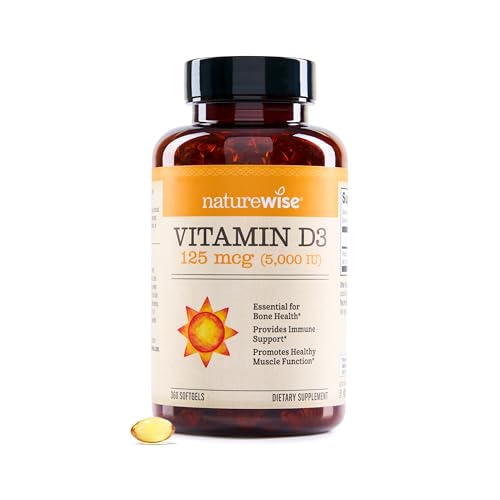
NatureWise Vitamin D3 5000 IU

NatureWise Vitamin · Anyone with vitamin D deficiency or seasonal mood changes — the safest starting point for mood supplementation

ವಿವರಗಳನ್ನು ಹೋಲಿಸಿ
05

Gaia Herbs Rhodiola Rosea

Gaia Herbs · Individuals whose low mood is driven by chronic stress, burnout, or fatigue

ವಿವರಗಳನ್ನು ಹೋಲಿಸಿ
06

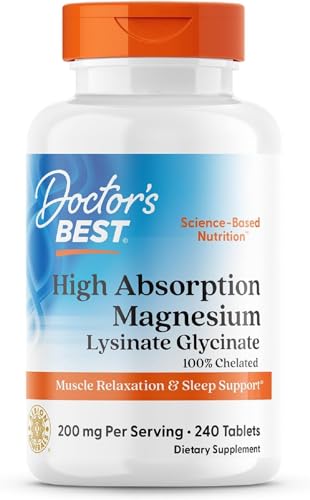
Doctor's Best Magnesium Glycinate 200mg

Doctor's Best · Individuals with anxiety, poor sleep, or stress who need calming mood support

ವಿವರಗಳನ್ನು ಹೋಲಿಸಿ
07

Jarrow Formulas Methyl B-12 & Methyl Folate

Jarrow Formulas · Individuals with B-vitamin deficiency, MTHFR mutations, or elevated homocysteine — foundational mood support

ವಿವರಗಳನ್ನು ಹೋಲಿಸಿ
08

Nootropics Depot Affron Saffron Extract

Nootropics Depot · Individuals willing to invest in a premium supplement with impressive depression research and minimal side effects

ವಿವರಗಳನ್ನು ಹೋಲಿಸಿ

ಯಾವುದೇ ರೀಟೇಲರ್ ಲಿಂಕ್ ಅನ್ನು ತೆರೆಯುವ ಮೊದಲು ಕೆಳಗಿನ ವಿವರವಾದ ವಿಮರ್ಶಾ ಕಾರ್ಡ್‌ಗಳನ್ನು ಓದಿ

ಮುಂದಿನ ಓದಿಗೆ

ಮುಂದಿನ ಓದಿಗೆ

"The Mood Cure"

ಅವರಿಂದ Julia Ross, MA

Detailed mood-type questionnaires to identify your specific neurotransmitter imbalances; targeted supplement protocols for each mood type; understanding of serotonin, dopamine, GABA, and endorphin deficiencies; practical dietary recommendations alongside supplement guidance

ಇದು ಏಕೆ ಇಲ್ಲಿ ಮೌಲ್ಯವನ್ನು ನೀಡುತ್ತದೆ

Ross's mood-type approach aligns perfectly with the evidence-based framework of matching specific supplements to specific neurotransmitter pathways. This is the most practical book on the topic for people considering mood supplements.

ಉತ್ತಮವಾದದ್ದು: Anyone wanting a practical guide to using amino acids and nutrients to improve mood naturally

ಪುಸ್ತಕದ ವಿವರಗಳನ್ನು ನೋಡಿ

ಮುಂದಿನ ಓದಿಗೆ

"Brain Food"

ಅವರಿಂದ Lisa Mosconi, PhD

Neuroscience-based explanation of how specific nutrients affect brain function and mood; evidence on omega-3s, B vitamins, and other nutrients; the gut-brain connection explained; dietary frameworks for optimal mental health

ಇದು ಏಕೆ ಇಲ್ಲಿ ಮೌಲ್ಯವನ್ನು ನೀಡುತ್ತದೆ

Mosconi provides the scientific backbone for understanding why nutritional supplements affect mood — the brain's unique nutritional requirements, how deficiencies impair neurotransmitter production, and what the imaging data actually shows.

ಉತ್ತಮವಾದದ್ದು: Understanding the scientific connections between nutrition, brain chemistry, and mood at a deeper level

ಪುಸ್ತಕದ ವಿವರಗಳನ್ನು ನೋಡಿ

AEO FAQ

ಪದೇ ಪದೇ ಕೇಳಲಾಗುವ ಪ್ರಶ್ನೆಗಳು

10 common questions answered

Based on clinical evidence, St. John's wort has the strongest research showing efficacy comparable to SSRIs for mild-to-moderate depression. However, it has dangerous drug interactions with many common medications. For people on medications, omega-3 fatty acids (high-EPA) and SAMe are evidence-based alternatives recommended as first- or second-line treatments. The "best" choice depends on your specific situation, medication use, and the type of depression you're experiencing.

Some supplements are safe alongside antidepressants, but others are dangerous. NEVER combine St. John's wort or 5-HTP with antidepressants — the risk of serotonin syndrome is real and potentially life-threatening. Omega-3 fatty acids, vitamin D, magnesium, and B vitamins are generally considered safe with antidepressants, but always inform your prescribing doctor about any supplements you're taking.

Most mood supplements require 4–8 weeks of consistent use before meaningful effects appear. SAMe is the notable exception, with studies showing improvements within 1–2 weeks. St. John's wort typically needs 4–6 weeks. Omega-3s may take 4–8 weeks. Vitamin D can take 8–12 weeks, especially if correcting a deficiency. Don't give up after just a few days — consistency is essential.

No — St. John's wort significantly reduces the effectiveness of oral contraceptives by inducing liver enzymes that metabolize the hormones faster. This can lead to contraceptive failure and unintended pregnancy. If you use hormonal birth control, St. John's wort is not an appropriate choice. Consider omega-3s, vitamin D, or magnesium as alternatives with no contraceptive interactions.

Magnesium glycinate, L-theanine, and ashwagandha target both anxiety and mood through GABA support and cortisol reduction. Rhodiola rosea is particularly effective for stress-driven mood issues. The combination of rhodiola, magnesium, and B vitamins has been studied together and shown to reduce stress and improve mood. Omega-3 fatty acids also address both mood and anxiety through anti-inflammatory mechanisms.

Yes, particularly if you're deficient — and roughly 40–50% of US adults are. A 2024 dose-response meta-analysis found that vitamin D3 supplementation significantly reduces depressive symptoms, with each additional 1,000 IU per day producing measurable improvements. The effects are strongest in the first 8 weeks of supplementation. Testing your levels first is recommended — supplementation is most effective when correcting an actual deficiency.

Serotonin syndrome is a potentially life-threatening condition caused by excessive serotonin levels. Symptoms include agitation, confusion, rapid heart rate, high blood pressure, dilated pupils, and muscle rigidity. It can occur when combining serotonergic supplements (St. John's wort, 5-HTP) with antidepressants (SSRIs, SNRIs, MAOIs) or with each other. Never combine these without medical supervision.

No. Supplements are supportive tools that work best alongside — not instead of — professional mental health care. For mild mood issues, supplements combined with lifestyle changes may be sufficient. For moderate-to-severe depression, professional treatment (therapy, medication) should be the primary approach, with supplements as complementary support. Never stop prescribed medication to try supplements without your doctor's guidance.

Start with the safest and most broadly beneficial options: vitamin D (get your levels tested), magnesium glycinate, and a methylated B-complex. These correct the most common deficiencies linked to low mood with minimal risk. If additional support is needed after 4–6 weeks, then consider targeted options like St. John's wort (if no medication conflicts), omega-3 EPA, rhodiola, or SAMe based on your specific mood pattern.

Emerging evidence suggests certain probiotic strains (particularly Lactobacillus and Bifidobacterium species) can improve mood and reduce anxiety through the gut-brain axis. The gut produces about 95% of the body's serotonin, and the microbiome influences inflammation and neurotransmitter production. While the evidence is promising, it's still in the early stages compared to supplements like St. John's wort or omega-3s. Consider probiotics as complementary support, not a primary mood intervention.

The e-book for this topic
Sources cited inside
Stress Recovery Micro-Habits Workbook
31 pages • fillable PDF

Stress Recovery Micro-Habits Workbook

Seven five-minute practices with the evidence for each, a chooser for every kind of moment, and a thirty-day log that shows your baseline settle.

What is inside:

✓ The Stress Response, Explained: The accelerator, the brake and the slower hormonal axis in plain language; what short bursts do and what a stuck accelerator costs; the cortisol day; the signs of a strong brake; and the red flags that mean getting help.
✓ What Works in Five Minutes: Nine practices graded by the evidence, from slow breathing and muscle relaxation to the ones that feel like a break but are not (scrolling, a drink).
✓ Seven Practices, One Page Each: Cyclic sighing, resonance breathing, progressive muscle relaxation, cold water to the face, a ten-minute green walk, worry postponement and a ten-minute body scan: how each works, the steps, the signs it is working, cautions, variations and the trials.
✓ Choosing and Keeping Them: Which practice for which moment, a day that uses them, six habit rules, cues that work and your own if-then plan, plus cut-out cards.
$27$10.80 one payment

PDF e-book + free online edition • 60-day money-back guarantee

🧠

ನಿಮ್ಮ ಜ್ಞಾನವನ್ನು ಪರೀಕ್ಷಿಸಿ

Take our Mental Wellness Quiz and see how much you really know about mental wellness.

ರಸಪ್ರಶ್ನೆ ತೆಗೆದುಕೊಳ್ಳಿ

ಈ ಲೇಖನವು ಉಪಯುಕ್ತವಾಗಿದೆಯೇ?

ಸಂಶೋಧಿಸಿ ಸತ್ಯ-ಪರಿಶೀಲಿಸಲಾಗಿದೆ

HS

ಲೇಖಕ

Health Secrets Editorial Team

The Health Secrets editorial team researches, writes and fact-checks every guide against the primary studies and clinical guidelines it cites.

HS

ಸತ್ಯ-ಪರಿಶೀಲಕರು

Health Secrets Editorial Team

ಎಲ್ಲ ವಿಷಯವೂ ಪುರಾವೆ-ಆಧಾರಿತವಾಗಿದ್ದು, ಪೀರ್-ರಿವ್ಯೂ ಮಾಡಲಾದ ಸಂಶೋಧನೆಯ ವಿರುದ್ಧ ಪರಿಶೀಲಿಸಲಾಗಿದೆ ಮತ್ತು ನಿಯಮಿತವಾಗಿ ನವೀಕರಿಸಲಾಗುತ್ತದೆ. ನಮ್ಮ ಸಂಪಾದಕೀಯ ತಂಡವು ನಿಖರತೆ ಮತ್ತು ಪಾರದರ್ಶಕತೆಗಾಗಿ ಕಠಿಣ ಮಾರ್ಗಸೂಚಿಗಳನ್ನು ಅನುಸರಿಸುತ್ತದೆ.

ಉಲ್ಲೇಖಗಳು & ಸೂಚನೆಗಳು

18 ಉಲ್ಲೇಖಿಸಲಾದ ಮೂಲಗಳು

1
Ng, Q.X., et al. (2017). "Clinical use of Hypericum perforatum (St John's wort) in depression: A meta-analysis." Journal of Affective Disorders, 210, 211–221.
2
Apaydin, E.A., et al. (2016). "A systematic review of St. John's wort for major depressive disorder." Systematic Reviews, 5, 148.
3
Zhao, X., et al. (2023). "The efficacy and safety of St. John's wort extract in depression therapy compared to SSRIs in adults: A meta-analysis." Advances in Clinical and Experimental Medicine, 32(2), 151–161.
4
Linde, K., et al. (2008). "St John's wort for major depression." Cochrane Database of Systematic Reviews, (4), CD000448.
5
Sarris, J., et al. (2016). "Adjunctive nutraceuticals for depression: A systematic review and meta-analyses." American Journal of Psychiatry, 173(6), 575–587.

ಚಿಕಿತ್ಸಾತ್ಮಕ ನಿರಾಕರಣ

This article is for informational purposes only and does not constitute medical advice. Read the full medical disclaimer. Always consult with a qualified healthcare provider before starting any new supplement, treatment, or major dietary change.

Mental Wellness Cornerstone Pillar

The Complete Guide to Mental Wellness

Explore our foundational comprehensive guide covering all clinical protocols, dietary strategies, and evidence for mental wellness.

Read Pillar Guide →

ನಿಮಗೆ ಇಷ್ಟವಾಗಬಹುದು

ಚರ್ಚೆ

0

No comments yet

Be the first to share your thoughts, clinical insights, or questions about this protocol.