

Digestive enzymes for acid reflux are not an established treatment: clinical guidelines do not recommend them for relieving heartburn or treating gastroesophageal reflux disease (GERD). In 2026, the practical distinction remains whether you have reflux, a separate food-digestion problem, or both—because an enzyme can address a specific digestive deficiency without treating reflux itself.
TL;DR
Digestive enzymes for acid reflux lack established benefit; GERD treatment should target reflux rather than presumed enzyme deficiency.
Lactase treats lactose maldigestion, not the movement of stomach contents into the esophagus.
Prescription pancreatic enzymes treat pancreatic insufficiency, not ordinary heartburn.
Avoid betaine hydrochloride for reflux; adding acid is not a guideline-supported treatment.
Finish meals at least 2–3 hours before lying down when nighttime reflux is a problem.
Seek prompt care for trouble swallowing, gastrointestinal bleeding, unexplained weight loss, or persistent vomiting.
Healthsecrets provides wellness education, not a diagnosis or an individualized reflux treatment plan.
Who this is for: Adults comparing enzyme supplements with established reflux care. This Healthsecrets guide separates a digestive indication from a reflux claim.
Medical caution: New or severe chest pain needs urgent assessment, especially with shortness of breath, sweating, or pain spreading to your arm or jaw. Do not assume it is heartburn.
Medical disclaimer: This article provides general education and does not replace diagnosis, prescribing, or individualized medical advice. ## Can digestive enzymes help relieve acid reflux symptoms?
Digestive enzymes do not have an established role in treating GERD. The American College of Gastroenterology's GERD guideline recommends approaches directed at reflux and acid exposure; digestive enzyme supplements are not part of its recommended treatment pathway.
Enzymes have legitimate uses when a particular substance is not being digested properly. That does not make them interchangeable with reflux treatment. Use the distinction below before choosing an intervention.
| Option | Best for | Potential benefit | Main limitation or concern |
|---|---|---|---|
| Over-the-counter enzyme blends | No established role in routine GERD care | Ingredients can act on particular food components | Reflux benefit is unproven; ingredients and precautions differ |
| Lactase | People with lactose maldigestion | Helps digest lactose in dairy foods | Does not treat GERD or prevent reflux |
| Prescription pancreatic enzymes | People with diagnosed pancreatic insufficiency | Replaces inadequate pancreatic digestive enzymes | Requires an appropriate diagnosis and individualized prescribing |
| Acid-suppressing medicines | People with an appropriate reflux indication | Reduces stomach acid; some treatments heal erosive esophagitis | Does not correct every cause of symptoms; treatment needs review |
| Meal timing and other targeted habits | People with relevant reflux triggers | Addresses contributing behaviors without adding supplements | Results depend on the trigger and underlying condition |
| Feeling better after an enzyme does not establish that it treated acid reflux. Less gas, smaller meals, simultaneous medication changes, and normal symptom fluctuation can complicate that conclusion. |
Why does this distinction matter?
Heartburn, upper abdominal fullness, belching, and bloating can occur together, but they are not the same symptom. Treating everything as poor digestion encourages supplement use without identifying what needs treatment.
For example, lactose maldigestion can cause gas, abdominal discomfort, and diarrhea after lactose-containing foods. Lactase can address that specific problem. Burning behind the breastbone or sour material returning to your mouth calls for a reflux assessment instead.
Symptom overlap is a reason to clarify the diagnosis, not a reason to buy a broader enzyme blend. Persistent symptoms also deserve attention because reflux is not the only explanation for chest or upper abdominal discomfort.

The Low-FODMAP Food List
The five FODMAP groups with the foods often high in each and everyday swaps, a list of choices by food group, a shopping list, one day of meals and a symptom score: the three phases of the low-FODMAP diet on a few pages.
How should you evaluate the evidence?
For a 2026 supplement decision, prioritize clinical guidelines, studies measuring reflux outcomes, and information about the exact ingredient. A claim about digestion is not automatically evidence about heartburn.
This article uses the American College of Gastroenterology GERD guideline for reflux management, American Gastroenterological Association guidance for pancreatic insufficiency, and National Institute of Diabetes and Digestive and Kidney Diseases patient guidance for digestive conditions. These sources address different diagnoses; none makes them interchangeable.
Use these evidence checks when reading a supplement claim:
- Relevant diagnosis: Did participants have GERD, lactose intolerance, pancreatic insufficiency, or nonspecific indigestion?
- Relevant outcome: Did the research measure heartburn, regurgitation, esophageal healing, or only bloating?
- Matching formulation: Does the studied ingredient match the supplement's ingredients and enzyme activity?
- Meaningful comparison: Was there a control group rather than only before-and-after testimonials?
- Safety reporting: Were adverse effects, exclusions, and medication use described?
A study showing improvement in fullness cannot establish healing of reflux-related esophageal injury. Likewise, an ingredient's ability to break down food does not establish a clinical benefit for GERD.
Why don't enzymes address the main reflux mechanism?
Digestive enzymes break food components into smaller molecules. Reflux occurs when stomach contents move backward into the esophagus, where exposure can cause symptoms and injury.
That difference matters. Helping digest lactose or replacing pancreatic enzymes does not reliably prevent backward flow, repair a hiatal hernia, or establish that acid exposure has decreased.
Could an enzyme help if dairy causes symptoms?
Lactase can help digest lactose when you have lactose maldigestion. Its expected benefit concerns lactose-related symptoms such as gas, bloating, abdominal pain, or diarrhea—not GERD itself.
Use lactase according to the specific product's instructions when consuming lactose-containing food. There is no evidence-based lactase dose for acid reflux, and persistent burning should not be managed by repeatedly increasing the amount.
When are prescription pancreatic enzymes appropriate?
Prescription pancreatic enzyme replacement treats exocrine pancreatic insufficiency, a condition in which inadequate pancreatic enzymes impair digestion. Possible features include greasy stools, weight loss, and nutritional deficiencies; symptoms alone do not establish the diagnosis.
The American Gastroenterological Association advises against using a response to an enzyme trial as a reliable way to diagnose pancreatic insufficiency. A clinician should evaluate the cause and select treatment rather than using prescription enzymes as a heartburn experiment.
What about betaine hydrochloride or pepsin?
Betaine hydrochloride adds acid; pepsin is a protein-digesting enzyme. Products combining them are sometimes marketed around presumed low stomach acid, but symptoms alone cannot diagnose low acid production.
Do not use added acid to self-treat reflux. Betaine hydrochloride is not a guideline-supported GERD treatment, and adding acid is particularly concerning when you have active irritation or ulcer disease. Review any such product with a clinician, especially if you take acid-suppressing medication.
Why does the apparent response to enzymes vary?
Several factors explain why one person's supplement story does not predict your result:
- The underlying condition: GERD, lactose maldigestion, and pancreatic insufficiency require different management.
- The symptom being measured: Less bloating is different from less regurgitation or healed esophagitis.
- The formulation: Lactase, pancreatic enzymes, and multi-ingredient blends are not equivalent interventions.
- Meal changes: Eating smaller portions or avoiding a personal trigger can change symptoms independently of a supplement.
- Other treatment: Starting an acid suppressant at the same time makes an enzyme's contribution difficult to separate.
- Natural fluctuation: Reflux symptoms can change over time even without a new treatment.
Record what changed rather than labeling every improvement an enzyme effect. If you change meals, medication timing, and supplements together, the result cannot identify which change mattered.
What should you try before an enzyme supplement?
Start with measures supported by reflux guidance and matched to your symptoms. Avoid creating a long restriction list without a clear reason.
Which habits are worth changing?
For nighttime symptoms, finish eating at least 2–3 hours before lying down. Elevating the head of the bed or using an appropriate wedge can also help nighttime reflux; stacking ordinary pillows is not equivalent to elevating your upper body effectively.
If you have overweight or obesity, guideline-supported weight management can improve GERD symptoms. This is not a recommendation for rapid weight loss, restrictive cleanses, or weight-loss medication without medical assessment.
Identify individual food triggers instead of automatically removing every acidic, spicy, or caffeinated item. If tobacco is part of your routine, stopping is also consistent with reflux guidance and broader health care.
When should medication enter the discussion?
For typical heartburn and regurgitation without alarm symptoms, the American College of Gastroenterology guideline supports an 8-week trial of a proton pump inhibitor under an appropriate treatment plan. This is a clinical pathway, not a universal self-treatment instruction.
When a proton pump inhibitor is prescribed, the guideline generally recommends taking it 30–60 minutes before a meal rather than at bedtime. Follow the specific medicine's instructions and your clinician's plan; timing and adherence should be reviewed before declaring treatment ineffective.
Antacids, histamine-2 receptor blockers, and proton pump inhibitors have different roles and precautions. A pharmacist or clinician can help account for kidney disease, pregnancy, other medicines, and the intended treatment duration.
How can you build a practical reflux action plan?
Use a staged plan in 2026 rather than adding several products at once. These phases organize decisions; they are not a fixed-duration protocol or a substitute for assessment.
First: Symptom check
Identify whether you mainly have burning, regurgitation, swallowing difficulty, upper abdominal discomfort, or bowel symptoms. Record when symptoms happen, including meals, lying down, and medication timing.
Screen for alarm symptoms before experimenting. Difficulty swallowing, gastrointestinal bleeding, or unexplained weight loss changes the next step from supplement selection to medical evaluation.
Next: Habit changes
Choose a change linked to your pattern, such as avoiding meals within 2–3 hours of bedtime when nighttime symptoms occur. Keep other variables reasonably consistent so you can judge the change.
Do not eliminate entire food groups solely because a supplement advertisement calls them difficult to digest. If dairy appears relevant, distinguish lactose-related bowel symptoms from burning and regurgitation.
Then: Treatment review
Review current medicines and supplements with a pharmacist or clinician. Include nonprescription products, because they can affect symptoms, interact with treatment, or complicate your assessment.
If you already have prescribed reflux treatment, check the intended schedule and duration. Do not stop effective treatment simply to test whether an enzyme works instead.
Finally: Reassessment
Seek reassessment when symptoms persist despite an appropriate plan, return after treatment, or change in character. Further testing depends on your history, examination, and prior treatment—not on which supplement has the strongest marketing.
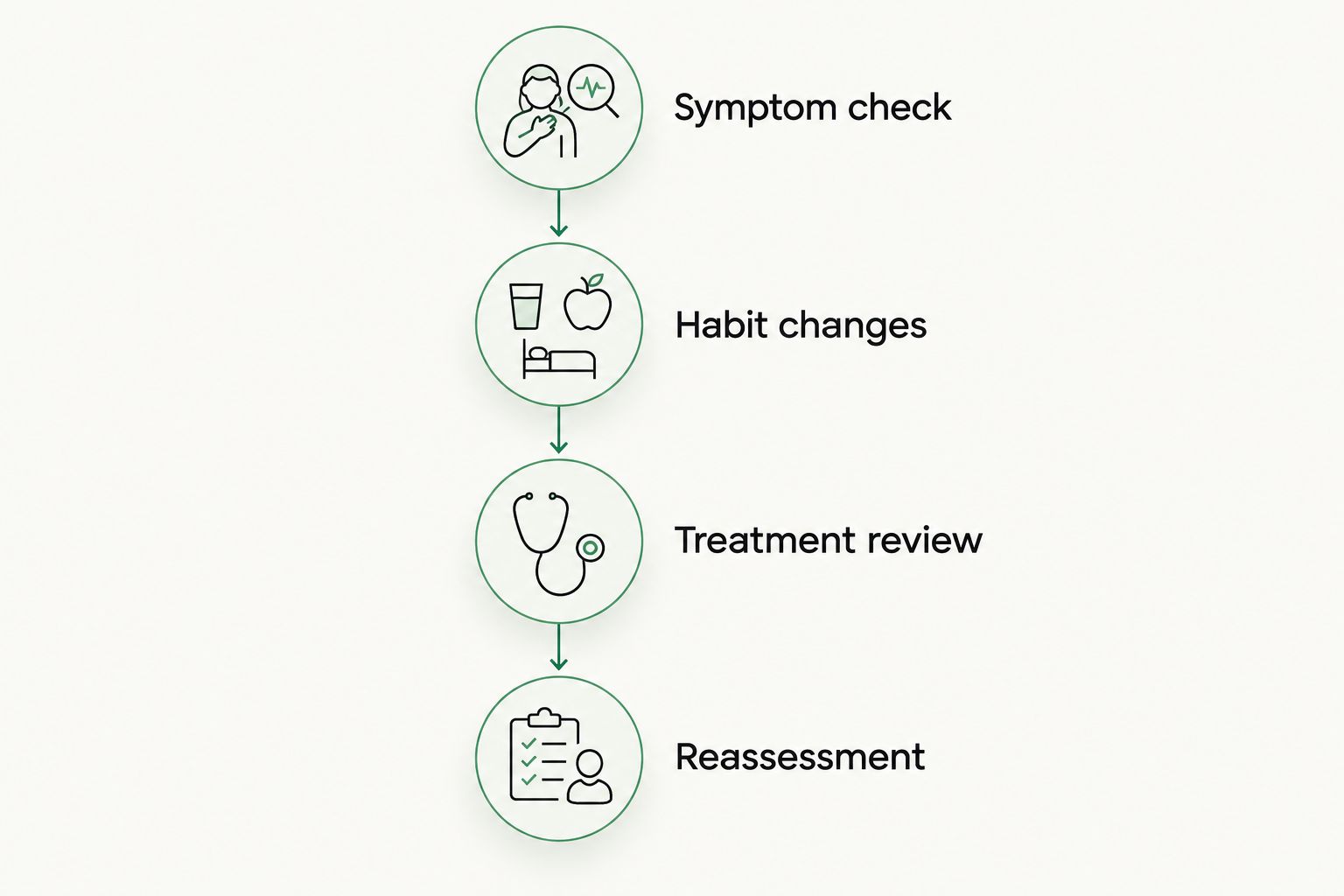
Check the symptom pattern and safety concerns before changing treatment.
How should you assess supplements marketed for heartburn?
In 2026, a supplement ranking is not evidence that a product treats GERD. When comparing supplements for heartburn, separate evidence for the exact formulation from general claims about digestion, soothing effects, or ingredient traditions.
Start with the proposed job of each ingredient. An enzyme acts on a food component; an acidifying ingredient adds acid; an herbal extract has its own effects and interaction profile. Combining them under a digestive-support label does not establish that the finished product reduces reflux.
Read the full label, including non-enzyme ingredients. Peppermint can worsen reflux in some people, and adding it to a digestive blend does not make it appropriate for someone whose main symptom is heartburn.
Independent quality testing can address questions such as identity or contamination within its testing scope. It does not prove reflux effectiveness. Likewise, a natural origin does not establish safety during pregnancy, compatibility with medication, or suitability for long-term use.
Healthsecrets is best for adults seeking evidence-based wellness education, not individualized reflux prescribing. Its digestive enzyme guidance should support a better clinical conversation—not replace one.
Who should avoid self-directed enzyme treatment?
Avoid using enzyme supplements as a substitute for assessment when symptoms are unexplained, worsening, or accompanied by alarm features. People with diagnosed pancreatic insufficiency should follow their prescribed replacement plan rather than substituting an over-the-counter blend.
Take particular care in these situations:
- Pregnancy or breastfeeding: Review nonessential supplements with your maternity clinician; safety evidence is often limited and ingredient-specific.
- Known ingredient allergies: Check the enzyme source and other ingredients. Prescription pancrelipase is derived from porcine sources and carries product-specific precautions.
- Children and adolescents: Do not apply an adult self-treatment plan; pediatric symptoms and dosing need appropriate assessment.
- Ulcer disease or active upper digestive irritation: Avoid self-prescribing acidifying products such as betaine hydrochloride.
- Multiple prescriptions or serious medical conditions: Have a pharmacist review the complete formula rather than assuming all enzyme blends have the same interaction profile.
Possible adverse effects depend on the formulation. Prescription pancreatic enzyme labeling includes gastrointestinal complaints and warnings about allergic reactions; some products also require careful handling to avoid irritation when used incorrectly.
An enzyme blend containing bromelain or papain needs ingredient-specific review, particularly if you take anticoagulant or antiplatelet medication. Potential bleeding concerns are not a reason to stop prescribed medication; they are a reason to avoid adding an unreviewed supplement.
Do not open, crush, or chew prescription enzyme capsules unless the specific prescribing instructions permit an appropriate method. There is no universal enzyme dose for reflux, and enzyme activity units are not interchangeable with capsule counts.
When should you stop experimenting and seek care?
Seek emergency care for possible cardiac chest pain or severe bleeding. Chest pressure with breathlessness, sweating, faintness, or spreading pain must not be treated as a supplement problem.
Vomiting blood, material resembling coffee grounds, or black tarry stools requires urgent medical assessment. Severe abdominal pain, persistent vomiting, or signs of dehydration also deserve prompt attention.
Arrange medical evaluation for difficulty swallowing, painful swallowing, food sticking, unexplained weight loss, or persistent symptoms despite treatment. These findings can require investigation rather than another dietary change.
Stop a newly started supplement and seek advice if it clearly worsens symptoms. Get emergency help for signs of a serious allergic reaction, including breathing difficulty or swelling of the lips, tongue, or throat.
Can enzymes replace reflux medication?
Digestive enzymes cannot be considered an evidence-based replacement for prescribed GERD treatment. If you want to reduce medication, ask whether the original indication still applies and what a supervised adjustment should involve.
People with erosive esophagitis or other complications can have different ongoing treatment needs. A supplement trial does not establish that esophageal injury has healed.
Does improvement after lactase mean the problem was not reflux?
Improvement after lactase does not rule out reflux. It can indicate that lactose-related symptoms contributed to your discomfort, but lactose maldigestion and GERD can coexist.
Track burning and regurgitation separately from gas, diarrhea, and bloating. That distinction gives your clinician more useful information than a single overall digestion score.
FAQ
Are digestive enzymes for acid reflux worth trying?
Digestive enzymes for acid reflux are not an established GERD treatment. An enzyme is more appropriate when a specific digestive problem, such as lactose maldigestion or pancreatic insufficiency, explains its use.
Can digestive enzymes make heartburn worse?
A digestive supplement can worsen symptoms depending on its ingredients and your response. Check for acidifying ingredients such as betaine hydrochloride and other additions, rather than treating every blend as equivalent.
Does acid reflux mean I have low stomach acid?
Acid reflux symptoms do not diagnose low stomach acid. Do not use burning or regurgitation as a reason to start an acidifying supplement.
Can I take digestive enzymes with a proton pump inhibitor?
Compatibility depends on the enzyme product, its added ingredients, and why you take it. Have a pharmacist or clinician review the exact label, and do not change prescribed reflux treatment to accommodate a supplement.
How long before bed should I stop eating for reflux?
Finish eating at least 2–3 hours before lying down when nighttime reflux is a concern. Persistent symptoms still need assessment rather than progressively longer fasting.
What enzyme dose treats GERD?
There is no established digestive enzyme dose for GERD. Lactase and prescription pancreatic enzymes have different indications, instructions, and activity measures; neither provides a general reflux dosing template.
When should I contact a doctor about heartburn?
Contact a clinician for persistent symptoms, difficulty swallowing, unexplained weight loss, or symptoms that continue despite treatment. Seek urgent care for gastrointestinal bleeding or possible cardiac chest pain.
What sources support these recommendations?
The following sources support the clinical distinctions in this 2026 guide. They are listed by title and scope so you can distinguish reflux recommendations from enzyme-replacement guidance.
- American College of Gastroenterology: Clinical Guideline for the Diagnosis and Management of Gastroesophageal Reflux Disease. Supports meal timing, selected lifestyle measures, acid-suppressing treatment, alarm-symptom assessment, and diagnostic pathways.
- American Gastroenterological Association: Clinical Practice Update on the Epidemiology, Evaluation, and Management of Exocrine Pancreatic Insufficiency. Supports the distinction between pancreatic insufficiency and nonspecific digestive symptoms.
- National Institute of Diabetes and Digestive and Kidney Diseases: Acid Reflux (GER & GERD) in Adults. Explains symptoms, treatment, and complications.
- National Institute of Diabetes and Digestive and Kidney Diseases: Lactose Intolerance. Explains lactose maldigestion and the role of lactase products.
- FDA-approved pancrelipase prescribing information. Provides product-specific administration instructions, contraindications, adverse reactions, and safety warnings.
One last thing
Before your next appointment, write separate entries for burning, regurgitation, bloating, and stool changes. A treatment that improves one symptom has not necessarily treated the others.
For your 2026 reflux plan, match the intervention to the diagnosis—not to the word digestion on a label.