Skip to content
Health Secrets
← All Tools

Supplement Dosage Calculator

Supplement dosing is not one-size-fits-all. The optimal dose depends on your body weight, existing nutrient levels, health goals, and potential interactions with medications or other supplements. Under-dosing wastes money (no therapeutic effect), while over-dosing certain nutrients — particularly fat-soluble vitamins A, D, E, and K — can cause toxicity. Evidence-based dosing targets the range shown effective in clinical trials while staying below established upper limits.

Metric

Evidence-Based Supplement Dosing

Supplement dosing is not one-size-fits-all. The optimal dose depends on your body weight, existing nutrient levels, health goals, and potential interactions with medications or other supplements. Under-dosing wastes money (no therapeutic effect), while over-dosing certain nutrients — particularly fat-soluble vitamins A, D, E, and K — can cause toxicity. Evidence-based dosing targets the range shown effective in clinical trials while staying below established upper limits.

Key Facts

  • Fat-soluble vitamins (A, D, E, K) accumulate in body fat and CAN reach toxic levels
  • Water-soluble vitamins (B, C) are excreted daily and rarely cause toxicity at normal doses
  • Magnesium absorption decreases above 200mg per dose — split large doses across the day
  • Vitamin D requires 2-3 months at consistent dosing to reach steady-state blood levels
  • Taking iron with vitamin C increases absorption by 2-3x; taking it with calcium blocks absorption
  • The effective dose in research often differs from the amount listed on supplement labels

Bioavailability: Why the Form of a Supplement Matters

Bioavailability — the fraction of a nutrient that reaches systemic circulation in active form — varies enormously between supplement forms. Magnesium oxide has only 4% bioavailability vs magnesium glycinate at 80%. Curcumin alone has <1% absorption but with piperine (BioPerine) it increases 2000%. Methylcobalamin (B12) is immediately usable vs cyanocobalamin which requires liver conversion. CoQ10 as ubiquinol is 2-6x better absorbed than ubiquinone. When calculating doses, the form matters as much as the amount — 500mg of a poorly absorbed form may deliver less active compound than 200mg of a highly bioavailable one.
The e-book for this topic
Sources cited inside
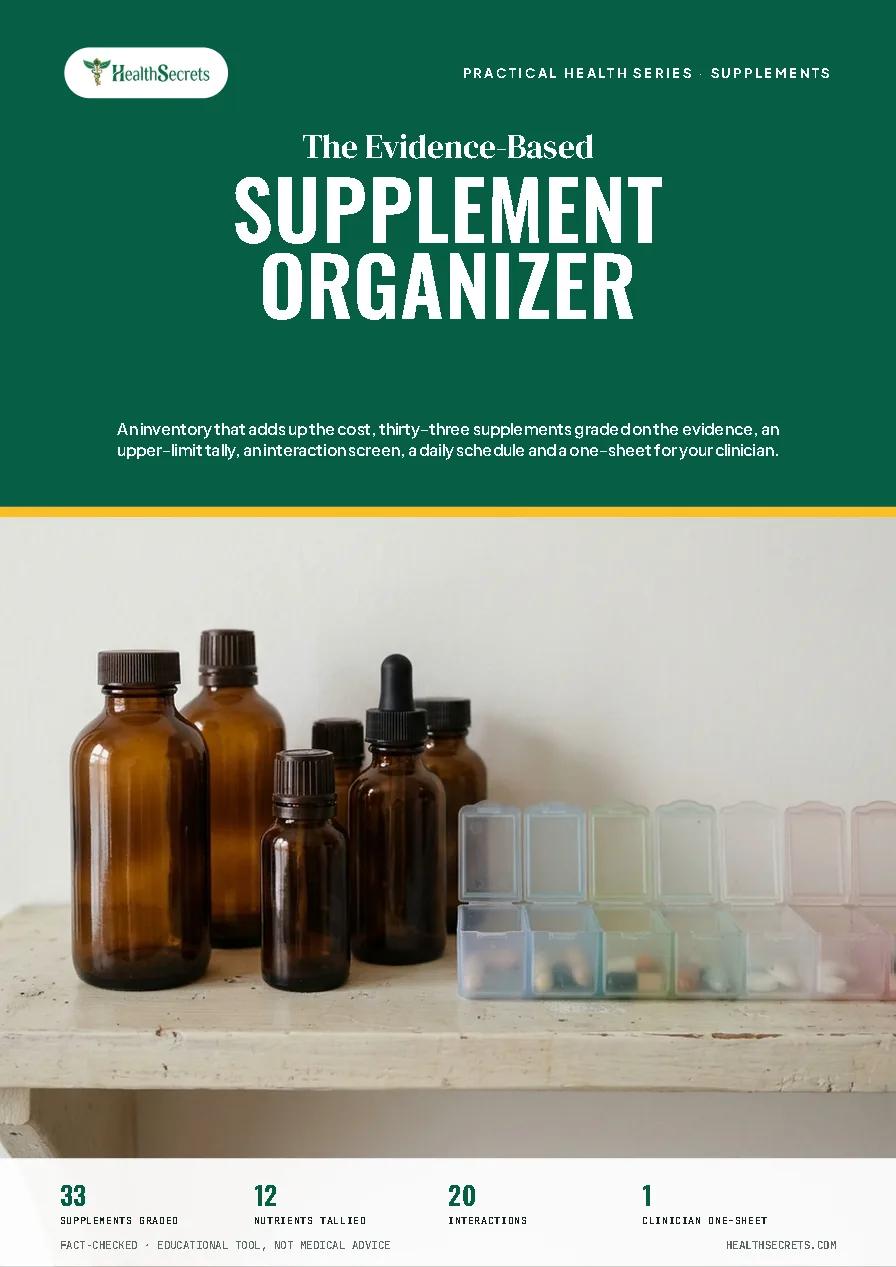
Evidence-Based Supplement Organizer & Safety Log
46 pages • fillable PDF

Evidence-Based Supplement Organizer & Safety Log

A cabinet inventory that adds up the cost, 33 supplements graded A to D, a tally of 12 nutrients against the upper limit, and a one-sheet for your doctor or pharmacist.

What is inside:

✓ The Audit and the Label: Three questions every bottle must answer, an inventory that adds up your monthly and yearly cost, how to read a Supplement Facts panel, and label math that converts compounds and units for you.
✓ 33 Supplements, Graded: From the multivitamin and vitamin D to berberine, ashwagandha and red yeast rice: forms, usual doses, upper limits, what the trials found, safety and stacking, each graded A to D.
✓ Is It What It Says?: Six seal programs compared, which seal fits which need, six myths about seals, how to read a certificate of analysis, and nine recalls that shaped the rules.
✓ Adding It Up: 16 upper limits and where the extra comes from, a tally that adds every source of 12 nutrients and marks each one under, near or over the limit, and six sample cabinets worked through.
$37 one payment

PDF e-book + free online edition • 60-day money-back guarantee

Frequently Asked Questions

How do I know what dose to take? +

Start with the dose shown effective in clinical research (not the label suggestion, which is often lower for liability). Then adjust: body weight (heavier people often need more), blood test results (if deficient, use loading doses), and individual response (some people are sensitive to standard doses).

Can I take all my supplements at once? +

Not ideally. Some compete for absorption (iron + calcium, zinc + copper). Fat-soluble vitamins need dietary fat for absorption (take with meals). Magnesium and zinc are best taken in the evening. Divide into 2-3 groups: morning with breakfast, and evening with dinner.

What supplements interact with medications? +

Common interactions: fish oil + blood thinners (increased bleeding risk), St. John's Wort + antidepressants/birth control (reduced effectiveness), vitamin K + warfarin (counteracts the drug), magnesium + antibiotics (reduced absorption). Always check interactions with a pharmacist.

Should I take supplements every day or cycle them? +

Depends on the supplement. Basics (D3, magnesium, omega-3) are safe daily long-term. Adaptogens (ashwagandha, rhodiola) benefit from 5-days-on/2-days-off or 8-weeks-on/2-weeks-off cycling. Fat-soluble vitamins should be periodically checked via blood tests to avoid accumulation.

Recommended Reading

Best Immune Boosting Supplements: Top 10 Science-Backed Options

Best Immune Boosting Supplements: Top 10 Science-Backed Options

Discover the best immune boosting supplements backed by clinical research. We reviewed dozens of products to find the top 10 science-backed options for vitamin C, D, zinc, elderberry, NAC, and mushroom immune support in 2025.

read article

Probiotics and Prebiotics: Complete Supplement Guide

Probiotics and Prebiotics: Complete Supplement Guide

Choosing the right probiotic or prebiotic supplement can transform your gut health, but with thousands of products available, finding what actually works requires understanding strains, CFU counts, and delivery mechanisms. This evidence-based guide reviews the top 11 probiotic, prebiotic, and synbiotic supplements for 2025, with detailed comparisons to help you find your ideal match.

read article

Milk Thistle for Liver Health: Silymarin Guide

Milk Thistle for Liver Health: Silymarin Guide

Milk thistle (silymarin) is one of the most evidence-backed herbal supplements for liver health. This comprehensive guide covers how silymarin protects liver cells, clinical evidence for fatty liver and hepatitis, dosing by condition, bioavailability solutions, and how to choose a quality supplement.

read article

Supplement Timing and Absorption: When to Take What

Supplement Timing and Absorption: When to Take What

Taking supplements at the right time can dramatically change how well your body absorbs them. This guide breaks down exactly when to take each type of supplement — from fat-soluble vitamins with meals to magnesium before bed — so you get the most from every capsule.

read article

B Vitamins Complete Guide: Energy and Nervous System

B Vitamins Complete Guide: Energy and Nervous System

B vitamins are a family of eight water-soluble nutrients that serve as essential cofactors in over 100 enzymatic reactions — from converting food into cellular energy to synthesizing neurotransmitters, building myelin sheaths around nerves, and regulating homocysteine for cardiovascular protection. This complete guide covers every B vitamin individually, explains methylated forms and the MTHFR polymorphism affecting 40% of the population, provides evidence-based dosing, and reviews the best supplements.

read article

Supplements Guide: Complete Evidence-Based Reference

Supplements Guide: Complete Evidence-Based Reference

With thousands of dietary supplements on the market, choosing the right ones can feel overwhelming. This evidence-based supplements guide breaks down the science behind vitamins, minerals, and popular supplements — helping you make informed decisions about what actually works, what to avoid, and how to build a safe, effective supplement routine.

read article

Stay Ahead of Health Science

Get evidence-based health insights, calculator updates, and weekly longevity guides delivered to your inbox.

Supplement Storage & Essentials

Keep your supplements organized and properly dosed.

As an Amazon Associate, Health Secrets earns from qualifying purchases. Product links open on Amazon, where current pricing and availability are displayed. We only feature products discussed in our editorial guides.

We value your privacy

We use cookies to enhance your browsing experience, serve personalized content, and analyze our traffic. By clicking "Accept All", you consent to our use of cookies.