If you have ever tried to meditate and felt like you were doing it wrong because your mind would not stop racing, you are not alone. That experience is not failure. It is exactly what meditation is designed to work with.
Meditation is one of the most thoroughly researched mental health practices in modern science, with over 5,000 years of history across Buddhist, Hindu, and Taoist contemplative traditions, and now backed by thousands of peer-reviewed studies. A landmark JAMA Internal Medicine meta-analysis of 47 clinical trials found that mindfulness meditation programs produced moderate evidence for reducing anxiety, depression, and pain [1]. More recently, a 2022 randomized clinical trial published in JAMA Psychiatry demonstrated that Mindfulness-Based Stress Reduction (MBSR) was as effective as the gold-standard antidepressant escitalopram for treating anxiety disorders [2].
The best part? You do not need any special equipment, a particular belief system, or even a quiet room. You can start with just 5 to 10 minutes a day, sitting in a chair, focusing on your breath. Research shows that 8 weeks of brief daily meditation (as little as 13 minutes) significantly improves attention, working memory, mood, and emotional regulation [3].
This guide covers everything you need to start and sustain a meditation practice: eight types of meditation explained, a step-by-step mindfulness protocol, solutions to every common obstacle, the science behind brain changes, and a progressive action plan from your first 5 minutes to a lifelong habit.
Related reading: mental wellness strategies | sleep optimization guide | improve focus naturally | lower cortisol naturally | neuroplasticity and brain rewiring
What Do You Need to Know Before Starting Meditation?
Meditation is a mental training practice that cultivates attention, present-moment awareness, and emotional resilience. You do not need to clear your mind, sit in a special position, or follow any religious tradition. The only requirement is a willingness to sit quietly, pay attention to something (usually your breath), and gently return your focus when your mind wanders.
What Is Meditation?
Meditation is the practice of training your attention and awareness through specific techniques such as breath focus, mantra repetition, body scanning, or compassion cultivation. The goal is not to stop thinking but to change your relationship with your thoughts, becoming an observer rather than being swept away by every mental event [5].
Who Is This Guide For?
This guide is designed for complete beginners who have never meditated, people who tried meditation and gave up because they thought they were doing it wrong, and anyone looking for an evidence-based, non-religious approach to meditation. No prior experience or flexibility is required.
What to Expect
- Week 1: Feeling awkward and restless is normal. You are building a new habit.
- Weeks 2 to 4: Settling becomes slightly easier. Brief moments of calm begin to appear.
- Weeks 4 to 8: Measurable improvements in attention, mood, and stress response. Brain structural changes begin.
- Months 3+: Practice feels natural. Sustained benefits in emotional regulation and stress resilience.
How Do You Choose the Right Type of Meditation?
For beginners, mindfulness meditation with breath focus is the ideal starting point because it is the simplest technique, requires no training or equipment, and has the strongest research base. Once you are comfortable, you can explore other types to find what resonates most with your goals.
Mindfulness Meditation (Best for Beginners)
Present-moment awareness using the breath as an anchor. You observe thoughts, feelings, and sensations without judgment. When your mind wanders, you notice and gently return to the breath. This is the foundation of MBSR and the most extensively researched form of meditation [4].
Loving-Kindness Meditation (Metta)
Compassion cultivation using phrases like "May I be happy, may I be healthy, may I be safe." You gradually extend these wishes from yourself to loved ones, neutral people, difficult people, and all beings. Best for increasing positive emotions and reducing self-criticism.
Body Scan Meditation
Progressive attention through each body part from toes to head, noticing sensations without judgment. Excellent for relaxation, sleep preparation, and developing body awareness.
Breath Awareness Meditation
Pure focus on breath sensations (air in nostrils, chest rising, belly expanding) without trying to control the breath. A simplified form of mindfulness that works well as a gateway practice.
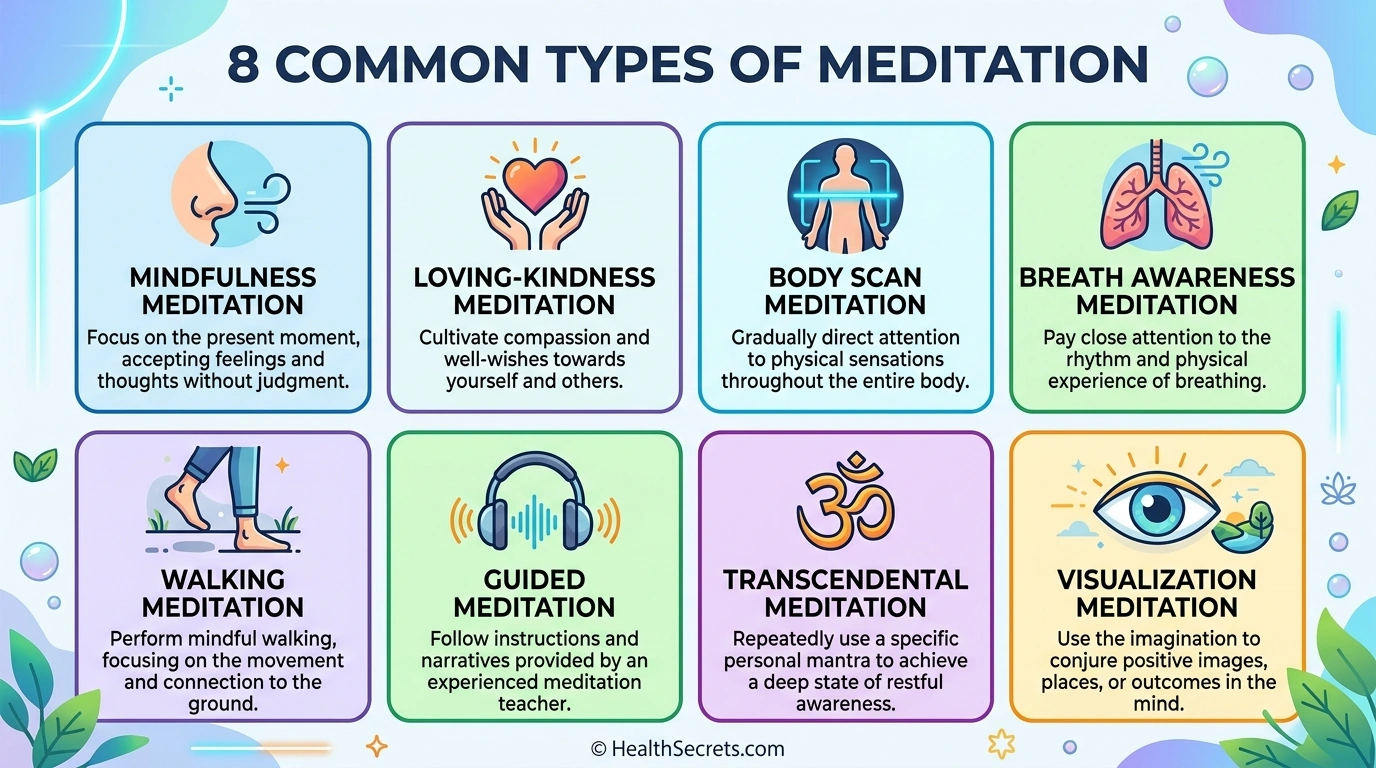
Walking Meditation
Mindful, slow walking with attention on the sensations of lifting, moving, and placing each foot. Ideal for people who find sitting meditation difficult due to restlessness.
Guided Meditation
Audio-led practice using apps like Headspace, Calm, or Insight Timer. A teacher talks you through the meditation, providing structure and support. Best for beginners who want scaffolding.
Transcendental Meditation (TM)
Silent mantra repetition for 20 minutes twice daily. Requires training from a certified instructor. Well-researched for cardiovascular health and stress reduction, but less accessible than mindfulness.
Visualization Meditation
Mental imagery of peaceful scenes (beach, forest, mountain) engaging all senses. Effective for relaxation, pain management, and sleep.

The Vagal Reset Breathing Cards
Four cut-out breathing protocols with count patterns and the situation each one fits, a session log, and the medical situations where breathwork is the wrong tool.
How Do You Set Up Your Meditation Space?
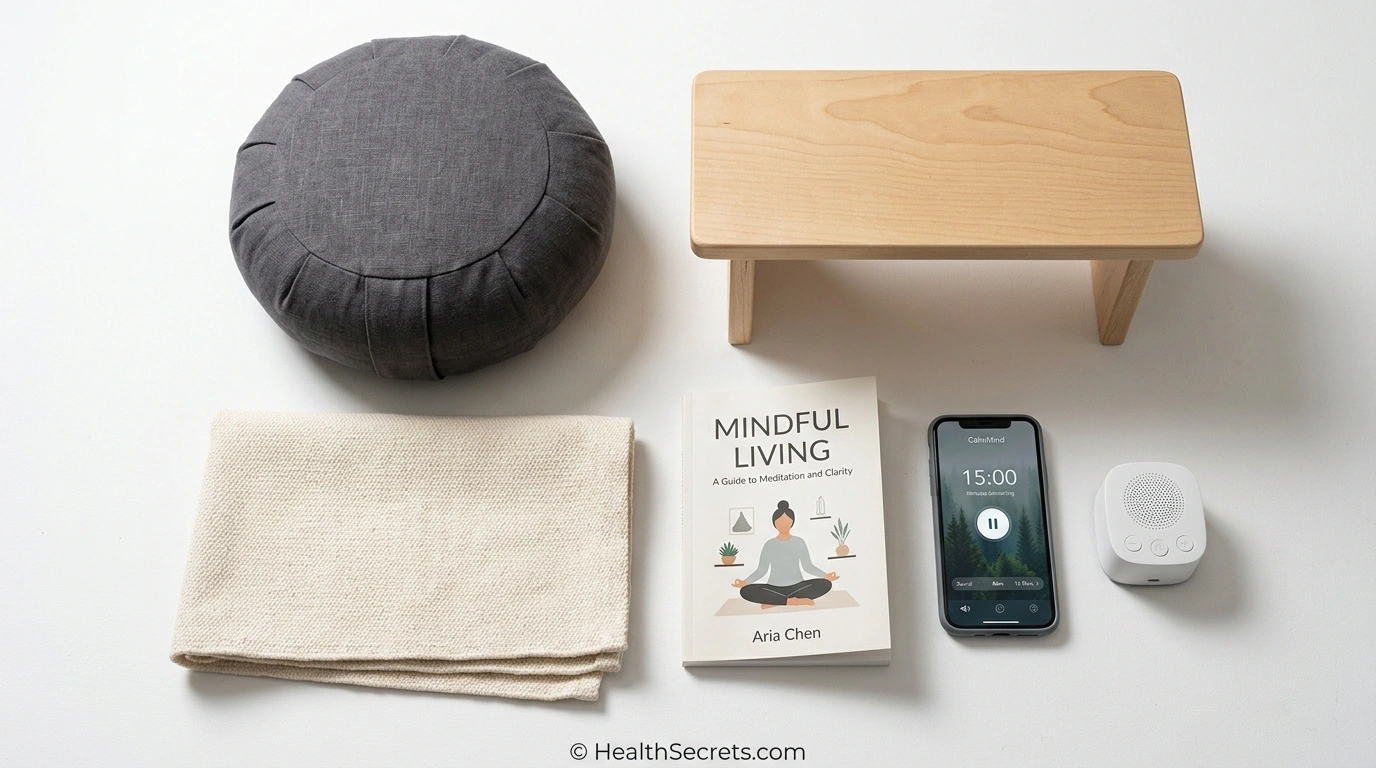
You do not need a dedicated meditation room or special equipment. Any quiet, comfortable space where you can sit without interruption for 5 to 10 minutes will work. The key is minimizing distractions so your attention can settle.
How to set up:
- Choose a consistent spot: Same place each day helps build the habit.
- Minimize distractions: Turn phone to silent or airplane mode. Close the door if possible.
- Temperature: Comfortable, not too hot or cold.
- Seating: Chair with feet flat on floor, meditation cushion on floor, or even your bed (though sitting is preferred over lying down to avoid drowsiness).
- No special equipment needed: A chair is perfectly fine. A cushion is optional.
How Do You Sit Correctly for Meditation?
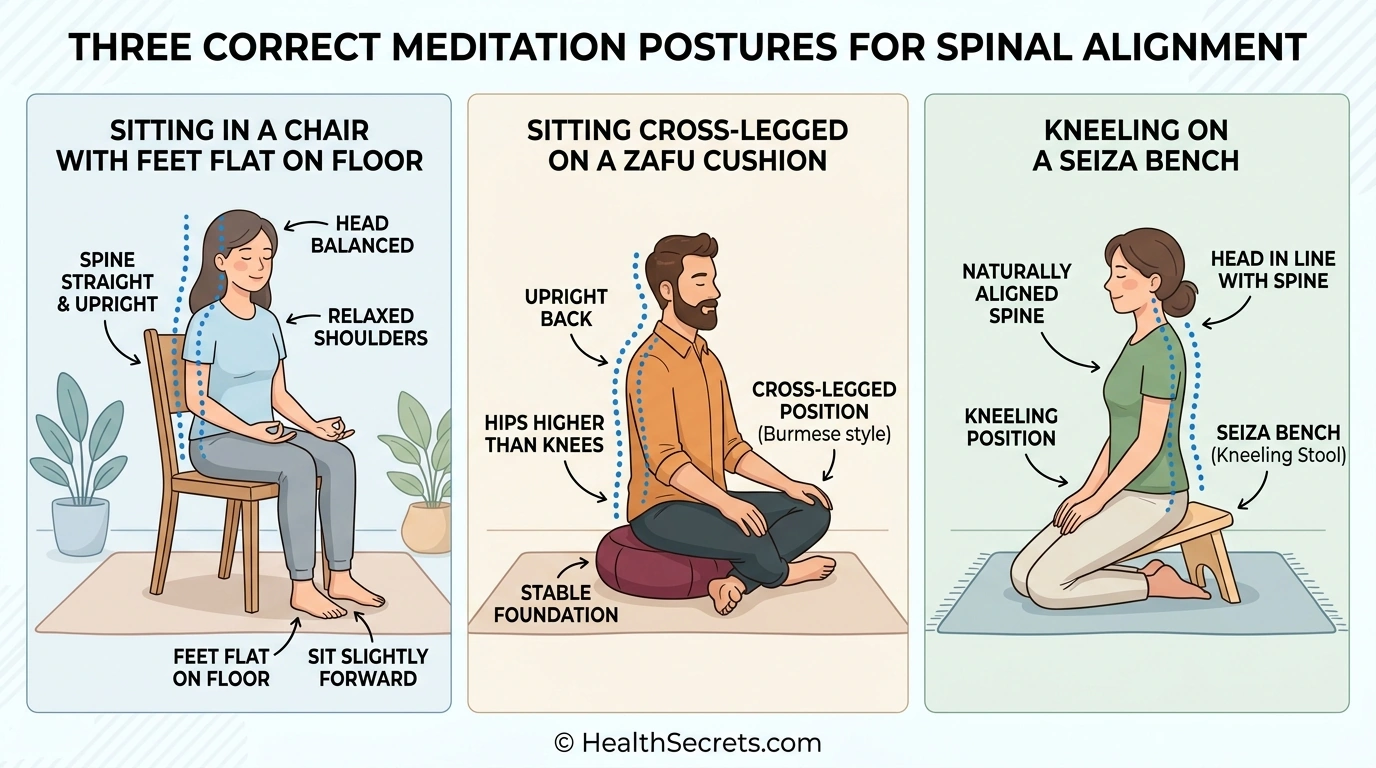
Sit in any position that is stable and comfortable with your back relatively straight but not rigid. The goal is a posture that supports alertness without creating tension or pain. You do not need to sit cross-legged on the floor.
Posture options:
- Chair: Feet flat on floor, back away from chair back (or lightly supported), hands on thighs or lap
- Cushion (zafu): Cross-legged on floor with hips elevated above knees for comfort
- Kneeling bench (seiza): Kneel with bench supporting your weight, taking pressure off knees
- Back: Straight but relaxed, like stacking blocks, not like a soldier at attention
- Hands: Resting on thighs or lap, palms up or down
- Eyes: Gently closed or soft downward gaze about 4 feet ahead
- Shoulders: Relaxed and dropped away from ears
How Do You Practice Mindfulness Meditation Step by Step?
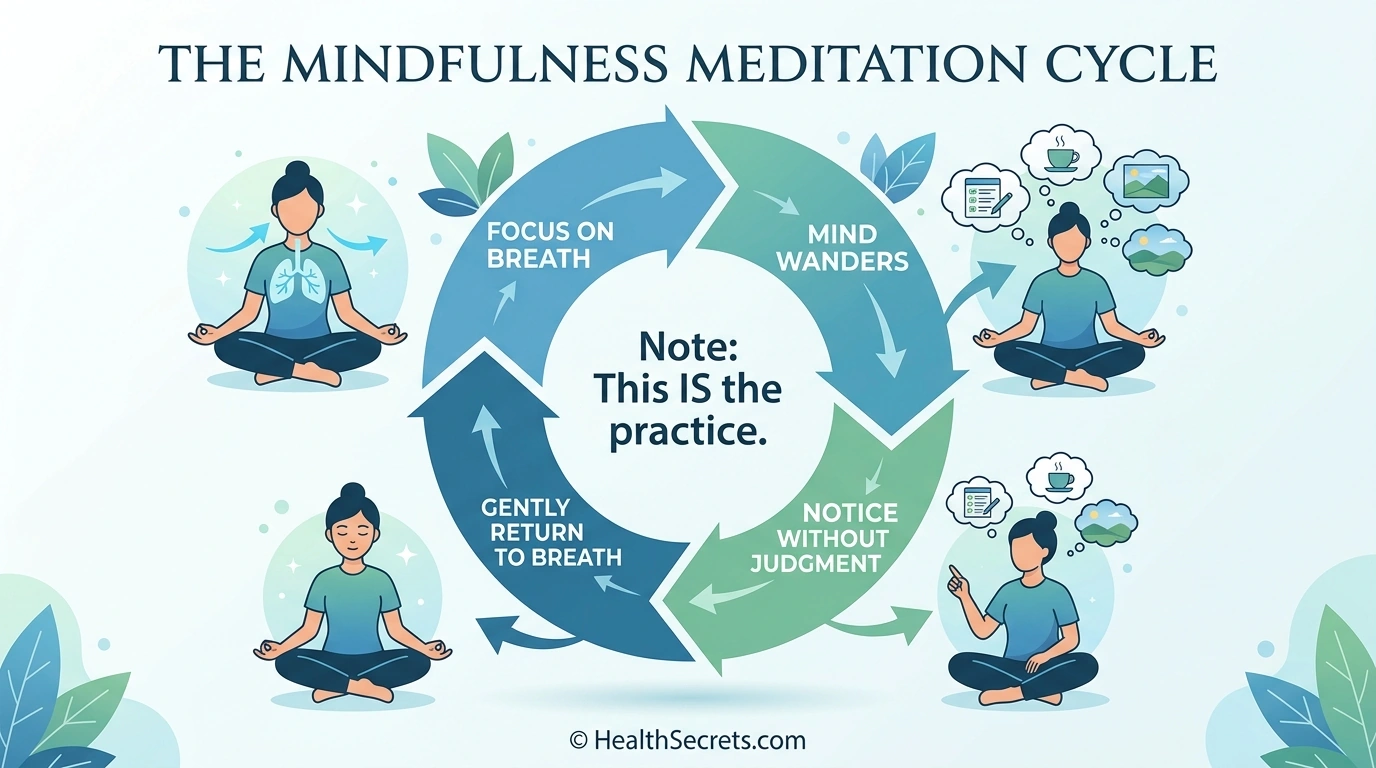
Mindfulness meditation follows a simple cycle: focus on the breath, notice when the mind wanders, and gently return to the breath. Each time you notice your mind has wandered and bring it back, you are doing one "rep" of the core attention-strengthening exercise. This is the practice.
The complete beginner protocol (5 to 10 minutes):
Settling in (1 minute):
- Sit in your chosen posture and close your eyes (or use a soft gaze)
- Take 3 slow, deep breaths to signal your body it is time to settle
- Let your breathing return to its natural rhythm. Do not try to control it
The practice (4 to 9 minutes):
- Focus on your breath sensations: the feeling of air entering your nostrils, your chest gently rising and falling, or your belly expanding and contracting
- Choose one anchor point (nostrils, chest, or belly) and stay with it
- When your mind wanders (it will, often), simply notice: "My mind wandered." No judgment.
- Gently bring your attention back to the breath. This is the practice.
- Repeat steps 5 to 7 as many times as needed. There is no "too many times."
Closing (30 seconds):
- When your timer sounds, keep your eyes closed for a moment
- Notice the sounds around you. Feel your body in the chair or on the cushion.
- Open your eyes slowly. Notice how you feel, even if the difference is subtle.
How Do You Build a Consistent Daily Meditation Habit?
Consistency is more important than duration. Research shows that daily practice, even for just 5 minutes, produces significantly better outcomes than longer but irregular sessions. The key is linking meditation to an existing daily habit and starting small enough that you never want to skip.
How to build the habit:
- Start with 5 minutes: So small it feels almost too easy. This removes the resistance.
- Same time every day: Morning (right after waking or after coffee) works best for most people because the mind is fresh and the day has not yet created distractions.
- Habit stack: Link it to an existing habit. "After I make my coffee, I sit and meditate for 5 minutes."
- Set a gentle timer: Use your phone timer or an app like Insight Timer. The timer frees you from checking the clock.
- Track your streak: Use a simple checkmark on a calendar. The visual chain motivates consistency.
- Increase gradually: After 2 weeks at 5 minutes, try 7 minutes. After another 2 weeks, try 10. No rush.
How Do You Handle a Wandering Mind During Meditation?
A wandering mind is not a problem to solve. It is the raw material of meditation practice. Every time you notice your mind has wandered and redirect your attention to the breath, you are strengthening the neural pathways responsible for sustained attention and emotional regulation.
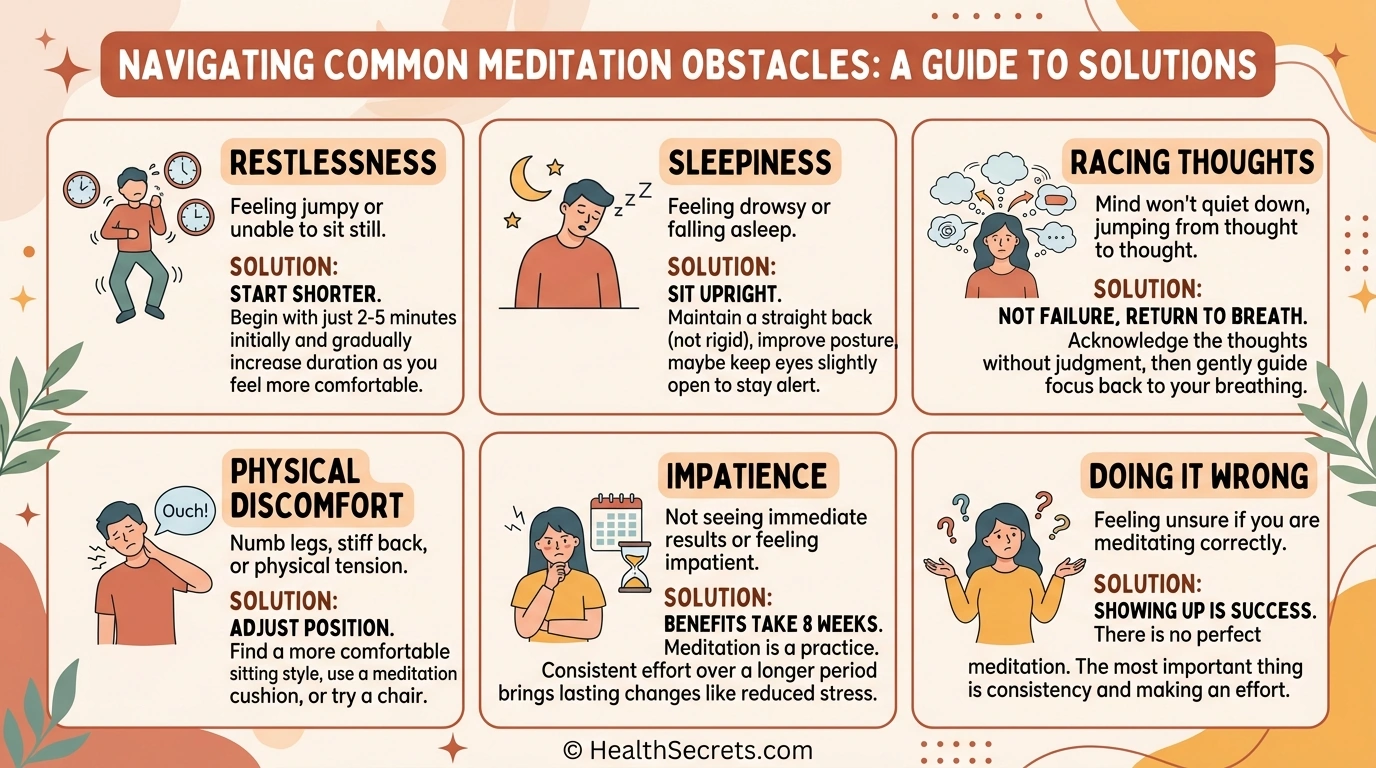
Research from Harvard found that meditation training reduced activity in the default mode network (DMN), the brain network responsible for mind-wandering and self-referential rumination, and that this effect persisted even when meditators were not actively meditating [6].
Practical techniques:
- Noting: Silently label what pulled you away: "thinking," "planning," "remembering." Then return to breath.
- Counting breaths: Count each exhale from 1 to 10. If you lose count, start over at 1. No frustration.
- Compassionate return: Treat yourself the way you would guide a puppy back to its spot. Gently, repeatedly, without frustration.
- Reframe: Each return to the breath is a successful repetition, not a failure. More wandering means more reps.
How Do You Progress Beyond Beginner Meditation?
Once you have established a consistent 10 to 15 minute daily practice for 4 to 8 weeks, you can deepen your practice by extending duration, exploring new meditation types, and bringing mindfulness into daily activities.
Progression path:
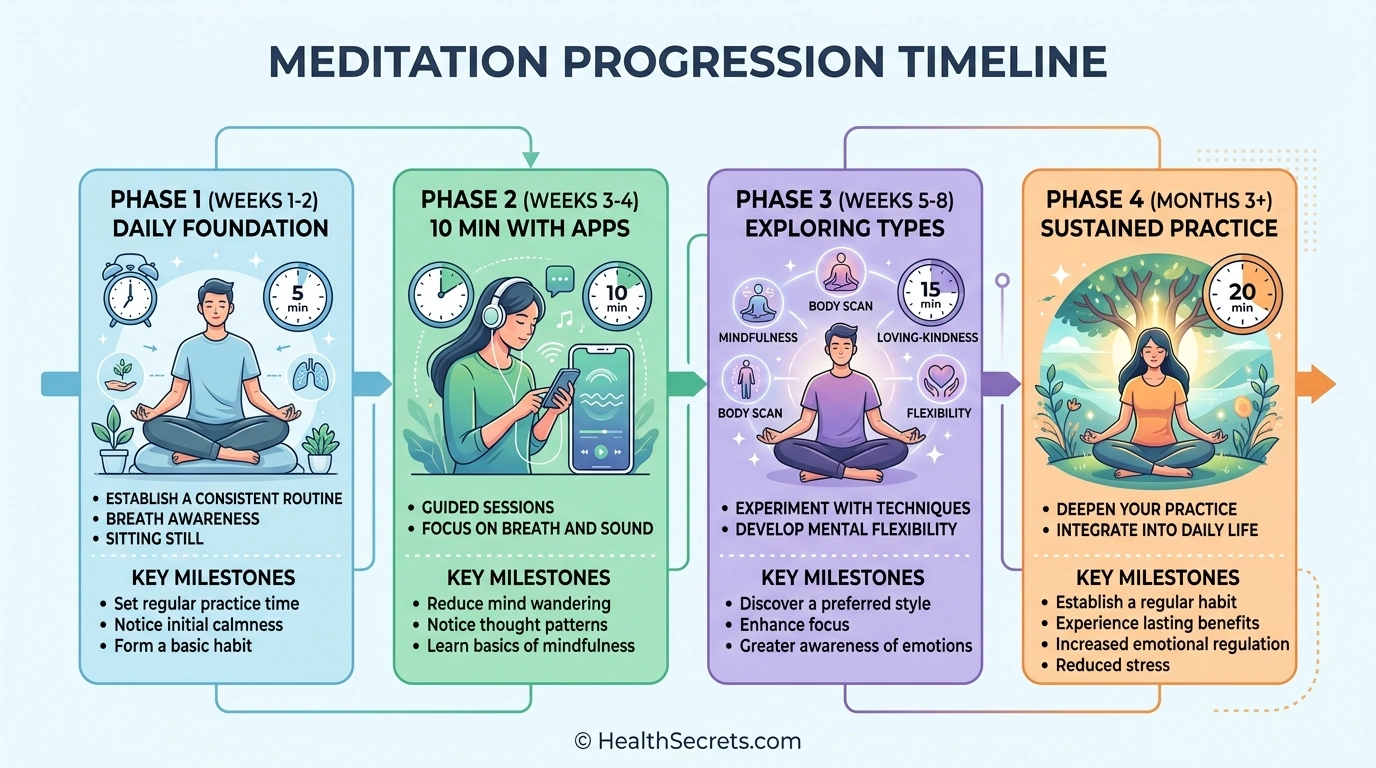
- Weeks 1 to 2: 5 minutes daily, guided mindfulness (apps helpful)
- Weeks 3 to 4: 10 minutes daily, begin unguided sessions
- Weeks 5 to 8: 15 minutes daily, explore loving-kindness or body scan
- Months 3 to 6: 20 minutes daily, mostly unguided, informal mindfulness throughout the day
- Months 6+: 20 to 30 minutes daily, consider a day-long retreat, explore different traditions
Informal mindfulness practices:
- Mindful eating: Notice flavors, textures, and the act of chewing without distractions
- Mindful walking: Feel each footstep during a short walk
- Mindful listening: Give full attention during conversations without planning your response
- Mini-meditations: 3 conscious breaths during transitions (before a meeting, after parking, waiting in line)
What Does the Science Say About Meditation and Your Brain?
Meditation produces measurable structural and functional changes in the brain within 8 weeks. These changes are visible on MRI scans and correlate with the psychological benefits that practitioners report, including reduced stress, improved focus, and better emotional regulation.
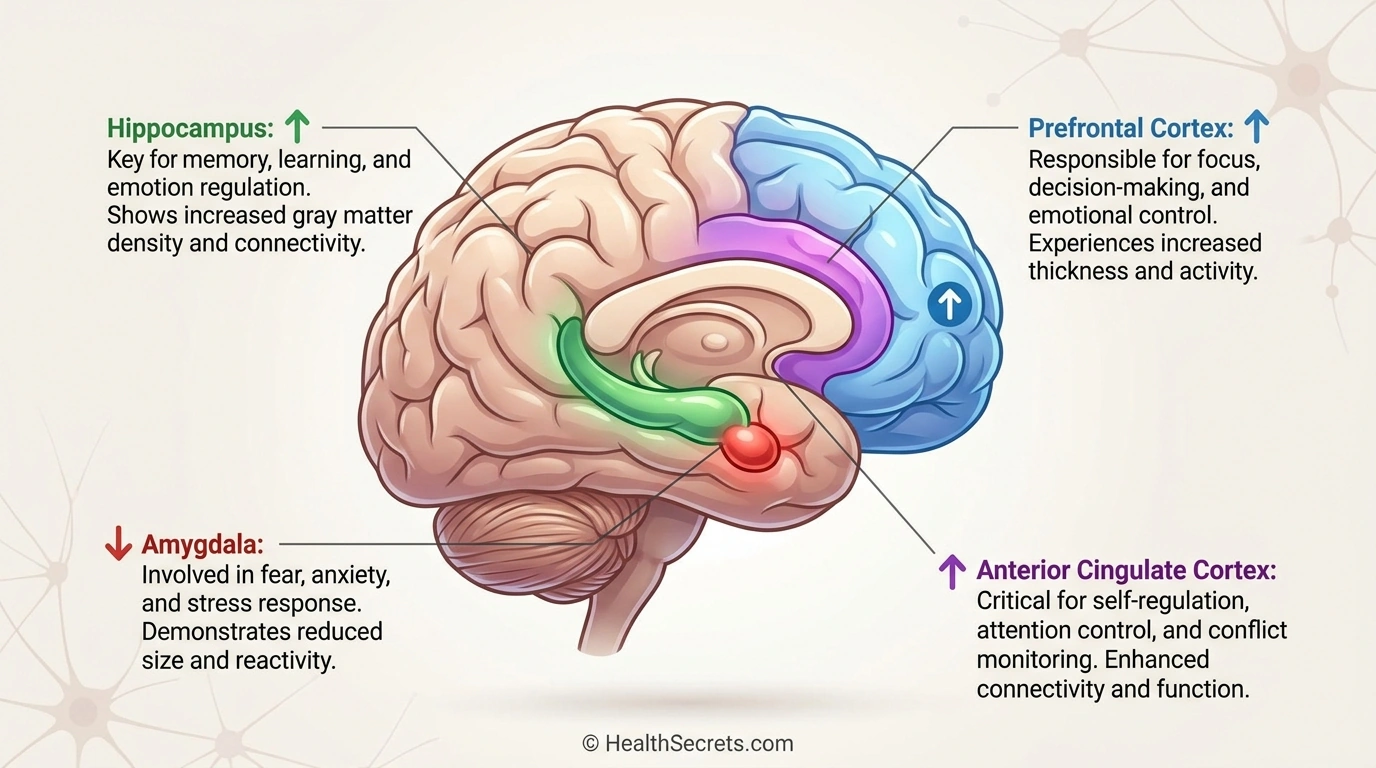
A landmark 2011 Harvard study found that 8 weeks of MBSR increased gray matter density in the hippocampus (learning and memory), posterior cingulate cortex (self-awareness), and temporo-parietal junction (empathy and perspective-taking), while decreasing gray matter in the amygdala (stress and fear responses) [4].
A 2024 systematic review confirmed that MBSR enhances brain regions related to emotional processing and sensory perception, improves psychological outcomes for anxiety and depression, and exhibits unique mechanisms of pain reduction compared to placebo [7].
A 2026 Mount Sinai study revealed that meditation induces changes in deep brain areas associated with memory and emotional regulation, providing evidence for its potential as a noninvasive therapy [8].
Key brain changes from regular meditation:
- Hippocampus: Increased gray matter density (learning, memory, emotional regulation)
- Prefrontal cortex: Increased thickness (attention, decision-making, impulse control)
- Amygdala: Reduced reactivity and gray matter (less fear and stress response)
- Default mode network: Reduced activity (less mind-wandering and rumination)
- Anterior cingulate cortex: Enhanced activity (better self-regulation and conflict monitoring)
What Are the Most Common Meditation Mistakes Beginners Make?
The most common mistakes are expecting to clear your mind completely, judging yourself when your mind wanders, sitting for too long too soon, and giving up after a few sessions because benefits have not appeared. All of these stem from misconceptions about what meditation is and how long it takes to work.
Mistakes and solutions:
- Trying to stop thoughts: Meditation is not about an empty mind. It is about observing thoughts without getting carried away. Let thoughts pass like clouds.
- Judging yourself: "I cannot meditate" usually means "My mind wanders a lot." That is normal. Self-compassion is part of the practice.
- Starting too long: Beginning with 20 to 30 minutes creates resistance and burnout. Start with 5 minutes. Increase gradually.
- Inconsistency: Meditating 5 minutes daily beats 30 minutes sporadically. Build the habit first, extend duration later.
- Expecting instant results: Measurable brain changes begin at 8 weeks. Subtle mood improvements often appear within 2 to 3 weeks. Be patient.
- Lying down: Increases drowsiness significantly. Sit upright unless you are doing a deliberate body scan for sleep.
- Meditating only when stressed: Meditation is training for stressful moments, not just a response to them. Regular practice builds the capacity you draw on during crises.
- Comparing yourself to others: Everyone's meditation experience is different. There is no "right" experience to have.
When to see a professional:
- Severe anxiety or depression (meditation supplements but does not replace therapy)
- Trauma history (meditation can sometimes intensify traumatic memories; work with a trauma-informed therapist)
- Psychosis or mania (some meditation practices may worsen symptoms; consult a psychiatrist)
- Persistent difficulty after several months (a meditation teacher can help troubleshoot)
Is Meditation Safe for Everyone? When Should You Seek Guidance?
Meditation is safe for the vast majority of people and has very few side effects. However, individuals with certain mental health conditions should work with a qualified professional to ensure meditation is introduced safely and appropriately.
Generally safe for:
- Healthy adults with no mental health concerns
- People with mild to moderate stress, anxiety, or low mood
- Older adults (no age limit; chair meditation is accessible)
- Children and adolescents (with age-appropriate guidance)
Consult a professional first if:
- You have PTSD or a trauma history (certain meditation practices can trigger flashbacks)
- You have bipolar disorder (some practices may trigger mania)
- You have psychotic disorders (meditation can intensify symptoms in some cases)
- You experience persistent distressing emotions during or after meditation
- You are currently in acute crisis (seek immediate professional help first)
Action Plan
What Should You Do First to Start Meditating Today?
Follow the sequence below, work through each phase in order, and use the checklist as your practical implementation guide.
Start with just 5 minutes of breath-focused mindfulness meditation tomorrow morning, immediately after an existing habit like making coffee. This single, small step is the foundation that every other benefit builds upon. Do not wait for perfect conditions.
Phase 1: Foundation (Week 1 to 2)
- Choose a consistent time (morning recommended)
- Find your spot (quiet, comfortable, minimal distractions)
- Sit comfortably (chair is fine, back straight but relaxed)
- Set timer for 5 minutes
- Practice breath-focused mindfulness (follow the Step 4 protocol)
- Track your sessions (checkmark on calendar)
Phase 2: Building (Week 3 to 4)
- Increase to 10 minutes daily
- Try one guided meditation session from an app (Headspace, Calm, or Insight Timer)
- Add one mini-meditation per day (3 breaths before a meeting or meal)
- Notice subtle changes in daily stress response
Phase 3: Deepening (Week 5 to 8)
- Increase to 15 minutes daily
- Try a new type of meditation (loving-kindness or body scan)
- Begin some unguided sessions
- Practice informal mindfulness (mindful eating, walking, or listening)
Phase 4: Sustaining (Months 3+)
- Maintain 15 to 20 minutes daily
- Explore different meditation traditions
- Consider a half-day or full-day meditation retreat
- Share your practice with someone (teaching deepens understanding)