
What if there were a compound your body already makes that could trigger cellular rejuvenation, mimic the benefits of fasting, and potentially add years to your lifespan? [14] [16]
Spermidine — a naturally occurring polyamine found in every human cell — is emerging as one of the most promising longevity compounds in modern anti-aging research [2] [20].
First identified in seminal fluid in the 17th century (hence its name), spermidine has recently captured the attention of longevity researchers worldwide. A landmark 2024 study in Nature Cell Biology demonstrated that spermidine is essential for fasting-mediated autophagy and longevity, establishing it as a key mediator of caloric restriction's benefits [5]. Epidemiological data from the Bruneck Study showed that higher dietary spermidine intake is associated with reduced mortality equivalent to being 5.7 years younger [3].
But this is still emerging science — and the gap between promising preclinical results and confirmed human benefits remains significant [19]. This guide balances the genuine excitement around spermidine with the scientific caution this early-stage research demands.
For a broader look at longevity strategies, explore our guides on Gut Health and Detox and Cleansing.
What Is Spermidine and Why Is It Important for Longevity?
Spermidine is a naturally occurring polyamine — a small, positively charged molecule found in every living cell — that plays critical roles in cell growth, DNA stability, and autophagy induction [9] [12]. Endogenous spermidine levels decline significantly with age, and this decline correlates with reduced autophagy capacity and accelerated biological aging.
Spermidine belongs to the polyamine family alongside putrescine and spermine. It is synthesized endogenously from putrescine via the enzyme spermidine synthase and can also be obtained from dietary sources and gut microbiota production. The molecule was first crystallized from human semen in the 1600s (hence the name), but its biological significance extends far beyond reproduction.
Why Does Spermidine Matter for Aging?
As we age, intracellular spermidine concentrations decrease, leading to:
- Reduced autophagy — damaged proteins and organelles accumulate, impairing cellular function
- Increased oxidative stress — declining antioxidant enzyme activity (SOD, catalase)
- Epigenetic changes — altered histone acetylation patterns affecting gene expression
- Mitochondrial dysfunction — impaired mitophagy leads to energy production decline
Restoring spermidine levels through diet or supplementation may partially reverse these age-related declines, which is the foundation of spermidine's longevity potential.

Are You Unknowingly Inflaming Your Body?
Get the free Health Vitals & Nutrient Checklist — the daily guide that shows you which habits and supplements are silently triggering inflammation.
How Does Spermidine Activate Autophagy and Promote Longevity?
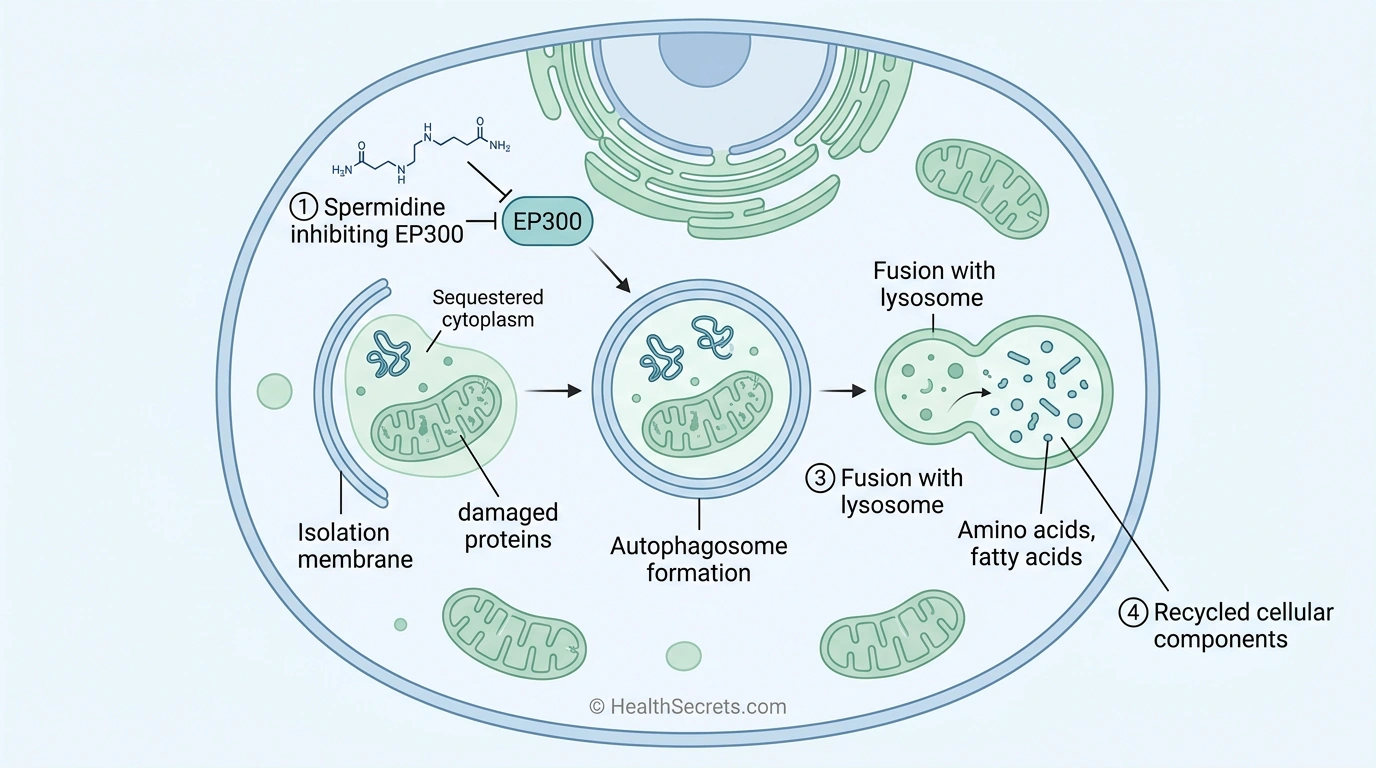
Spermidine activates autophagy primarily by inhibiting the acetyltransferase EP300 (p300), which leads to hypoacetylation of key autophagy-related proteins and triggers the cellular self-cleaning cascade. This mechanism mimics caloric restriction at the molecular level, activating the same longevity pathways without requiring food deprivation.
What Are Spermidine's Key Mechanisms of Action?
- Autophagy induction via EP300 inhibition — spermidine inhibits the acetyltransferase EP300, reducing acetylation of cytoplasmic proteins and activating the autophagy machinery (ATG proteins, Beclin-1, LC3)
- Mitophagy activation — spermidine activates the PINK1/Parkin mitophagy pathway, selectively removing damaged mitochondria and improving cellular energy production [18]
- Anti-inflammatory effects — autophagy-mediated clearance of damaged organelles reduces NLRP3 inflammasome activation and pro-inflammatory cytokine production
- Epigenetic modulation — spermidine reduces histone H3 acetylation, influencing gene expression patterns associated with longevity
- Cardiovascular protection — animal studies show spermidine supplementation reduces cardiac hypertrophy, improves diastolic function, and enhances arterial elasticity
- Neuroprotection — spermidine-induced autophagy clears aggregated proteins (amyloid-beta, alpha-synuclein) linked to neurodegenerative diseases
What Does the 2024 Nature Study Reveal?
The landmark Hofer et al. (2024) study published in Nature Cell Biology demonstrated that spermidine levels increase during fasting across yeast, flies, mice, and human volunteers [1]. Critically, blocking endogenous spermidine synthesis significantly attenuated fasting-induced autophagy. This establishes spermidine not merely as an autophagy inducer, but as an essential mediator of fasting's longevity benefits [4] [11].

Healthy Aging Annual Planning Binder
Bring your longevity priorities, preventive screening schedules, and strength routines into one organized quarterly system.
How Well Is Spermidine Absorbed and Does Supplementation Work?
Dietary spermidine is rapidly absorbed in the small intestine (duodenum and proximal jejunum) without extensive degradation, with mouse studies suggesting 60–75% of ingested spermidine enters circulation within minutes. However, a key pharmacokinetic study found that supplemental spermidine at doses under 15 mg/day may not significantly increase blood spermidine levels, as it appears to be presystemically converted to spermine.
This bioavailability finding is important for setting realistic expectations:
- Food-derived spermidine may have advantages due to the accompanying polyamine matrix and slower release from the food matrix
- Supplemental spermidine at standard doses (1–6 mg/day) may exert effects locally in the gut or through conversion to spermine rather than by directly raising circulating spermidine
- Higher doses (15–40 mg/day) have been clinically tested with good safety outcomes, though more research is needed on their long-term efficacy
- Gut microbiome composition significantly influences endogenous spermidine production and may modulate the response to supplementation
Does Spermidine from Food Work Better Than Supplements?
Food-derived spermidine has undergone more extensive safety testing compared to synthetic forms. Natural sources also provide accompanying polyamines (putrescine, spermine) that create a beneficial recycling loop within the body. This is why most longevity researchers recommend a food-first approach, with supplementation as an adjunct rather than a replacement for dietary spermidine.
How Much Spermidine Should You Take for Longevity Benefits?
Optimal spermidine dosing remains under investigation, but current evidence suggests 1–6 mg/day from wheat germ extract is well-established for safety, while clinical trials have tested up to 40 mg/day without significant adverse effects.
The EU has authorized up to 6 mg/day from wheat germ extract for adults, providing a regulatory benchmark.
What Do Clinical Studies Use?
- Bruneck Study (epidemiological): Higher dietary spermidine intake (estimated 80+ micromol/day from food) correlated with reduced mortality
- SmartAge Trial (12 months): Approximately 1.2 mg/day supplemental spermidine from wheat germ extract in older adults with subjective cognitive decline [7]
- Pharmacokinetic study: Up to 15 mg/day did not significantly raise plasma spermidine (converted to spermine presystemically)
- Safety study: 40 mg/day for short-term use showed good safety outcomes
Practical Dosing Recommendations
- Dietary target: Aim for spermidine-rich foods daily (wheat germ, soybeans, mushrooms, aged cheese)
- Supplement starting dose: 1–2 mg/day from wheat germ extract, taken with meals
- Maintenance dose: 2–6 mg/day, based on EU regulatory guidance
- Note: Higher doses may be explored under medical supervision, but long-term data is limited
- Timing: Take with meals for optimal absorption; some practitioners recommend morning dosing to align with circadian autophagy rhythms
What Foods Are Highest in Spermidine?
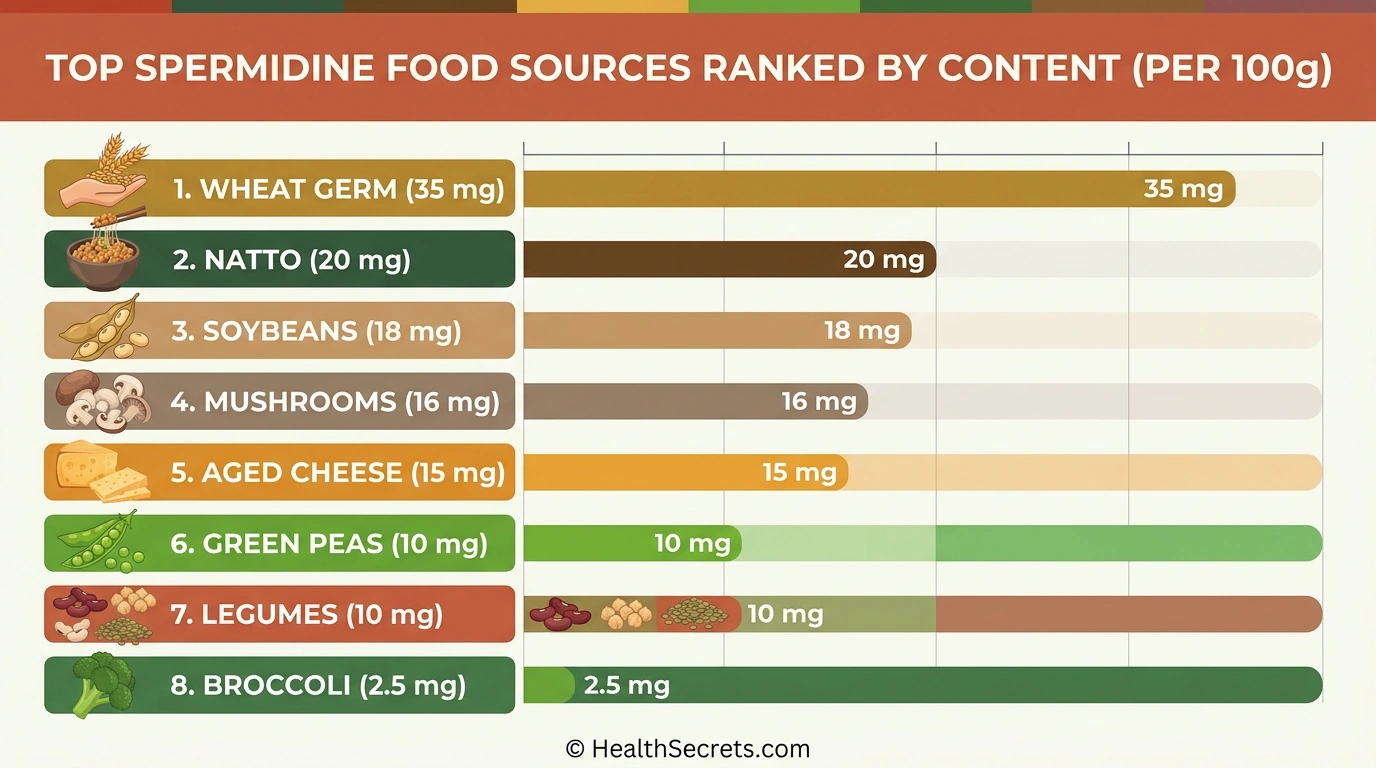
The richest dietary sources of spermidine are wheat germ (up to 35 mg/100g), fermented soy products like natto (20 mg/100g), dry soybeans (18 mg/100g), and certain mushrooms (up to 16 mg/100g). A Mediterranean-style diet naturally provides moderate spermidine intake through its emphasis on legumes, whole grains, and aged cheeses.
Top Spermidine-Rich Foods
| Food | Spermidine (mg/100g) | Notes |
|---|---|---|
| Wheat germ | 24–35 | Richest known source; easy to add to smoothies and cereals |
| Natto (fermented soybeans) | ~20 | Fermentation increases polyamine content significantly |
| Dry soybeans | ~18 | Also high in protein and isoflavones |
| Shiitake/King trumpet mushrooms | Up to 16 | Cook lightly to preserve polyamine content |
| Aged cheese (cheddar, blue) | 5–15 | Longer aging increases polyamine content |
Other Notable Sources
- Green peas — 5–10 mg/100g
- Legumes (lentils, chickpeas) — 3–10 mg/100g
- Broccoli and cauliflower — ~2.5 mg/100g
- Nuts and seeds — 5–6 mg/100g
- Hazelnuts — ~2.1 mg/100g
- Chicken liver — high spermine and spermidine content
- Citrus fruits and pears — 2–3 mg/100g (moderate)
A diverse diet rich in whole grains, legumes, mushrooms, and fermented foods can provide meaningful spermidine intake without supplementation.
Is Spermidine Safe and What Are the Potential Side Effects?
Spermidine supplementation shows an excellent safety profile in clinical studies up to 12 months, with adverse event rates comparable to placebo. A Phase II trial involving 100 older adults found no significant differences in adverse events between spermidine and placebo groups over 12 months. However, long-term data beyond one year remains limited.
Common Side Effects
When side effects occur, they are typically mild and temporary:
- Mild gastrointestinal symptoms (nausea, digestive discomfort)
- Occasional diarrhea, particularly at higher doses
- Rare allergic reactions in sensitive individuals
Important Safety Considerations
- Cancer concern: A March 2026 study from Tokyo University of Science showed polyamines (including spermidine) can accelerate cancer cell growth. People with active cancer or a history of cancer should consult their oncologist before supplementing
- DFMO interaction: Difluoromethylornithine (DFMO) is a polyamine synthesis inhibitor used in cancer treatment — spermidine supplementation could theoretically counteract its effects
- Pregnancy and breastfeeding: Insufficient safety data; avoid supplementation during these periods
- EU regulatory limit: Up to 6 mg/day from wheat germ extract is authorized for adults; this does not apply to pregnant or breastfeeding individuals
- Food vs. supplement safety: Food-derived spermidine has a longer safety track record than isolated supplemental forms
Who Should Avoid Spermidine Supplements?
- Individuals with active cancer or undergoing cancer treatment
- Those taking DFMO or other polyamine-modulating medications
- Pregnant or breastfeeding individuals
- Anyone with known allergies to wheat (for wheat germ-derived supplements)
What Should You Realistically Expect from Spermidine Supplementation?
You should expect spermidine to be a promising but still unproven longevity intervention in humans. While animal and epidemiological data are compelling, the 12-month SmartAge clinical trial found no significant cognitive benefits from modest spermidine supplementation in older adults, and doses under 15 mg/day may not meaningfully raise blood levels.
What the Evidence Strongly Supports
- Spermidine powerfully induces autophagy in cell and animal models
- Higher dietary spermidine intake correlates with reduced mortality in observational studies
- Spermidine is essential for the benefits of fasting and caloric restriction (2024 Nature study)
- Supplementation up to 12 months is safe and well-tolerated
What Remains Uncertain
- Whether supplemental spermidine at standard doses (1–6 mg) produces clinically meaningful benefits in humans
- The optimal dose for human longevity benefits
- Long-term safety beyond 12 months at supplemental doses
- Whether raising blood spermidine levels is necessary for benefits (gut-local effects may matter)
- The relative contribution of dietary vs. endogenous vs. microbiome-produced spermidine
A Balanced Perspective
Spermidine is one of the most scientifically grounded emerging longevity compounds, but it is not a proven anti-aging pill. The wisest approach is to increase dietary spermidine through whole foods (which carry virtually no risk and many additional nutritional benefits), consider modest supplementation as an optional addition, and follow the evolving research [13]. The best longevity strategy remains a comprehensive approach: quality sleep, regular exercise, stress management, and a nutrient-dense diet — of which spermidine-rich foods are one component.
Action Plan
What Is the Best Action Plan for Adding Spermidine to Your Longevity Protocol?
Follow the sequence below, work through each phase in order, and use the checklist as your practical implementation guide.
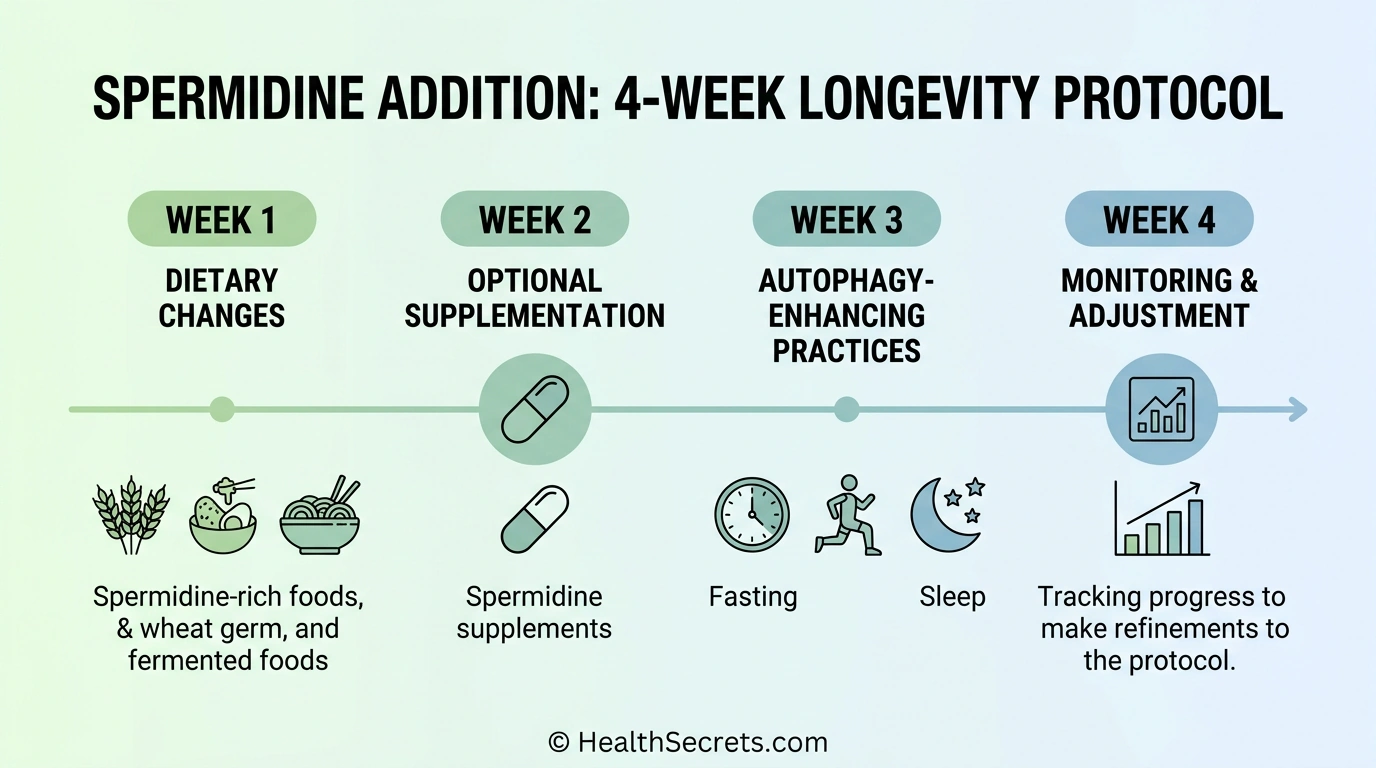
The best action plan starts with dietary optimization in Week 1, adds optional supplementation in Week 2, integrates complementary autophagy-supporting practices in Week 3, and establishes a long-term monitoring strategy in Week 4. This food-first approach maximizes benefits while minimizing risk from this still-emerging science.
Week 1 — Dietary Foundation
- Add 2 tablespoons of wheat germ daily to smoothies, yogurt, or cereal
- Include fermented soy products (natto, tempeh, miso) 2–3 times per week
- Eat mushrooms (shiitake, king trumpet) 3–4 times per week
- Add legumes (lentils, chickpeas, green peas) to daily meals
- Include aged cheese in moderate portions
Week 2 — Optional Supplementation
- If dietary intake is insufficient, start with 1–2 mg/day wheat germ extract
- Take with breakfast for circadian alignment
- Monitor for any digestive discomfort and adjust
Week 3 — Autophagy-Supporting Practices
- Implement time-restricted eating (12–16 hour overnight fast) to synergize with spermidine
- Add 30 minutes moderate exercise daily (exercise independently activates autophagy)
- Prioritize 7–9 hours quality sleep (autophagy peaks during deep sleep)
- Reduce excessive sugar and processed food intake
Week 4 — Monitor and Adjust
- Track subjective energy, digestion, and cognitive clarity
- Consider biomarker testing if available (inflammatory markers, metabolic panels)
- Research and follow new spermidine clinical trials
- Reassess protocol at 3 months


