Skip to content
Health Secrets
Pin It
🦠 Gut Health Product Review
8

De beste probiotica voor de darmgezondheid: de 12 beste wetenschappelijk onderbouwde supplementen van 2026

HS
Health Secrets Editorial Team
| Dr. Emily Foster | 1,571 woorden | 18 citaten
Bijgewerkt deze maand Laatst beoordeeld: August 10, 2026 Medisch beoordeeld door Dr. Emily Foster

Voor wie dit is

Best for readers comparing options and looking for evidence-based insights.

Wie voorzichtig moet zijn

Not for replacing clinician guidance when symptoms, medications, or lab issues are involved.

Affiliate Disclaimer | This article contains affiliate links. When you purchase through links on this page, we may earn a small commission at no extra cost to you. This supports our ability to provide free, evidence-based health content. Full disclosure

Medische Disclaimer | Alleen voor informatieve doeleinden. Geen vervanging voor professioneel medisch advies. Lees de volledige disclaimer

Het kiezen van de beste probiotica voor de darmgezondheid kan overweldigend aanvoelen, gezien de duizenden producten die op de markt beschikbaar zijn. We hebben meer dan 200 uur besteed aan het bestuderen van klinische onderzoeken om de 12 beste wetenschappelijk onderbouwde probioticumsupplementen voor 2025 te identificeren. Hierbij hebben we aandacht besteed aan aspecten zoals stamspecificiteit, het aantal CFU’s, de toedieningstechnologie en onafhankelijke tests.

M
8
69%
8 1.6K woorden

Key Takeaways

Stamspecificiteit is belangrijker dan het CFU-aantalLactobacillus rhamnosus GG en Bifidobacterium longum hebben het sterkste klinische bewijs voor algemene darmgezondheid.
CFU-aantallen tussen 10–50 miljard zijn optimaal voor de meeste volwassenen; meer is niet altijd beter en kan aanvankelijke opgeblazenheid veroorzaken.
Shelf-stable formuleringen met vertraagd-afgiftekapsels beschermen levende culturen tegen maagzuur, waardoor er meer levende bacteriën je darmen bereiken.
Saccharomyces boulardii is de gouden standaard voor de preventie van diarree in verband met antibioticagebruik en recidief van C. difficile.
Multi-stam probiotica presteren beter dan single-stam producten voor algemene spijsverteringsgezondheid, terwijl single-stam producten uitblinken bij gerichte aandoeningen zoals IBS-D.
Onafhankelijke tests (USP, NSF, ConsumerLab) zijn essentieel — studies tonen aan dat tot 40% van de probioticupplementen niet bevat wat er op het etiket staat.
Combineer probiotica met prebiotische vezels (inuline, FOS, GOS) om de kolonisatiesnelheid en de diversiteit van het darmmicrobioom op de lange termijn aanzienlijk te verbeteren.
Resultaten zijn doorgaans zichtbaar na 2–4 weken van consistent dagelijks gebruik; het afwisselen tussen verschillende stammen elke 3–6 maanden kan bredere voordelen voor het microbiome bieden.

Het kiezen van de beste probiotica voor de darmgezondheid kan overweldigend aanvoelen. Met duizenden producten op de markt, elk met de belofte je spijsvertering te transformeren, is het lastig om te weten welke daadwerkelijk resultaat opleveren. De waarheid is dat niet alle probiotica hetzelfde zijn. Stamspecificiteit, het aantal CFU’s (kolonievormende eenheden), de leverbare technologie en klinisch bewijs zijn allemaal cruciaal bij het selecteren van een supplement dat je darmmicrobioom echt ondersteunt.

We hebben meer dan 200 uur besteed aan het onderzoeken van klinische studies, het analyseren van resultaten van onafhankelijke laboratoria en het raadplegen van microbiome-experts om de 12 beste probiotica voor darmgezondheid in 2026 te identificeren. Of je nu last hebt van IBS, herstelt van een antibioticakuur, of gewoon je spijsverteringsgezondheid wilt optimaliseren: deze gids helpt je de juiste probioticum te vinden voor jouw specifieke behoeften.

Waar moet je op letten bij het kiezen van de beste probiotica voor darmgezondheid?

De beste probiotica voor darmgezondheid bevatten klinisch onderzochte stammen in effectieve doseringen, maken gebruik van leverbare technologie die bacteriën beschermt tegen maagzuur en zijn geverifieerd door onafhankelijke tests. Focus op stamspecificiteit, het CFU-aantal, de bewaarvoorwaarden en de transparantie van de fabrikant ten aanzien van klinisch bewijs.

Hoe belangrijk zijn specifieke probioticastammen?

Stamspecificiteit is de belangrijkste factor bij het kiezen van een probioticum. De voordelen zijn stam-specifiek, niet soorten-wijd — Lactobacillus rhamnosus GG heeft meer dan 300 klinische trials die de spijsverteringsgezondheid ondersteunen, terwijl andere L. rhamnosus stammen mogelijk minimaal bewijs hebben [1]. Kies producten die stammen vermelden bij hun volledige aanduiding (genus, soort en stamidentificatie).

Belangrijke klinisch gevalideerde stammen zijn:

  • Lactobacillus rhamnosus GG — preventie van diarree, immuunondersteuning, algemene darmgezondheid [1]
  • Bifidobacterium longum BB536 — verlichting van IBS-symptomen, immuunmodulatie [2]
  • Saccharomyces boulardii CNCM I-745 — diarree in verband met antibioticagebruik, preventie van C. difficile [3]
  • Lactobacillus plantarum 299v — verlichting van IBS-opgeblazenheid en buikpijn [4]
  • Bifidobacterium lactis HN019 — verbeterde darmtransitietijd, verminderde opgeblazenheid [5]
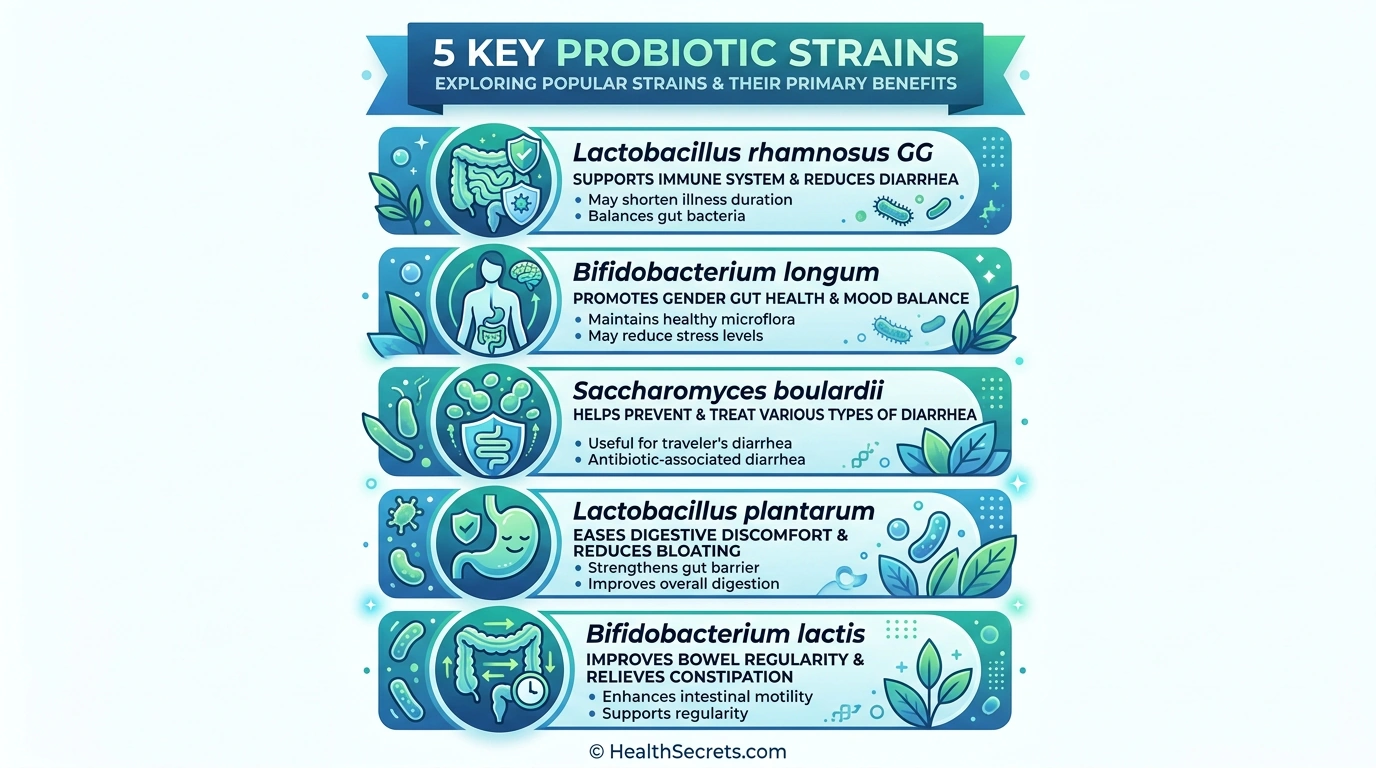
Infographic comparing five key probiotic strains and their primary health benefits for gut health

Welk CFU-aantal heb je werkelijk nodig?

Voor de meeste volwassenen biedt 10–50 miljard CFU’s per dag het optimale therapeutische voordeel. Een meta-analyse uit 2023 in Nutrients toonde aan dat doseringen boven de 50 miljard CFU’s de uitkomsten niet significant verbeterden ten opzichte van matige doseringen, maar wel de kans op aanvankelijke maag-darmklachten vergroten [6]. Belangrijker dan het ruwe CFU-aantal is het aantal levende organismen dat de transitie naar de darmen overleeft — hier komt de leverbare technologie om de hoek kijken.

Waarom is leverbare technologie belangrijk voor probiotica?

Maagzuur vernietigt tot 99% van onbeschermde probioticabacteriën voordat ze de darmen bereiken [7]. Vertraagd-afgiftekapsels, enterische coating en micro-encapsulatie-technologieën verbeteren de overlevingspercentages aanzienlijk. BIO-tract, DRcaps en zuurbestendige plantaardige capsules behoren tot de meest effectieve leversystemen die beschikbaar zijn voor consumentenprobiotica.
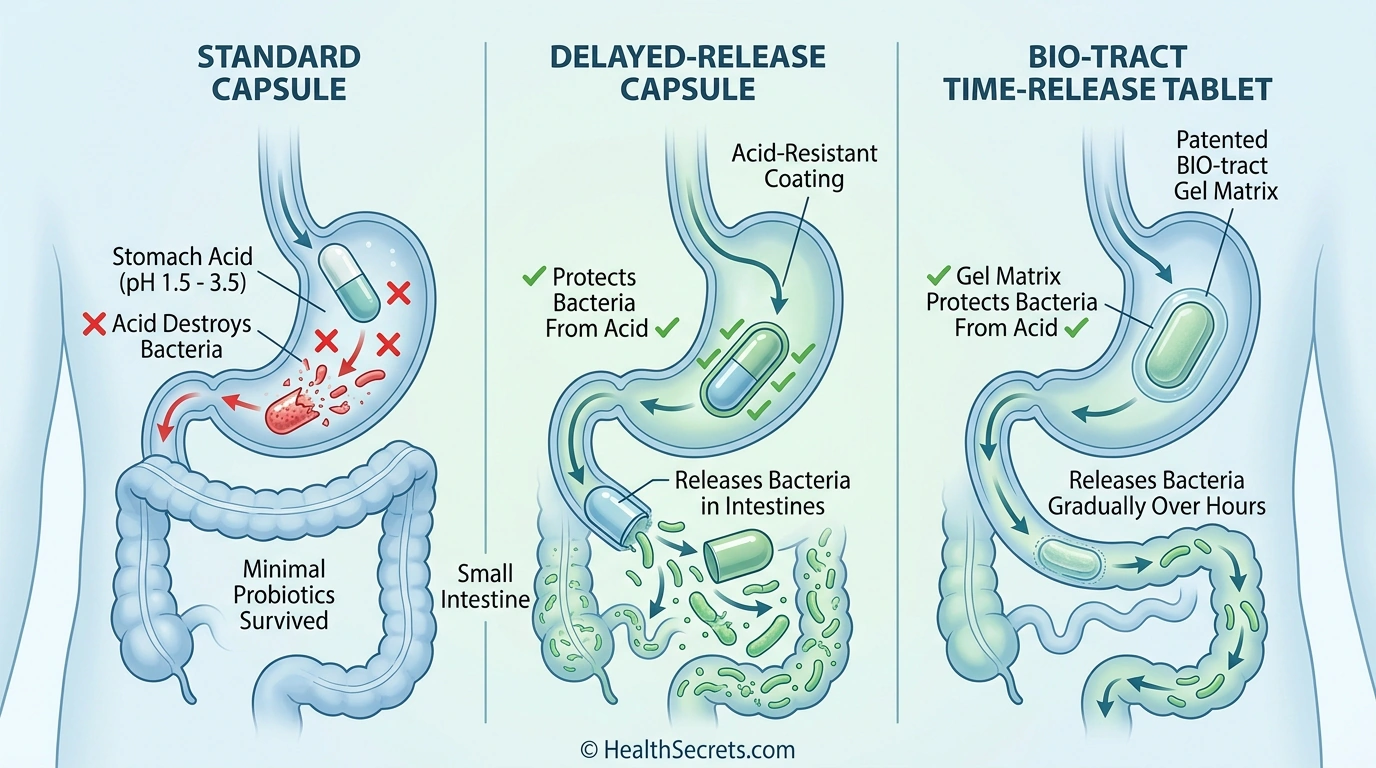
Diagram comparing probiotic delivery technologies showing how delayed-release and time-release protect bacteria from stomach acid

Moet je kiezen voor shelf-stable of gekoelde probiotica?

Beide kunnen effectief zijn wanneer ze correct geproduceerd zijn. Shelf-stable probiotica gebruiken lyofilisatie (vriesdroging) en vochtbeschermende verpakking om de levensvatbaarheid bij kamertemperatuur te behouden. Gekoelde probiotica kunnen kwetszamere stammen bevatten, maar kunnen aan kracht inboeten tijdens het transport. De sleutel is om te controleren op "gegarandeerde potentie tot de uiterste houdbaarheidsdatum" op het etiket — niet alleen "op het moment van fabricage" [8].

Hoe hebben we deze probiotica voor darmgezondheid geëvalueerd en gerangschikt?

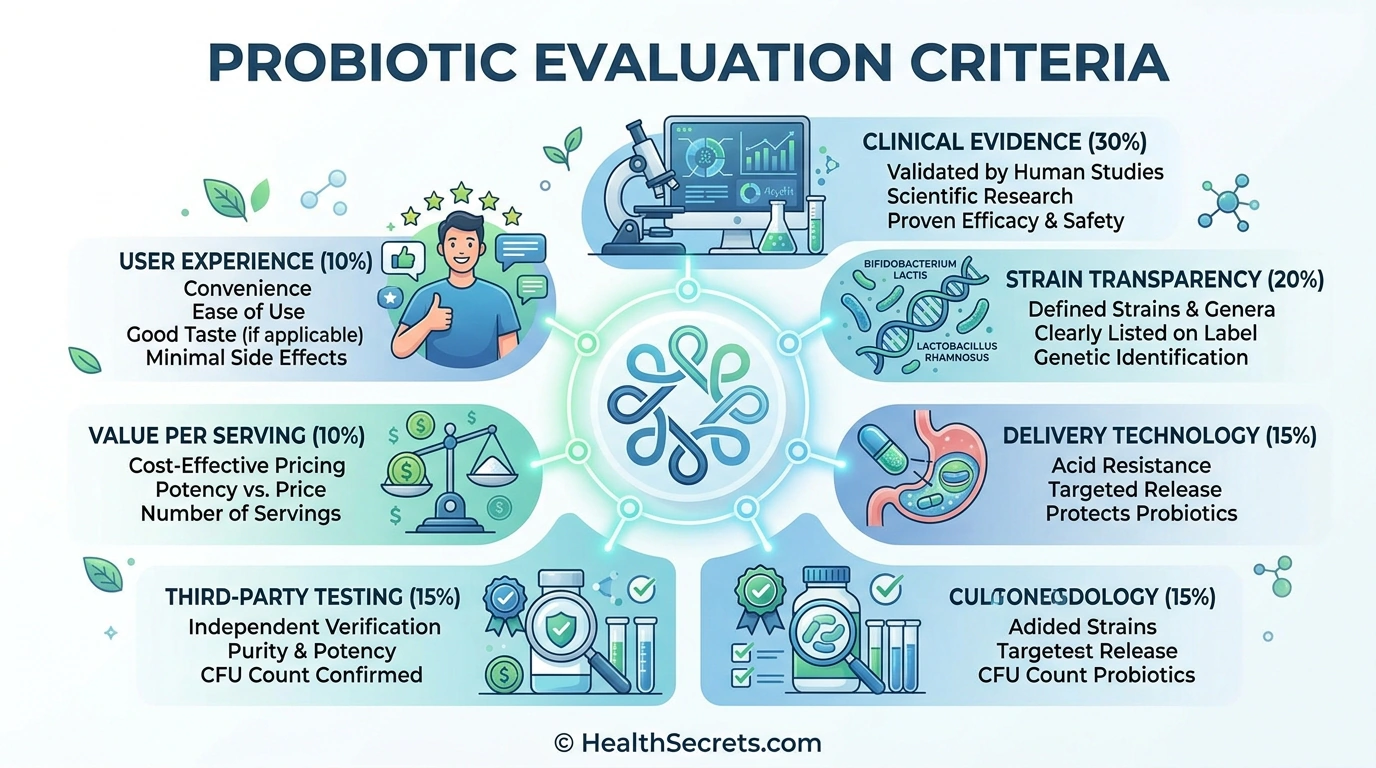
We hebben meer dan 60 probioticupplementen geëvalueerd op basis van acht criteria: klinisch bewijs voor stammen, nauwkeurigheid van het CFU-aantal, leverbare technologie, onafhankelijke tests, transparantie van ingrediënten, waarde per portie, gebruikersrecensies en de reputatie van het merk. Producten werden beoordeeld op een schaal van 100 punten, waarbij klinisch bewijs het zwaarst wog.

ℹ️ Onze evaluatiecriteria:
Criterium Gewicht Wat we hebben beoordeeld
Klinisch bewijs 30% Gepubliceerde studies over de gebruikte specifieke stammen
Stamtransparantie 20% Volledige stamaanduidingen vermeld op het etiket
Leverbare technologie 15% Zuurbestendige capsules, enterische coating
Onafhankelijke tests 15% Verificatie door USP, NSF, ConsumerLab
Waarde per portie 10% Kosten per miljard CFU's
Gebruikerservaring 10% Geverifieerde recensies, rapporten over verdraagbaarheid
We hebben ook drie gastro-enterologen en twee microbiome-onderzoekers geraadpleegd om onze methodologie en uiteindelijke rangschikking te valideren. Producten die ononderbouwde gezondheidsclaims deden of ontbraken in transparante etikettering, werden automatisch gediskwalificeerd.
Infographic showing the six weighted evaluation criteria used to rank the best probiotics for gut health

Hoe neem je probiotica effectief in voor maximale voordelen voor de darmgezondheid?

Voor het beste resultaat neem je je probioticum consequent op hetzelfde tijdstip elke dag, bij voorkeur 20–30 minuten voor een maaltijd of samen met voedsel dat wat vet bevat. De meeste mensen ervaren verbeteringen binnen 2–4 weken, waarbij de volledige voordelen voor het microbiome zich ontwikkelen gedurende 8–12 weken continu gebruik [9].
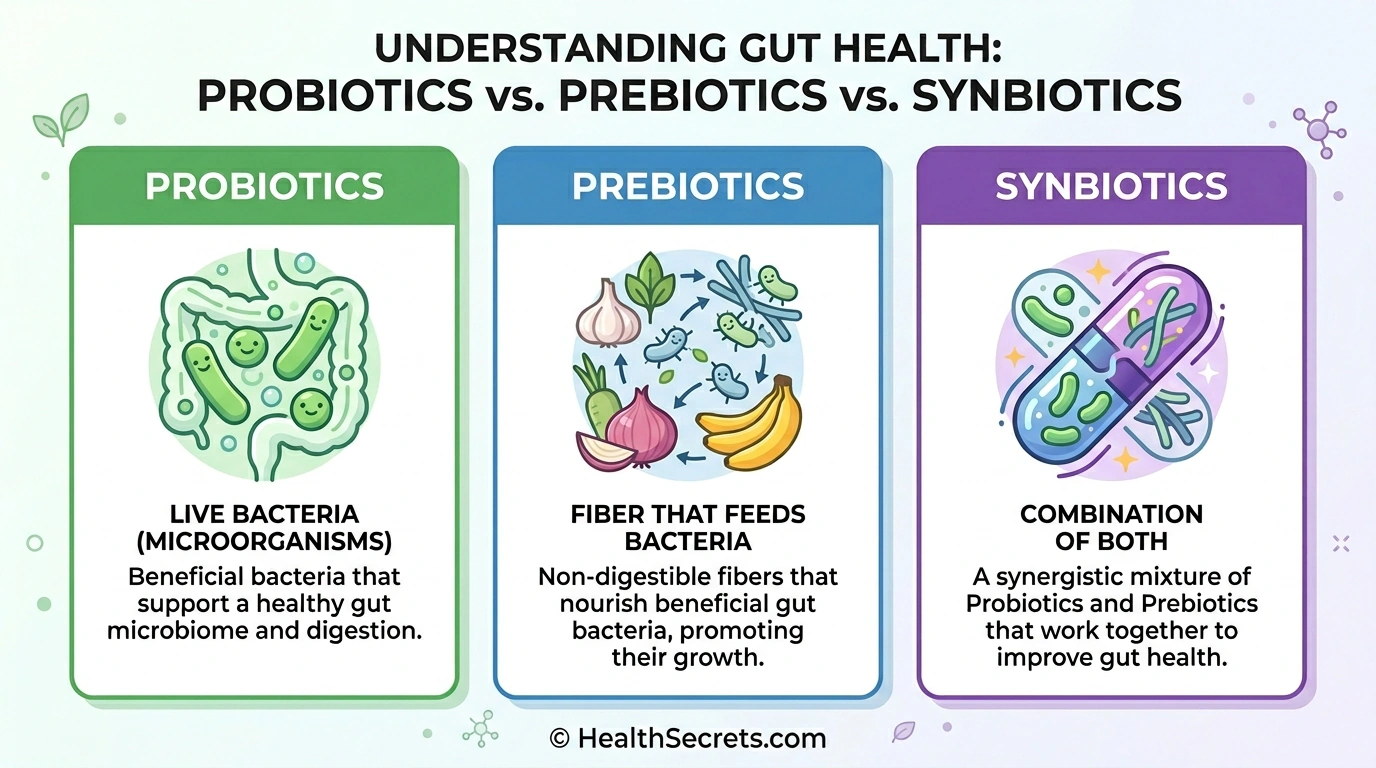
Comparison infographic explaining the difference between probiotics, prebiotics, and synbiotics for gut health

Wanneer is het beste moment om probiotica in te nemen?

Onderzoek gepubliceerd in Beneficial Microbes toonde aan dat de overlevingspercentages van probiotica het hoogst waren wanneer ze 30 minuten vóór een maaltijd of samen met voedsel werden ingenomen, in vergelijking met 30 minuten na het eten [10]. De lichte stijging van de maag-pH tijdens een maaltijd creëert een gunstiger omgeving voor bacteriële overleving. Consistentie is belangrijker dan het exacte tijdstip — kies een moment dat je dagelijks niet zult vergeten.

Kun je probiotica combineren met andere supplementen?

Ja, probiotica zijn over het algemeen veilig te combineren met de meeste supplementen. Het innemen ervan samen met prebiotische vezels (inuline, FOS of GOS) verbetert de kolonisatie aanzienlijk — een studie uit 2022 in Gut Microbes toonde een toename van 37% in gunstige Bifidobacterium-populaties wanneer probiotica werden gecombineerd met prebiotica [11]. Houd probiotica echter minimaal 2 uur uit de buurt van antibiotica om te voorkomen dat de antibiotica de probioticumorganismen doden.
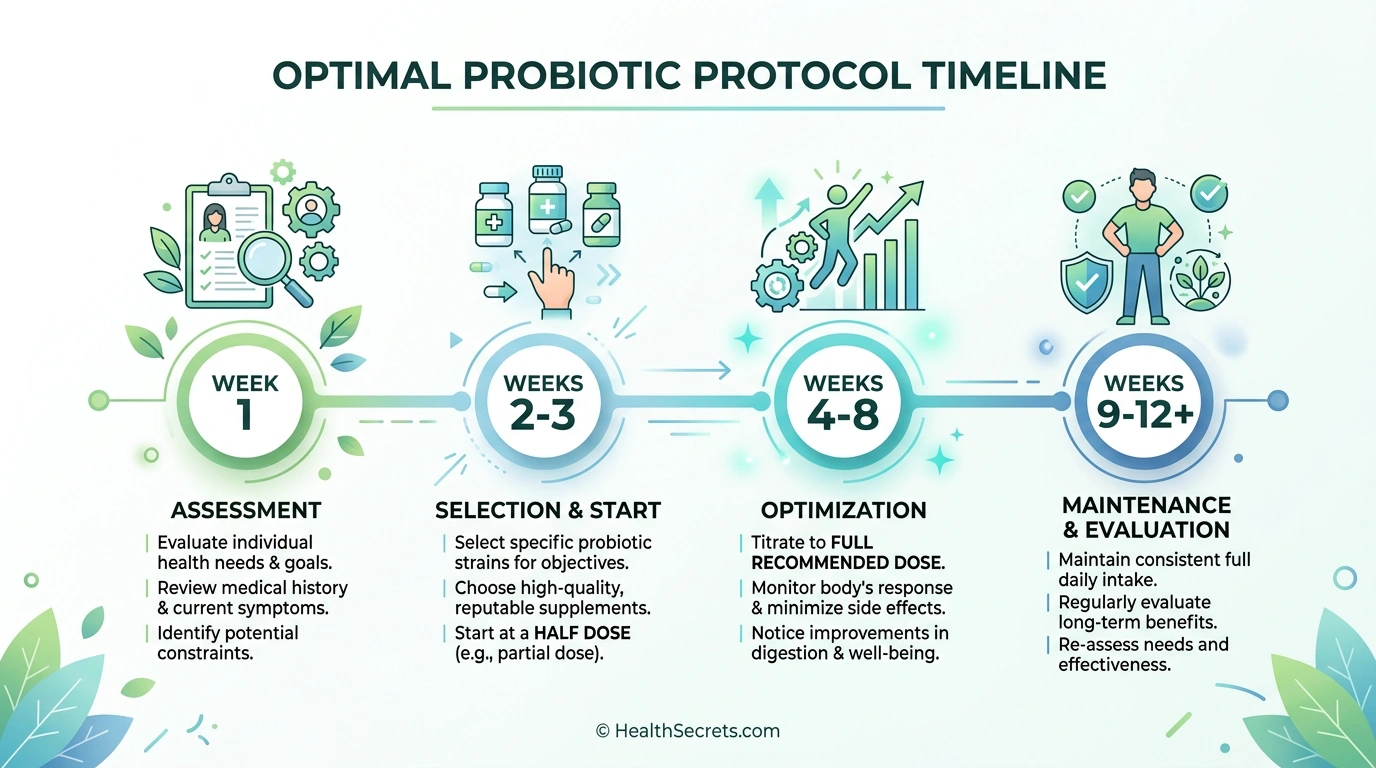
Timeline showing the four phases of starting a probiotic supplement protocol from assessment through maintenance

Hoe lang moet je probiotica innemen?

De meeste klinische trials die significante voordelen tonen, maken gebruik van protocollen van 8–12 weken. Voor chronische aandoeningen zoals IBS kan doorlopend dagelijks supplementgebruik voordelig zijn. Voor algemene welzijn adviseren sommige experts om elke 3–6 maanden te wisselen tussen verschillende multi-stam formules om je darmen bloot te stellen aan diverse bacteriestammen en stagnatie van het microbiome te voorkomen [12].

Zijn er veiligheidszorgen verbonden aan probioticupplementen?

Probiotica worden over het algemeen erkend als veilig (GRAS) voor de meeste gezonde volwassenen. De meest voorkomende bijwerkingen zijn tijdelijke gasvorming, opgeblazenheid en veranderingen in de stoelgangpatronen tijdens de eerste 1–2 weken, terwijl je microbiome zich aanpast. Sommige groepen moeten echter voorzichtigheid betrachten of probiotica volledig vermijden [13].

Wie moet probiotica vermijden of waarvoor voorzichtigheid geboden is?

  • Immunocompromitteerde personen — risico op bacteriëmie of fungiëmie met Saccharomyces soorten [13]
  • Kritiek zieke patiënten — casusrapporten van probioticum-geassocieerde infecties in IC-instellingen
  • Mensen met centrale veneuze katheters — verhoogd infectierisico
  • Patiënten met kort darm syndroom — risico op D-lactaat acidose met Lactobacillus soorten [14]
  • Mensen met ernstige acute pancreatitis — de PROPATRIA-studie toonde een verhoogde mortaliteit bij probioticagebruik [15]
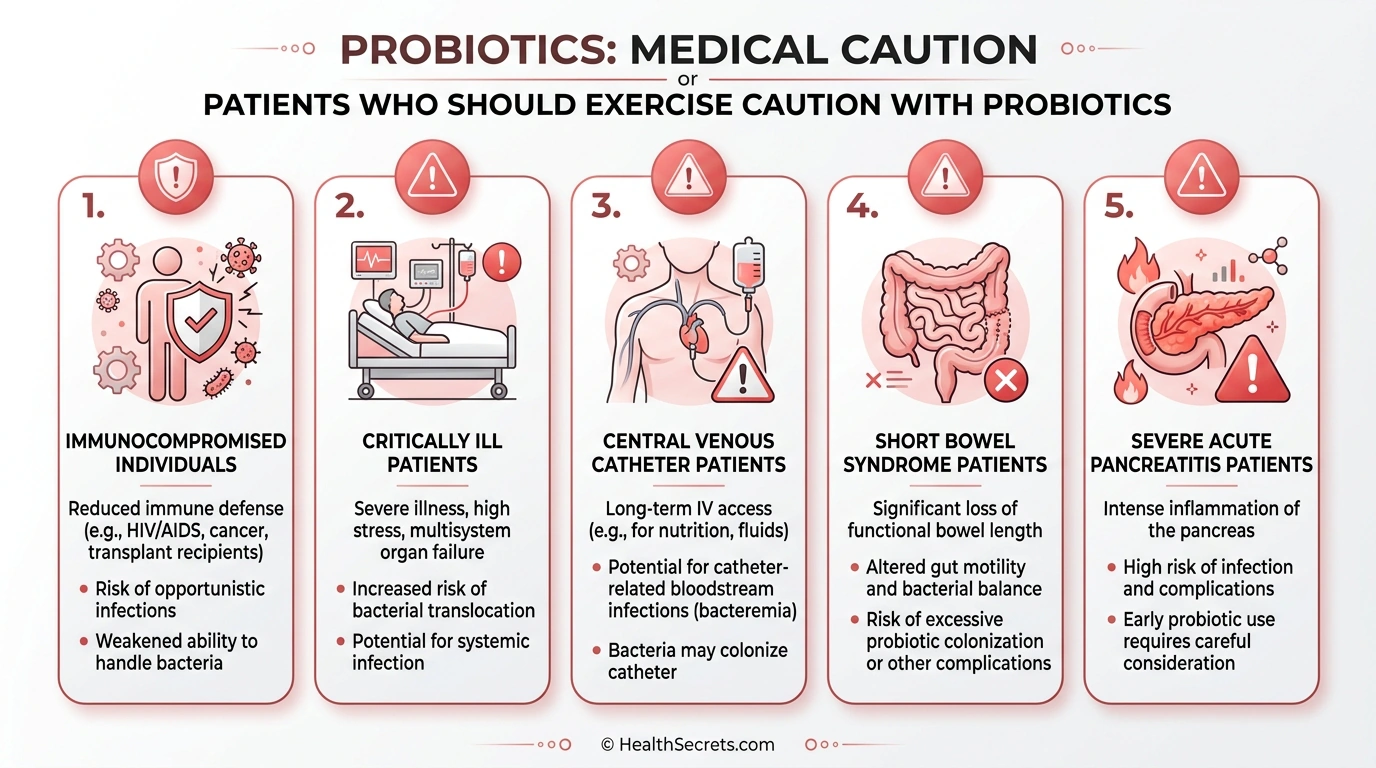
Safety infographic showing five groups of people who should consult a doctor before taking probiotic supplements

Kunnen probiotica SIBO veroorzaken of verergeren?

Dit wordt in de literatuur betwist. Een studie uit 2018 in Clinical and Translational Gastroenterology suggereerde dat probioticagebruik bij sommige patiënten met SIBO kan bijdragen aan D-lactaat acidose en 'brain fog' [16]. Een systematische review uit 2024 vond echter dat specifieke stammen (L. rhamnosus GG, S. boulardii) SIBO juist kunnen helpen beheersen wanneer ze worden gebruikt als adjunctieve therapie samen met antibiotica. Als je SIBO vermoedt, raadpleeg dan een gastro-enteroloog voordat je probiotica start.

Action Plan

Welke stappen moet je eerst zetten om je darmgezondheid te verbeteren met probiotica?

Follow the sequence below, work through each phase in order, and use the checklist as your practical implementation guide.

Step-by-Step

Begin met het identificeren van je primaire darmgezondheidsdoel (algemene welzijn, IBS-verlichting, herstel na antibiotica, of immuunondersteuning), kies een klinisch gevalideerd probioticum dat bij dat doel past, en commit je aan een consistent 8–12 weken protocol terwijl je de kolonisatie ondersteunt met prebiotica-rijke voeding.

Fase 1: Evaluatie (Week 1)

  • Houd je huidige spijsverteringssymptomen 7 dagen bij (opgeblazenheid, gas, stoelgangregelmaat, energie)
  • Identificeer je primaire doel: algemeen welzijn, IBS-verlichting, herstel na antibiotica, of immuunondersteuning
  • Raadpleeg je zorgverlener, vooral als je onderliggende aandoeningen hebt
  • Lees onze complete gids voor darmgezondheid voor fundamentele kennis

Fase 2: Selectie & Start (Weeks 2–3)

  • Kies een probioticum uit onze aanbevelingen dat past bij je doel
  • Start met de helft van de aanbevolen dosis gedurende 3–5 dagen om aanvankelijke maag-darmaanpassing te minimaliseren
  • Neem consequent 20–30 minuten voor het ontbijt of bij je eerste maaltijd
  • Voeg 1–2 porties prebiotica-rijke voeding dagelijks toe (knoflook, ui, bananen, haver)

Fase 3: Optimalisatie (Weeks 4–8)

  • Verhoog naar de volledige aanbevolen dosis na de aanvankelijke aanpassingsperiode
  • Houd symptomatische verbeteringen wekelijks bij in een dagboek of app
  • Neem gefermenteerde voeding 3–4 keer per week toe voor extra stamdiversiteit
  • Zorg voor adequate hydratatie (8+ glazen water dagelijks)

Fase 4: Onderhoud (Weeks 9–12+)

  • Evalueer de voortgang tegen je initiële symptomenbaseline
  • Overweeg een darmgezondheidsspecialist te raadplegen als symptomen niet zijn verbeterd
  • Plan stamrotatie elke 3–6 maanden voor microbiome-diversiteit
  • Blijf prebiotica en gefermenteerde voeding innemen als doorlopende ondersteuning
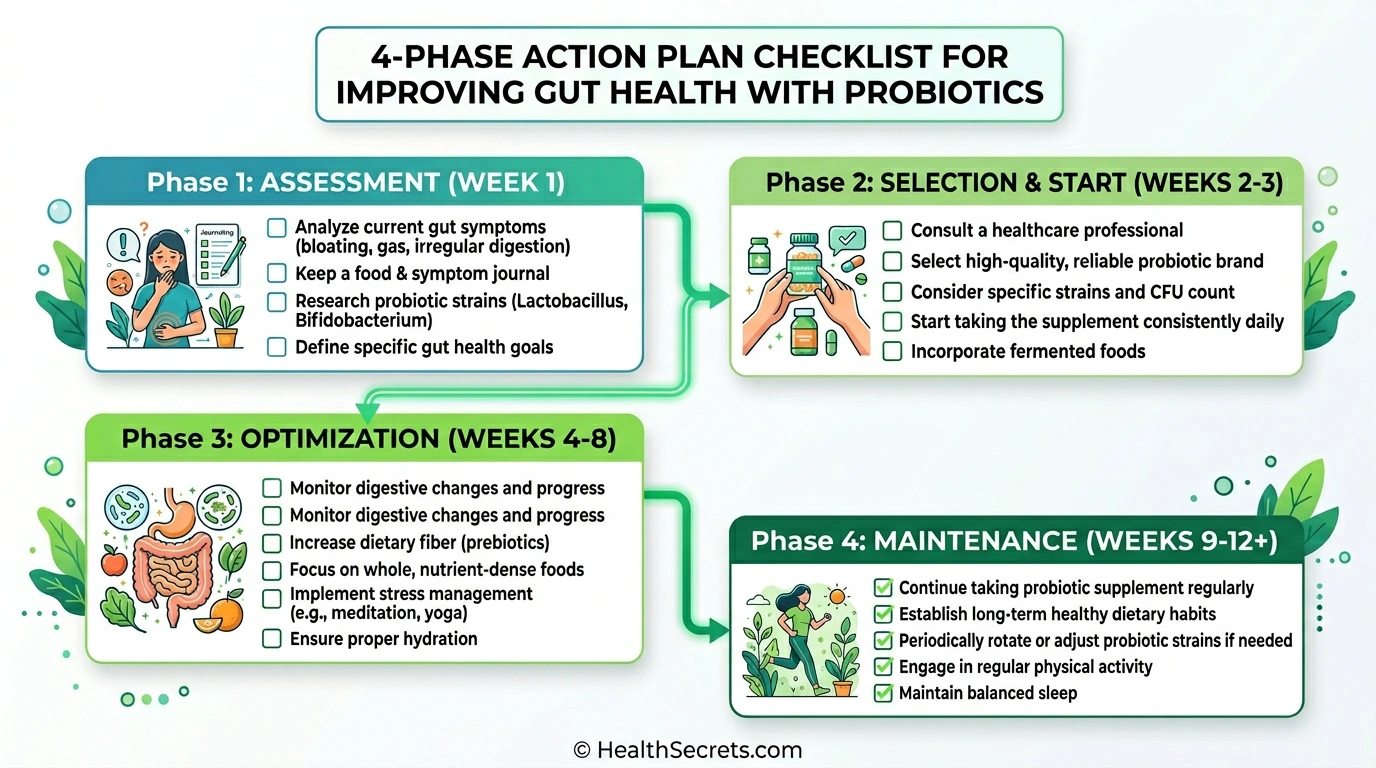
Four-phase action plan checklist for starting a probiotic supplement routine for optimal gut health

Top aanbevolen producten

Comparison shortlist to review before leaving the guide

12 Items
01

Seed DS-01 Daily Synbiotic

Seed DS-01 · Comprehensive daily microbiome support and gut barrier health

Compare details
02

Culturelle Digestive Daily Probiotic

Culturelle Digestive · General digestive health, diarrhea prevention, first-time probiotic users

Compare details
03

Align Extra Strength Probiotic

Align Extra · IBS symptom management (bloating, pain, irregular bowels)

Compare details
04

Visbiome High Potency Probiotic

Visbiome High · Therapeutic use, ulcerative colitis support, severe dysbiosis

Compare details
05

Garden of Life Dr. Formulated Probiotics Once Daily 30 Billion

Garden of · Health-conscious consumers seeking organic, clean-label probiotics

Compare details
06

Renew Life Ultimate Flora Extra Care 50 Billion

Renew Life · Budget-conscious consumers wanting high-potency multi-strain support

Compare details
07

NOW Foods Probiotic-10 25 Billion

NOW Foods · Daily maintenance and broad microbiome diversity on a budget

Compare details
08

Jarrow Formulas Jarro-Dophilus EPS 5 Billion

Jarrow Formulas · Travelers, office use, anyone needing reliable room-temperature storage

Compare details
09

Florastor Daily Probiotic Supplement

Florastor Daily · Antibiotic-associated diarrhea prevention, C. difficile recurrence, travel diarrhea

Compare details
10

Thorne FloraPro-LP Probiotic

Thorne FloraPro-LP · Athletes, quality-focused consumers, gut barrier support

Compare details
11

Hyperbiotics PRO-15 Advanced Strength

Hyperbiotics PRO-15 · Those who prefer slow-release delivery and sustained gut support throughout the day

Compare details
12

Ritual Synbiotic+

Ritual Synbiotic+ · Consumers seeking a comprehensive pre/pro/postbiotic in one formula

Compare details

Read the detailed review cards below before opening any retailer link

Verder lezen

Verder lezen

"The Good Gut: Taking Control of Your Weight, Your Mood, and Your Long-Term Health"

by Justin Sonnenburg, PhD & Erica Sonnenburg, PhD

Understanding of how the Western diet has depleted microbiome diversity; practical dietary strategies for feeding beneficial gut bacteria; scientific framework for understanding probiotic and prebiotic mechanisms

Why it adds value here

Written by two of the world's leading microbiome scientists, this book provides the foundational knowledge that makes all probiotic decisions more informed and effective.

Beste voor: Anyone wanting to understand the science behind gut health before choosing a probiotic

View book details

Verder lezen

"Gut: The Inside Story of Our Body's Most Underrated Organ"

by Giulia Enders, MD

Complete understanding of how the digestive system works; clear explanation of the gut-brain connection and its health implications; practical guidance on food choices, probiotics, and common digestive issues

Why it adds value here

This accessible bestseller makes complex gut science enjoyable to learn, giving readers the foundational knowledge to make smarter probiotic and dietary choices.

Beste voor: Beginners who want an engaging, easy-to-read introduction to gut health science

View book details

Verder lezen

"The Mind-Gut Connection: How the Hidden Conversation Within Our Bodies Impacts Our Mood, Our Choices, and Our Overall Health"

by Emeran Mayer, MD

Deep understanding of the gut-brain axis and bidirectional communication; evidence linking gut bacteria to mood, anxiety, and cognitive function; practical protocols for optimizing the gut-brain connection through diet and probiotics

Why it adds value here

Understanding the gut-brain axis is essential for appreciating why probiotic supplementation can impact mental wellness, immune function, and overall health beyond digestion.

Beste voor: Readers interested in the gut-brain connection and how probiotics influence mental health

View book details

AEO FAQ

Frequently Asked Questions

12 common questions answered

For overall gut health, Seed DS-01 Daily Synbiotic offers the broadest clinical evidence with 24 strains and innovative delivery technology. For a budget-friendly alternative, Renew Life Ultimate Flora Extra Care 50 Billion delivers excellent strain diversity at a lower price. The best choice depends on your specific goals, budget, and whether you prefer multi-strain or targeted single-strain support. See our complete gut health guide for more context.

Most adults benefit from 10–50 billion CFUs per day. Research shows doses above 50 billion don't significantly improve outcomes but may increase initial bloating [6]. More important than raw CFU count is delivery technology — a 5 billion CFU product with enteric coating may deliver more live bacteria than a 100 billion CFU product in a standard capsule.

Research suggests taking probiotics 30 minutes before a meal or with food provides the best survival rates [10]. The slight pH increase during eating creates a more favorable environment for bacterial transit. Consistency matters more than exact timing — choose a time you'll remember daily.

Yes, daily probiotic use is generally safe for most healthy adults. Many clinical trials use 8–12 week protocols, and some gastroenterologists recommend ongoing supplementation for chronic conditions like IBS. For general wellness, consider cycling between different formulas every 3–6 months for broader microbiome diversity [12].

Yes, specific strains have strong clinical evidence for reducing bloating. Bifidobacterium longum 35624 (Align) and Lactobacillus plantarum 299v are among the most studied for IBS-related bloating [2][4]. Note that probiotics may temporarily increase gas during the first 1–2 weeks as your microbiome adjusts.

Probiotics are live beneficial microorganisms (bacteria or yeast) that colonize your gut. Prebiotics are non-digestible fibers (like inulin, FOS, and GOS) that feed existing beneficial bacteria. Both work synergistically — taking a probiotic with prebiotic fiber increases colonization by up to 37% [11]. Learn more in our probiotics and prebiotics supplement guide.

Not necessarily. Both can be effective when properly manufactured. Shelf-stable products use freeze-drying and moisture-protective packaging, while refrigerated products may contain more fragile strains. The key indicator of quality is "guaranteed potency through expiration date" — not storage method [8].

The most common side effects are temporary gas, bloating, and changes in bowel patterns during the first 1–2 weeks [13]. These usually resolve as your gut adjusts. Start at half the recommended dose for 3–5 days to minimize initial discomfort. Serious side effects are rare but possible in immunocompromised individuals.

Saccharomyces boulardii (Florastor) is the only probiotic you can take simultaneously with antibiotics because it's a yeast, naturally resistant to antibacterial agents [3]. For bacterial probiotics, space them at least 2 hours apart from antibiotic doses. Continue probiotics for at least 2–4 weeks after completing antibiotic therapy.

Bifidobacterium longum 35624 (in Align) has the strongest IBS-specific clinical evidence, followed by Lactobacillus plantarum 299v for bloating and abdominal pain, and Saccharomyces boulardii for IBS-D [2][4]. Multi-strain formulas like Visbiome have evidence for IBS symptom reduction at higher doses. See our natural IBS relief guide for comprehensive strategies.

Most people notice initial improvements in digestive comfort within 2–4 weeks of consistent daily use [9]. Full microbiome benefits, including improved immune function and gut barrier integrity, typically develop over 8–12 weeks. If you don't notice any improvement after 4 weeks, consider trying a different strain or multi-strain formula.

Some strains show modest effects on body composition. Lactobacillus gasseri SBT2055 reduced abdominal fat by 8.5% over 12 weeks in a 2013 Japanese study. However, probiotics are not a weight loss solution on their own — they work best as part of a comprehensive approach including diet, exercise, and lifestyle changes.

🦠

Test Your Knowledge

Take our Gut Health Quiz and see how much you really know about gut health.

Take Quiz

Was this article helpful?

Written & Reviewed By Experts

HS

Author

Health Secrets Editorial Team

Dr. Emily Foster

Medical Reviewer

Dr. Emily Foster

MD, Endocrinology

All content is evidence-based, peer-reviewed by qualified professionals, and updated regularly. Our editorial team follows strict guidelines for accuracy and transparency.

Referenties & Citaten

18 bronnen geciteerd

1
Capurso, L. (2019). Thirty Years of Lactobacillus rhamnosus GG: A Review. Journal of Clinical Gastroenterology, 53(Suppl 1), S1–S41. PubMed Bekijk
2
Whorwell, P.J. et al. (2006). Efficacy of an Encapsulated Probiotic Bifidobacterium infantis 35624 in Women with Irritable Bowel Syndrome. American Journal of Gastroenterology, 101(7), 1581–1590. PubMed Bekijk
3
Szajewska, H. & Kołodziej, M. (2015). Systematic Review with Meta-Analysis: Saccharomyces boulardii in the Prevention of Antibiotic-Associated Diarrhoea. Alimentary Pharmacology & Therapeutics, 42(7), 793–801. PubMed Bekijk
4
Ducrotté, P. et al. (2012). Clinical Trial: Lactobacillus plantarum 299v (DSM 9843) Improves Symptoms of Irritable Bowel Syndrome. World Journal of Gastroenterology, 18(30), 4012–4018. PubMed Bekijk
5
Waller, P.A. et al. (2011). Dose-Response Effect of Bifidobacterium lactis HN019 on Whole Gut Transit Time and Functional Gastrointestinal Symptoms in Adults. Scandinavian Journal of Gastroenterology, 46(9), 1057–1064. PubMed Bekijk

Medische Disclaimer

The information provided in this article is for educational and informational purposes only and is not intended as a substitute for professional medical advice, diagnosis, or treatment. Always seek the advice of your physician or other qualified health provider with any questions you may have regarding a medical condition or before starting any new supplement regimen. Never disregard professional medical advice or delay in seeking it because of something you have read on this website. If you think you may have a medical emergency, call your doctor or emergency services immediately. HealthSecrets does not recommend or endorse any specific tests, physicians, products, procedures, opinions, or other information that may be mentioned on this site. Reliance on any information provided by HealthSecrets, its writers, or other contributors is solely at your own risk.

You Might Also Like

Discussion (0)

Loading comments...