
If you've ever had a urinary tract infection, you already know the misery — that relentless burning, the constant urge to go, and the sinking feeling that it might come back again next month. You're far from alone. UTIs rank among the most common bacterial infections worldwide, affecting roughly 50–60% of women at some point in their lives. And for about 25% of those women, the infections keep recurring.
Here's what most people don't realize: while antibiotics remain essential for treating active UTIs, a growing body of research supports using natural remedies for UTI prevention. Cranberry products reduced UTI risk by 30% in a massive 2023 Cochrane review of 50 clinical trials ([1]). D-mannose, a simple sugar that blocks bacterial adhesion, has shown promise in several trials — though results remain mixed in larger studies ([2]). Probiotics, vitamin C, and smart hydration habits round out a prevention toolkit grounded in real science.
This guide walks you through each natural remedy for UTI prevention step by step — what the research actually says, how to dose correctly, and how to build a daily routine that keeps infections from coming back. We'll also be straight about when these remedies aren't enough and antibiotics are non-negotiable.
For more on supporting your body's natural defenses, check out our complete immune system guide and our gut health guide for the connection between gut bacteria and urinary health.
What Do You Need to Know Before Trying Natural Remedies for UTI?
Before starting any natural UTI prevention protocol, you need to understand what causes these infections and who they affect most. UTIs occur when bacteria — primarily E. coli, responsible for 80–90% of cases — enter the urinary tract through the urethra and colonize the bladder wall. Women are significantly more susceptible due to shorter urethras and anatomical proximity to the GI tract.
A recurrent UTI is defined as two or more infections within six months, or three or more within a year. If that describes your situation, natural prevention strategies may help break the cycle. But there's a critical distinction you must understand before going further.
Prevention vs. treatment are fundamentally different. The natural remedies in this guide are supported by evidence for preventing UTIs or reducing recurrence. They are not replacements for antibiotics when you have an active infection. An untreated UTI can progress to a kidney infection (pyelonephritis), which is a medical emergency. If you currently have UTI symptoms — burning urination, urgency, cloudy or bloody urine, pelvic pain — see your healthcare provider first.
With that foundation in place, let's walk through the most evidence-backed natural approaches, starting with the remedies that have the strongest research behind them.

Want Everyday Habits That Actually Stick?
Download the free printable habit checklist — evidence-backed clinical frameworks for daily energy, cellular recovery, and longevity.
How Do You Use D-Mannose to Prevent Urinary Tract Infections?
D-mannose is a naturally occurring simple sugar found in cranberries, apples, and peaches that works by binding to E. coli bacteria in the urinary tract, preventing them from attaching to the bladder wall so they get flushed out during urination. The standard prevention dose is 2g daily, typically taken as a powder dissolved in water.
The mechanism is elegantly simple. E. coli bacteria use finger-like projections called fimbriae to latch onto mannose receptors on bladder cells. When you consume D-mannose, it concentrates in your urine and essentially "occupies" those bacterial binding sites. The bacteria grab onto the free-floating mannose molecules instead of your bladder wall, and you urinate them right out ([4]).
What does the research actually show?
The evidence on D-mannose is genuinely mixed, and honesty matters here. A 2023 randomized controlled trial found that a D-mannose-based supplement complex (DAPAD) achieved 88.6% clinical resolution versus 20% for placebo in treating acute E. coli UTIs ([3]). However, the largest trial to date — a 2024 double-blind RCT published in JAMA Internal Medicine involving 99 primary care centers — found that 2g daily D-mannose did not significantly reduce UTI recurrence compared to placebo in women with recurrent UTIs ([2]).
What does this mean practically? D-mannose appears safe with minimal side effects (mild GI discomfort at high doses), and the biological mechanism is well-established. Some individuals may respond better than others, particularly those whose recurrent UTIs are predominantly caused by E. coli. At prevention doses of 2g daily, it's a low-risk option worth trying alongside other strategies in this guide.
Dosing:
- Prevention: 2g daily (powder or capsules)
- During acute symptoms: 1.5g every 2–3 hours for 3 days, then 1.5g twice daily (always alongside medical care)
- Best taken: Dissolved in water, on an empty stomach


Fermentation Safety Starter Kit
A 32-page downloadable digital PDF guide featuring brine salinity calculation charts, equipment sanitation checklists, batch tracking logs, and 6 guided beginner recipes. (Digital PDF Only — No physical items shipped).
How Does Cranberry Help Prevent UTIs Naturally?
Cranberry contains proanthocyanidins (PACs) — specifically type-A
PACs — that prevent E. coli bacteria from adhering to the bladder wall, similar to D-mannose but through a different mechanism. The 2023 Cochrane review of 50 clinical trials found cranberry products reduced UTI risk by 30%, making cranberry one of the most well-supported natural prevention options available.
That 2023 Cochrane meta-analysis deserves a closer look. Across 8,857 randomized participants, cranberry products significantly reduced UTI risk (RR 0.70, 95% CI 0.58–0.84) with moderate-certainty evidence. The benefit was strongest in women with recurrent UTIs (26% reduction), children (54% reduction), and people susceptible to UTIs from medical interventions (53% reduction) ([1]). A 2026 multicenter RCT further confirmed that whole cranberry fruit powder reduced culture-confirmed UTIs in women with recurrent infection history ([8]).
Here's where most people go wrong: grabbing cranberry juice cocktail at the grocery store. Those sugary drinks contain minimal PACs and loads of added sugar. You need 36mg of PACs daily for preventive benefit — that typically means concentrated supplements standardized to PAC content, or 8–10 ounces of pure, unsweetened cranberry juice.
Dosing:
- Target: 36mg PACs daily
- Best forms: Cranberry capsules/tablets standardized to PAC content, or unsweetened pure cranberry juice
- Avoid: Cranberry juice cocktails with added sugar
- Safety note: Generally safe; may interact with warfarin (blood thinners) — check with your doctor

How Can Probiotics and Vitamin C Support Urinary Tract Health?
Probiotics containing specific Lactobacillus strains help maintain a healthy urinary microbiome that resists pathogenic bacteria, while vitamin C acidifies urine to create a less hospitable environment for E. coli. Together, they form a supporting layer in your UTI prevention strategy — not the primary defense, but a meaningful complement to D-mannose and cranberry.
Which probiotic strains help with UTIs?
Not all probiotics are created equal for urinary health. The strains with the most evidence include:
- Lactobacillus rhamnosus GR-1 — the most studied strain for urogenital health
- Lactobacillus reuteri RC-14 — often paired with L. rhamnosus GR-1
- Lactobacillus crispatus — naturally dominant in a healthy vaginal microbiome
These strains work through competitive exclusion — they colonize mucosal surfaces and produce lactic acid, hydrogen peroxide, and biosurfactants that prevent pathogenic bacteria from gaining a foothold. Vaginal probiotics may be more effective than oral forms for urinary health, though oral supplements still show benefit at doses of 1–10 billion CFU daily ([6]).

Does vitamin C actually prevent UTIs?
Vitamin C (ascorbic acid) has been explored alongside D-mannose for UTI prevention. The theory: vitamin C acidifies urine, making it harder for bacteria to thrive. At doses of 500–1000mg daily, it may provide modest benefit — though the evidence is weaker than for cranberry or D-mannose. Consider it a low-cost, low-risk addition rather than a primary strategy.
How Does Staying Hydrated Help Flush UTI-Causing Bacteria?
Drinking adequate water — 8 to 10 glasses daily — is one of the simplest and most effective UTI prevention strategies because frequent urination physically flushes bacteria from the urinary tract before they can establish an infection. This isn't folk wisdom; it's basic microbiology that even conventional urologists recommend as a first-line prevention measure.

The logic is straightforward. Bacteria need time to adhere to the bladder wall and multiply. Every time you urinate, you're washing out bacteria that haven't yet established a colony. The more frequently you go, the fewer bacteria survive.
Practical hydration tips for UTI prevention:
- Aim for 8–10 glasses (64–80 oz) of water daily — more if you're active or in hot weather
- Don't hold it. When you feel the urge, go. Holding urine gives bacteria more time to multiply
- Space your water intake throughout the day rather than drinking large amounts at once
- Monitor your urine color — pale yellow indicates good hydration; dark yellow means drink more
- During an active UTI, increase intake to help flush bacteria more aggressively

How Do You Build a Daily UTI Prevention Routine?
The most effective UTI prevention combines supplements with simple hygiene and lifestyle habits into a consistent daily routine. No single remedy works as well alone as a layered approach — think of it as building multiple barriers that bacteria have to overcome.
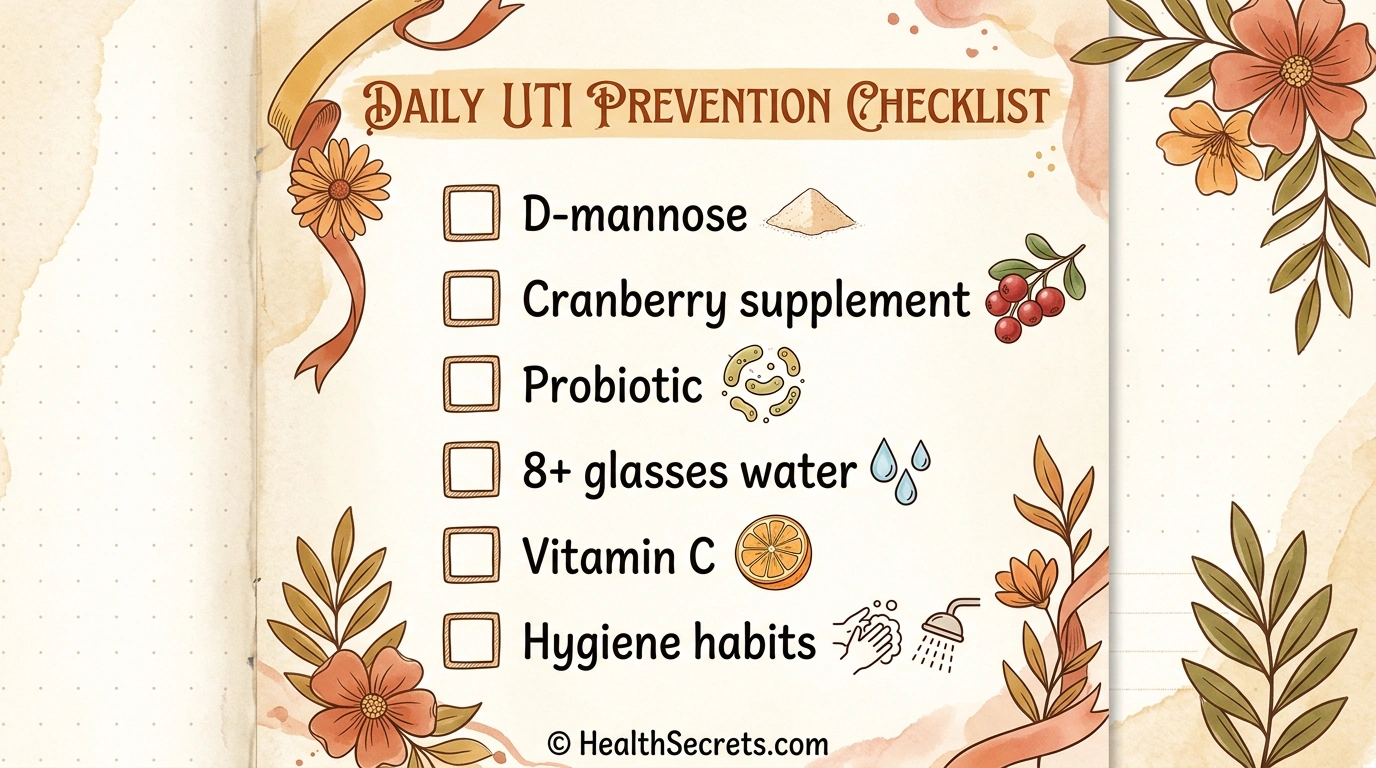
Your daily UTI prevention checklist:
- Take D-mannose (2g) in the morning with water on an empty stomach
- Take cranberry supplement (36mg PACs) with breakfast
- Take a urinary probiotic (L. rhamnosus/L. reuteri) daily
- Drink 8–10 glasses of water throughout the day
- Take vitamin C (500mg) with a meal
- Wipe front to back after using the bathroom
- Urinate within 30 minutes after sexual activity
- Wear breathable cotton underwear
- Avoid douches, feminine sprays, and harsh soaps in the genital area
- Don't hold urine — go when you feel the urge
For women dealing with recurrent UTIs, additional strategies include: avoiding spermicide-based contraceptives (which disrupt vaginal flora), discussing vaginal estrogen therapy with your doctor if post-menopausal, and keeping a UTI diary to identify personal triggers.
What Are the Most Common Mistakes People Make with Natural UTI Remedies?
The biggest mistake is using natural remedies to treat an active UTI instead of seeing a doctor. This delays proper antibiotic treatment and risks the infection spreading to the kidneys. Natural remedies are for prevention — not a substitute for medical care when you're actively infected.
Other common mistakes include:
- Buying cranberry juice cocktail instead of supplements standardized to 36mg PACs — the sugar in cocktails may actually worsen things
- Stopping prevention too soon — most studies showing benefit used supplements for 3–6 months consistently
- Taking the wrong probiotic strains — generic probiotics may not contain the Lactobacillus strains studied for urinary health
- Relying on a single remedy — layering multiple approaches (D-mannose + cranberry + hydration + hygiene) provides better protection than any one alone
- Ignoring worsening symptoms — fever, back pain, nausea, or blood in urine require immediate medical attention
- Not tracking recurrence patterns — keeping a diary helps you and your doctor identify triggers and measure whether prevention is working
When Should You Stop Natural Remedies and See a Doctor for a UTI?
You should see a doctor immediately if you develop fever, flank or back pain, nausea, vomiting, or blood in your urine — these symptoms suggest the infection may have reached your kidneys, which requires prompt antibiotic treatment. Any UTI symptoms lasting more than 48 hours also warrant medical evaluation rather than continued home management.
See a doctor immediately if you experience:
- Fever (100.4°F / 38°C or higher)
- Pain in your back or sides (flank pain)
- Nausea or vomiting
- Blood in your urine (hematuria)
- Symptoms that worsen or don't improve within 48 hours
- You are pregnant (UTIs during pregnancy require antibiotics)
- You are male (UTIs in men may indicate prostate issues and need evaluation)
Important safety notes for supplements:
- D-mannose: Generally safe; may cause mild GI upset at high doses; use caution with diabetes (it's a sugar, though minimally absorbed)
- Cranberry: Safe for most people; may interact with warfarin; avoid if you have a history of kidney stones (oxalate content)
- Probiotics: Very safe for most people; immunocompromised individuals should consult their doctor first
- Vitamin C: Safe at 500–1000mg daily; higher doses may cause GI upset and increase kidney stone risk
Natural remedies complement but never replace medical care. If your doctor recommends prophylactic antibiotics for severe recurrent UTIs, these natural strategies can be used alongside that treatment ([9]).
Action Plan
What Should You Do First to Start Preventing UTIs Naturally?
Follow the sequence below, work through each phase in order, and use the checklist as your practical implementation guide.
Start with hydration and cranberry — the two strategies with the strongest evidence and lowest barriers to entry. Add D-mannose and probiotics in week two, then build consistent hygiene habits into your daily routine by week three. This phased approach prevents overwhelm and lets you gauge what works for your body.
Phase 1 (Week 1): Foundation
- Increase water intake to 8–10 glasses daily
- Start a cranberry supplement standardized to 36mg PACs
- Begin a UTI diary to track symptoms and triggers
Phase 2 (Week 2): Core Supplements
- Add D-mannose 2g daily (morning, empty stomach)
- Start a urinary-specific probiotic (L. rhamnosus GR-1 or similar)
- Add vitamin C 500mg daily
Phase 3 (Week 3): Lifestyle Habits
- Implement all hygiene practices (front-to-back, post-intercourse urination)
- Review and adjust contraceptive methods if applicable
- Schedule a follow-up with your doctor to discuss your prevention plan
Phase 4 (Months 2–6): Consistency and Tracking
- Maintain daily supplement routine
- Review UTI diary monthly for patterns
- Adjust dosing or products based on response