Here's something that might surprise you about the longevity lifestyle: the people who live the longest, healthiest lives on the planet aren't doing anything particularly exotic.
No biohacking. No expensive longevity clinics. No elaborate supplement stacks.
They're walking to the market. Eating beans. Laughing with friends over a glass of wine. Tending their gardens well into their 90s. And somehow—without trying all that hard—they're reaching 100 at rates ten times higher than the rest of us.
These communities are called Blue Zones, and they've been studied extensively by researcher Dan Buettner in partnership with National Geographic and a team of demographers, scientists, and medical researchers [1]. The five original Blue Zones—Okinawa (Japan), Sardinia (Italy), Nicoya Peninsula (Costa Rica), Ikaria (Greece), and Loma Linda, California (USA)—share remarkably similar lifestyle patterns despite being scattered across different continents, cultures, and climates [2].
And here's the really good news: research suggests that roughly 75% of your longevity is determined by lifestyle and environment, not genetics [3]. That means you have far more control than you probably think.
In this guide, you'll learn the specific daily habits of the world's longest-lived populations—the Power 9—and exactly how to implement each one in your modern life, step by step. No moving to a Greek island required.
If you're interested in the broader science of aging well, check out our complete detox and cleansing guide and our 7-day detox diet and cleanse plan.
What Do You Need to Know Before Starting a Longevity Lifestyle?
A longevity lifestyle isn't a diet or exercise program—it's a holistic pattern of daily habits drawn from the world's longest-lived communities. Before you begin, understand that these changes work best when adopted gradually, starting with one or two habits and building over months. The evidence is strong, the habits are free or low-cost, and it's genuinely never too late to start.
What Are the Blue Zones and Why Do They Matter?
In the early 2000s, Dan Buettner partnered with National Geographic and longevity researchers to identify the places where people live the longest, healthiest lives [1]. They found five regions—dubbed "Blue Zones"—where centenarians thrive at extraordinary rates:
- Okinawa, Japan — Highest centenarian concentration globally; women live longer than anywhere else; low heart disease, cancer, and dementia rates
- Sardinia, Italy — Mountainous region with remarkable male longevity; shepherds walk miles daily into their 90s
- Nicoya Peninsula, Costa Rica — Lowest middle-age mortality in the world; strong sense of purpose (plan de vida)
- Ikaria, Greece — The island where people "forget to die"; Mediterranean diet, daily naps, and deep social bonds
- Loma Linda, California — Seventh-day Adventist community; faith-based lifestyle, vegetarian diet, and Sabbath rest
People in these regions don't just live longer—they live better. Lower rates of chronic disease, stronger physical function, sharper cognition, and richer social lives [2].
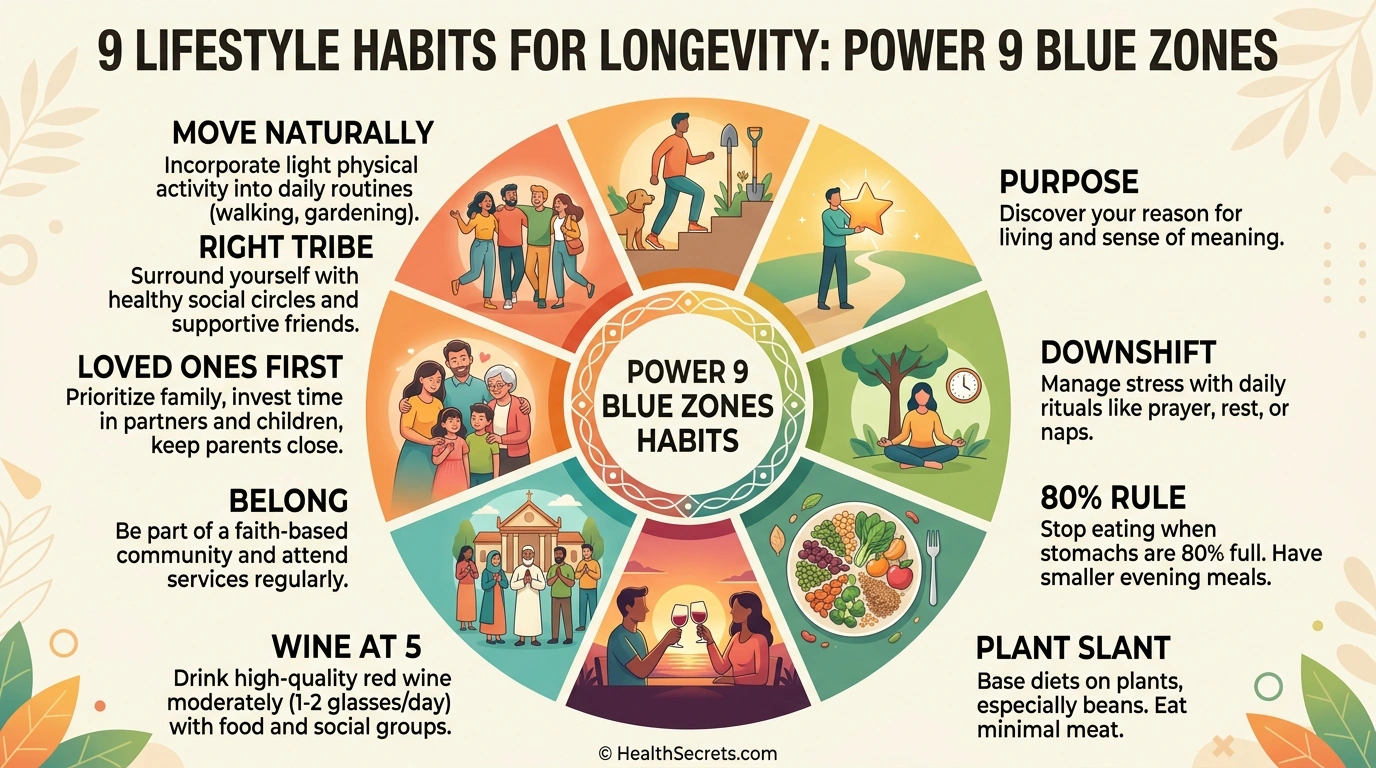
Despite vast cultural differences, researchers identified nine common lifestyle patterns—the Power 9—that appear across every Blue Zone.
How Much of Longevity Is Genetics vs. Lifestyle?
Here's the empowering part. Family studies have consistently shown that only about 25% of human longevity variation is attributable to genetic factors [3]. The remaining 75% comes down to lifestyle and environment. (A newer 2026 study in Science suggested genetics may account for closer to 50%, but even at that estimate, lifestyle remains enormously influential [17].)
Twin studies drive this point home: identical twins raised in different environments can have lifespans that differ by decades. And when Blue Zones populations migrate to Western countries and adopt Western habits, their longevity advantage disappears.
Your genes load the gun. Your lifestyle pulls the trigger—or doesn't.
How Do You Build Natural Movement Into Your Daily Life?
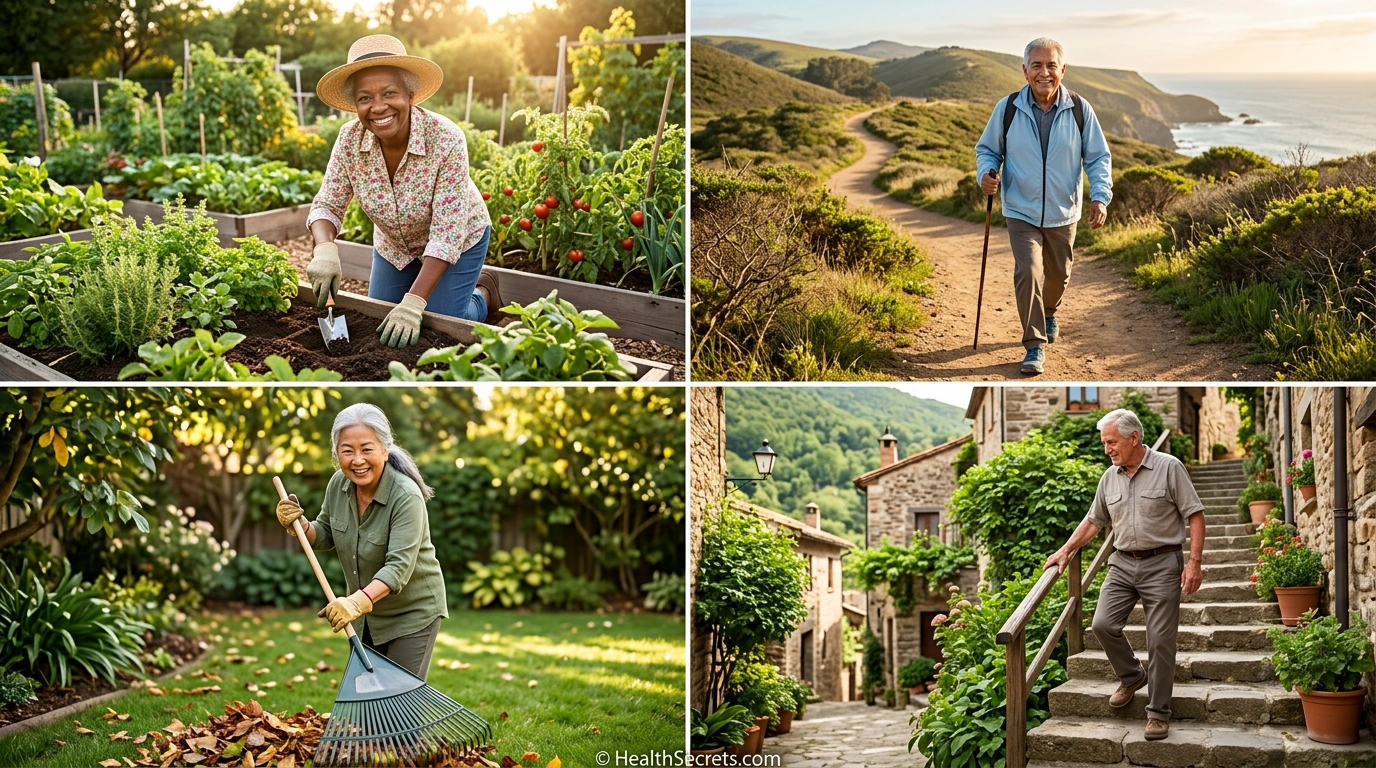
Blue Zones centenarians don't pump iron or run marathons—they move naturally throughout the day by walking, gardening, doing housework, and working physically, which research confirms is a cornerstone of healthy aging [1]. Sardinian shepherds walk five-plus miles over mountainous terrain daily well into their 90s, and Okinawans sit on the floor, getting up and down dozens of times a day.
The principle is simple: build movement into your life rather than segregating it into "exercise time."
Practical Implementation
Daily movement habits:
- Walk or bike for errands instead of driving
- Take stairs instead of elevators
- Use a standing desk or stand during calls
- Garden or do yard work regularly
- Park far from entrances
- Do housework yourself
Target: Roughly 10,000 steps daily (or equivalent natural activity).
The key difference? The modern approach is to sit all day and then do one hour of intense exercise. The Blue Zones approach is moderate, consistent movement woven throughout the entire day. You don't need to become a shepherd—but a 30-minute daily walk, hourly movement breaks, and choosing active leisure adds up dramatically over decades.

Stress Recovery Micro-Habits Workbook
A 30-day experiment framework of 5-minute restorative practices to support nervous system regulation.
How Do You Shift Toward a Plant-Based Longevity Diet?
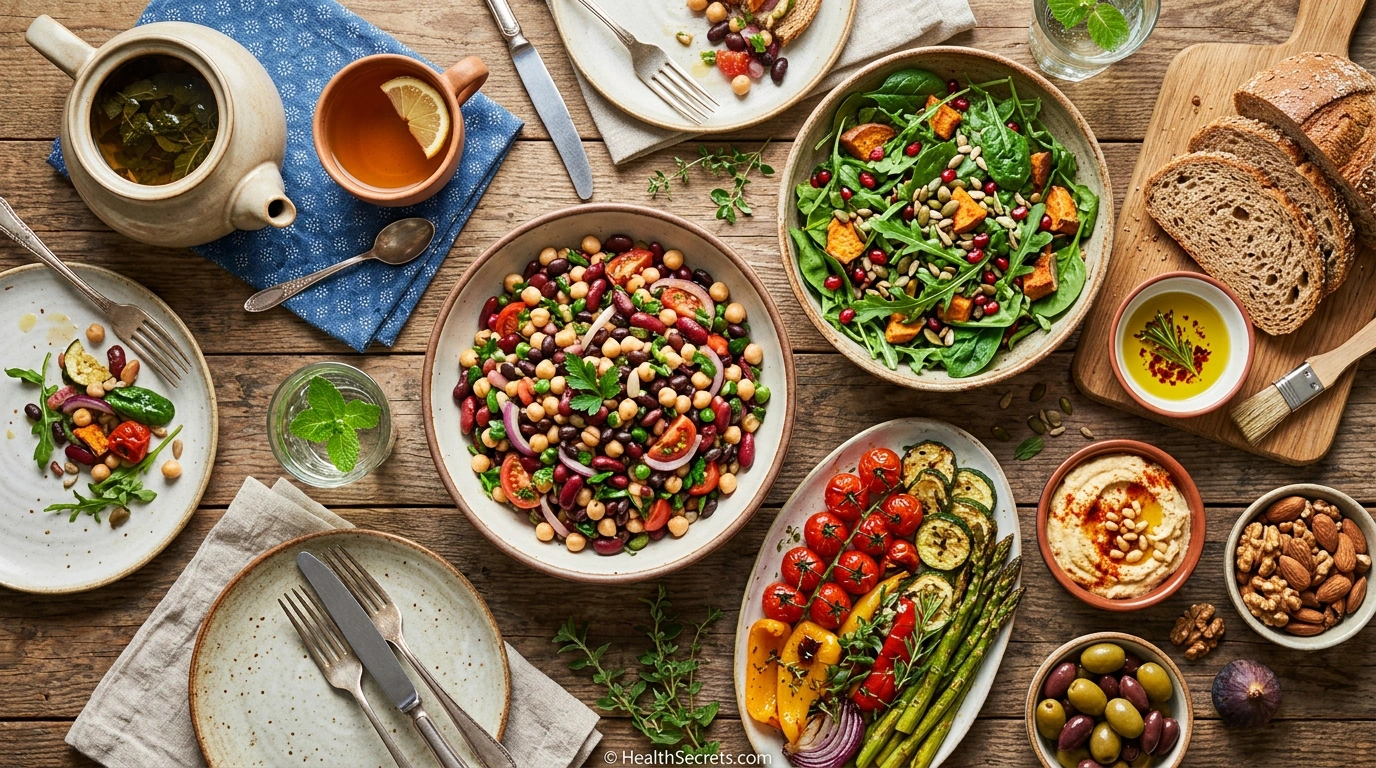
Every Blue Zones population eats a predominantly plant-based diet—roughly 95% plants—with beans, lentils, and chickpeas as the absolute cornerstone, averaging one cup daily [6]. Meat appears about five times monthly in small portions, more as a condiment than a main dish. Processed foods are virtually absent.
Here's how each Blue Zone eats:
- Okinawa: Sweet potatoes, tofu, miso, bitter melon
- Sardinia: Fava beans, sourdough bread, barley, pecorino cheese
- Nicoya: Black beans, corn tortillas, squash
- Ikaria: Lentils, wild greens, herbal teas, olive oil
- Loma Linda: All bean varieties, nuts, whole grains, fruits
How to Start
You don't need to overhaul your diet overnight. Start gradually:
- Week 1–2: Add one cup of beans to your daily meals
- Week 3–4: Make half your plate vegetables at every meal
- Week 5–6: Switch refined grains for whole grains
- Week 7–8: Reduce meat to 2–3 times per week
- Month 3+: Continue eliminating processed foods
One thing Blue Zones people absolutely do not eat: packaged snacks, soft drinks, refined sugars, or highly processed foods. Eat real, whole foods your great-grandmother would recognize. For more on plant-based eating and gut health, check our dedicated guide.
3: How Do You Discover Your Purpose (Ikigai)?
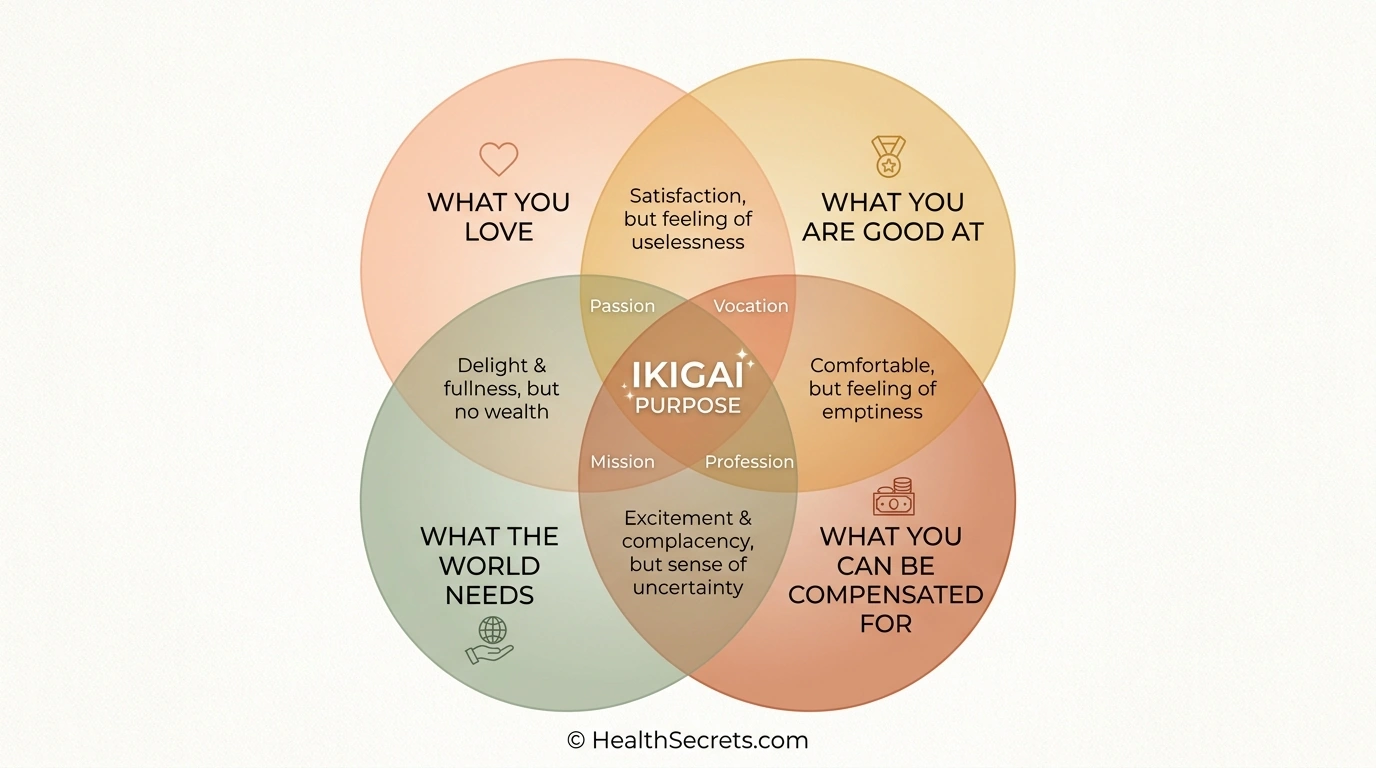
In Okinawa they call it ikigai. In Nicoya, plan de vida. Both translate to "why I wake up in the morning"—and research links a strong sense of purpose to up to seven extra years of life expectancy, with lower risks of Alzheimer's, stroke, and heart disease [5]. Blue Zones centenarians never fully retire; they remain engaged in meaningful activity throughout life.
Purpose doesn't have to be grand. It might be caring for grandchildren, tending a garden, helping neighbors, or teaching a skill.
The Ikigai Framework
Your purpose lives at the intersection of:
- What you love
- What you're good at
- What the world needs
- What you can be compensated for (not necessarily money)
How to Implement
- Identify 2–3 activities that bring meaning and schedule them regularly
- Volunteer or mentor younger people
- Pursue creative projects you've been putting off
- Stay engaged in community—never fully retire
- Revisit your purpose regularly as it evolves
How Do You Create Daily Stress Management Rituals?
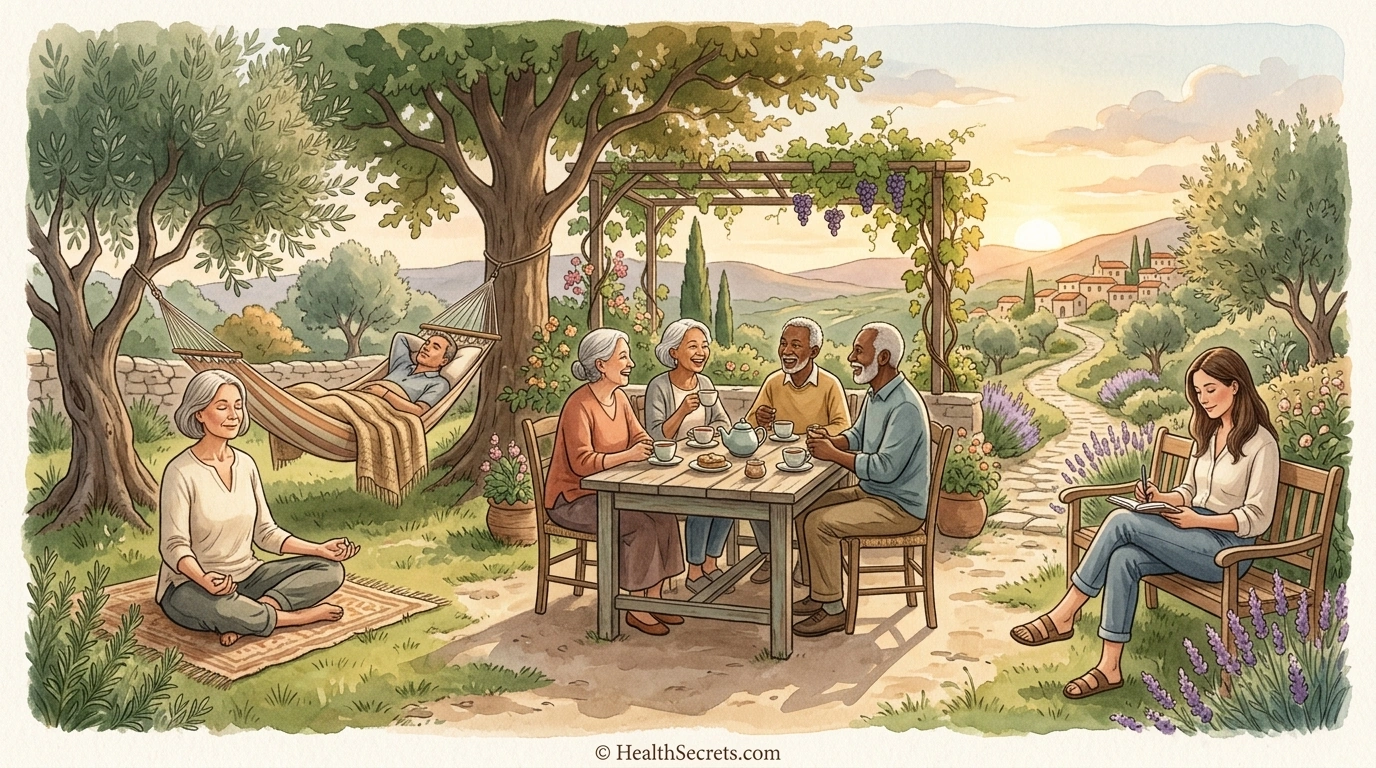
Chronic stress triggers inflammation, which accelerates every major age-related disease. Blue Zones populations don't avoid stress—they have built-in daily rituals to shed it [1]. Okinawans pause to remember ancestors. Ikarians nap for 30–60 minutes. Sardinians gather for happy hour with friends. Adventists pray and keep a 24-hour weekly Sabbath.
The principle: stress relief must be a daily ritual, not something reserved for vacations.
Practical Daily Rituals (Choose 1–2)
- Morning: Meditation (10–20 min), prayer, journaling, or a nature walk
- Midday: A 20–30 minute nap, lunch away from your desk, or a short outdoor walk
- Evening: Social time with family, reading, gentle stretching, or a gratitude practice
- Weekly: One full rest day, nature immersion, or a social gathering
Make it non-negotiable—same time, same place. Stress management isn't a luxury for longevity. It's foundational. Learn more about the connection between stress, toxins, and aging.
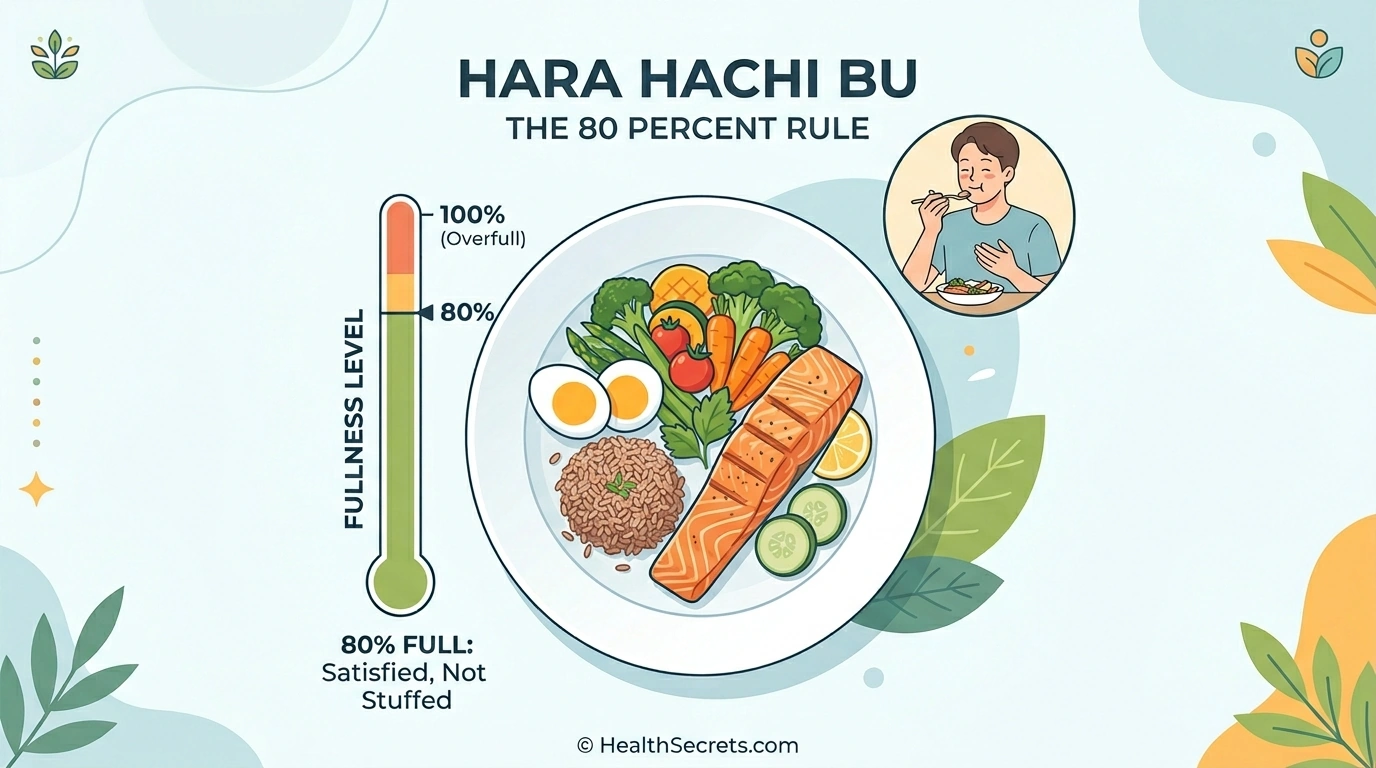
5: How Do You Practice the 80% Rule (Hara Hachi Bu)?
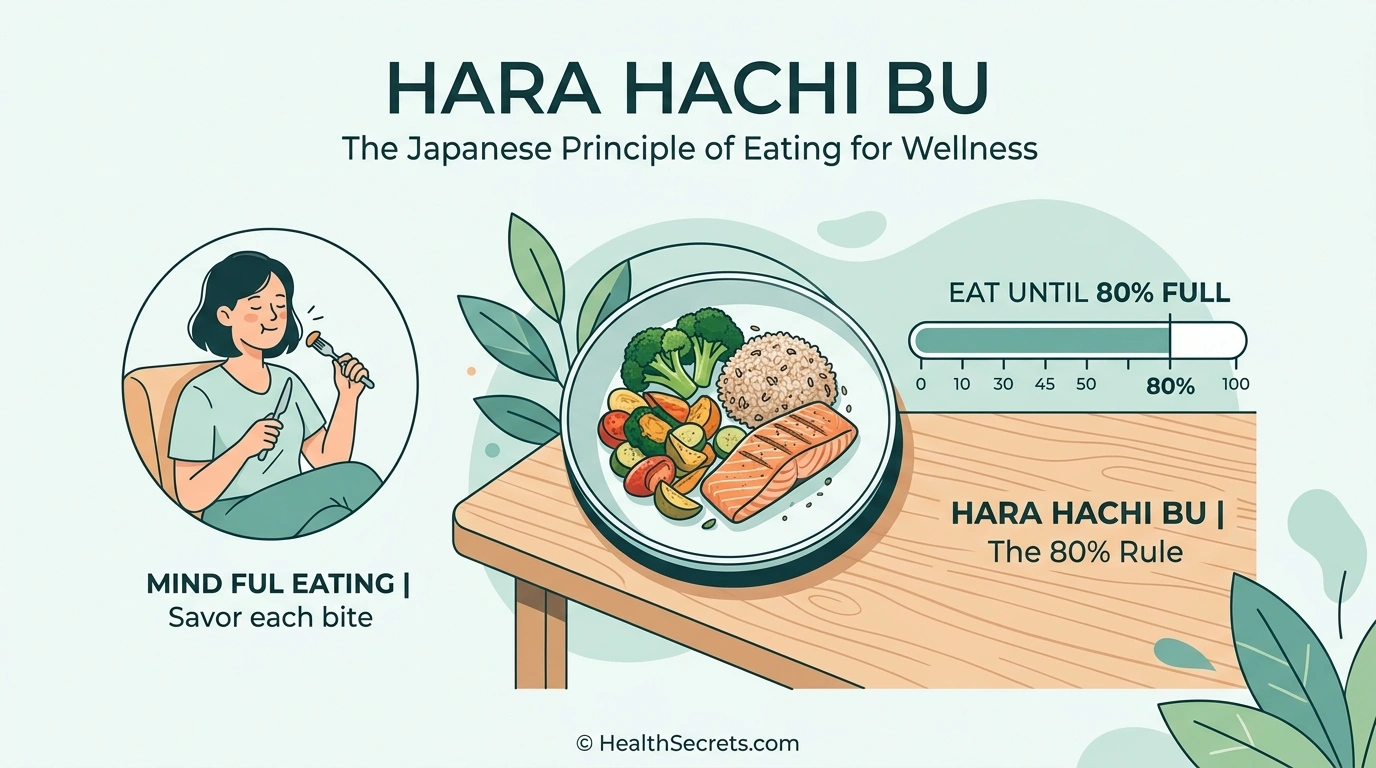
Hara hachi bu is an Okinawan phrase meaning "eat until you are 80% full"—and it's one of the simplest caloric restriction strategies ever documented [1]. Because it takes roughly 20 minutes for your stomach to signal fullness to your brain, stopping at 80% means you'll feel perfectly satisfied shortly after. Eating to 100% means you'll feel stuffed.
How to Implement
- Eat slowly: Chew 20–30 times per bite and put your fork down between bites
- Use smaller plates: 10-inch instead of 12-inch; portions look larger
- Eliminate distractions: No TV, phone, or computer during meals
- Stop at "no longer hungry": Not "full," not "stuffed"—just satisfied
- Serve food away from the table: Reduces automatic second helpings
- Eat your largest meal midday: Keep dinner light and finish by 6–7 PM for a natural 12–14 hour overnight fast
This isn't a diet. It's a mindset shift that achieves caloric restriction naturally—no counting, no deprivation, no willpower battles.
How Do You Build Strong Social Connections for Longevity?
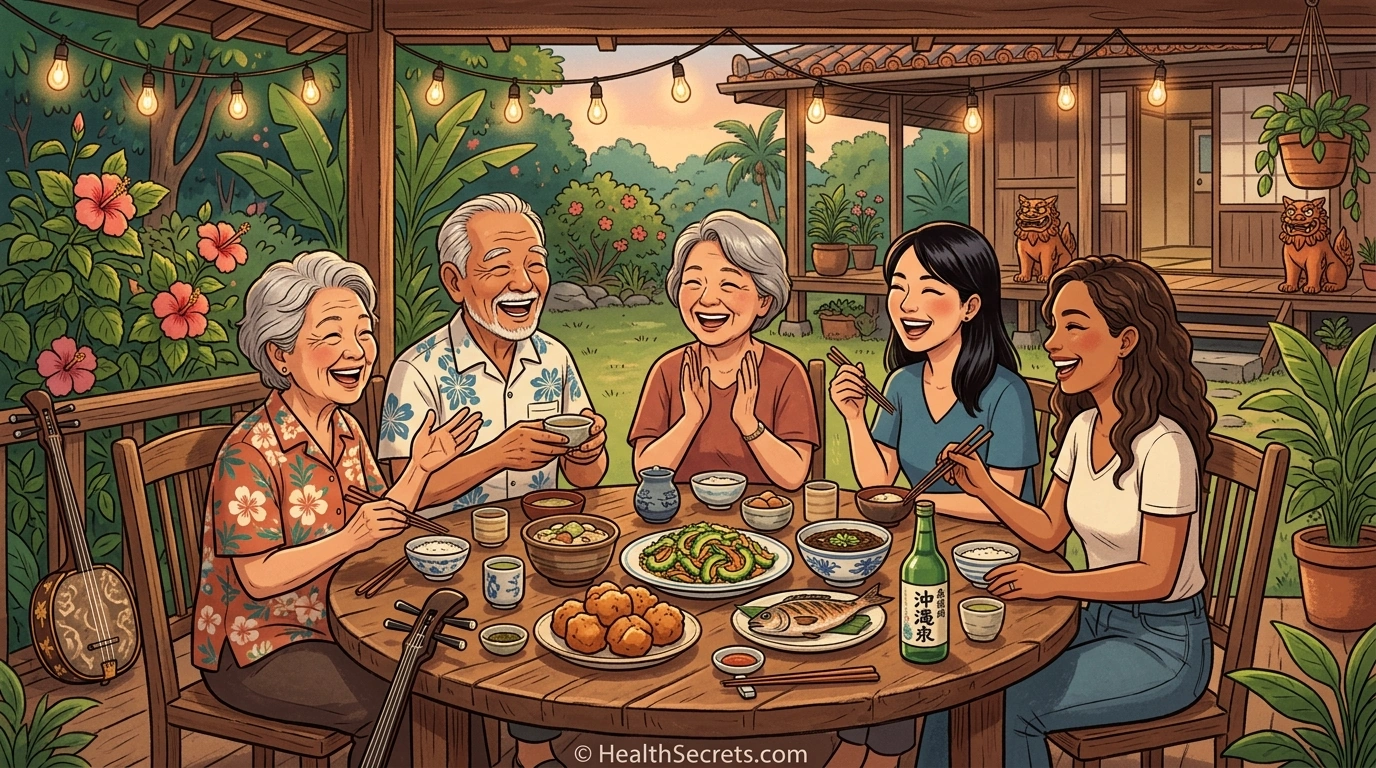
Blue Zones centenarians put family first and cultivate deep, lifelong social bonds [1]. Multi-generational living is the norm, commitment to a life partner adds roughly three years to life expectancy, and Okinawans form moais—small lifelong friend groups that meet regularly for mutual support. Research shows strong social connections reduce mortality risk by about 50%, while loneliness carries health risks comparable to smoking 15 cigarettes daily [4].
How to Implement
- Family: Weekly device-free family meals, regular contact with aging parents, multi-generational activities
- Friendships: Cultivate 3–5 close, health-supportive friendships; join a book club, hiking group, or faith community
- Create your moai: Form a small group of 4–6 people who meet regularly, support each other's health goals, and commit long-term
Your friends' habits influence your own—so choose your tribe intentionally. Social connection isn't a nice-to-have for longevity. It's essential.
How Do You Design a Complete Daily Longevity Routine?
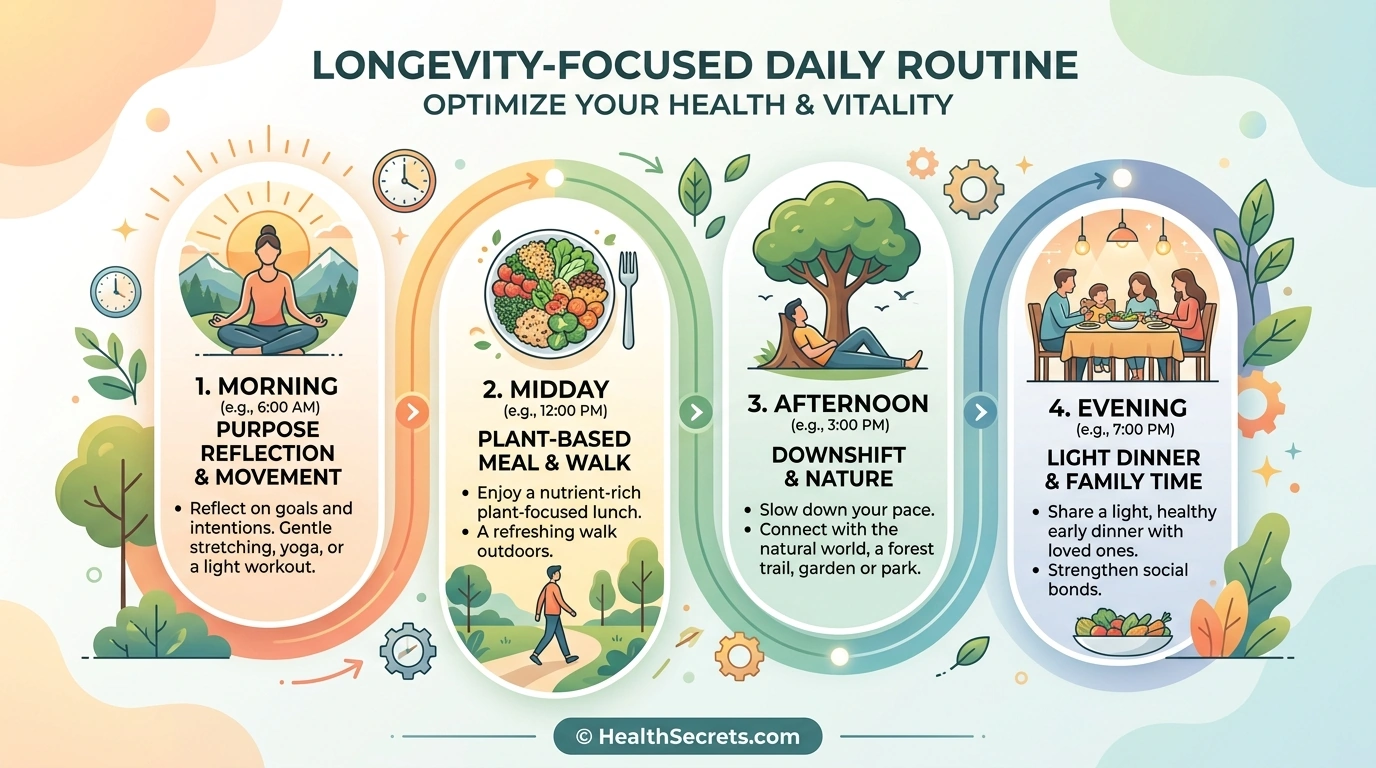
The most effective longevity lifestyle weaves all these habits into a realistic daily rhythm you can actually maintain. You don't need to implement everything at once—start with one or two habits and build gradually over months. The Blue Zones approach works because these habits reinforce each other: movement reduces stress, social meals support plant-based eating, and purpose gives you a reason to keep showing up.
Sample Daily Rhythm
- Morning (30–60 min): Purpose reflection or meditation (10 min) → Movement: walk, bike, garden, or yoga (20–30 min) → Plant-based breakfast (oats with nuts, avocado toast, or smoothie)
- Midday: Largest meal of the day—salad with beans, grain bowl, or vegetable soup. Eat slowly, stop at 80% full. Post-meal walk (10–15 min).
- Afternoon: Down-shift ritual—nap, breathing exercises, or a call with a friend. Active errands or gardening.
- Evening: Light, early plant-based dinner with family (no phones). Social connection time. Reading, gentle stretching, or gratitude journaling before bed.
- Weekly: One full rest day. Social gathering (moai, faith community, volunteer work). Nature immersion.
The 16-Week Ramp-Up
- Weeks 1–4: Add 1 cup beans daily + 30-minute walk
- Weeks 5–8: Add a daily stress ritual (meditation or nap)
- Weeks 9–12: Implement the 80% rule at meals
- Weeks 13–16: Strengthen social connections (join a group or start a moai)

The Vagal Reset Breathing Cards
Four cut-out breathing protocols with count patterns and the situation each one fits, a session log, and the medical situations where breathwork is the wrong tool.
What Are the Most Common Mistakes When Adopting Longevity Habits?
The biggest mistake is trying to change everything at once—and then giving up two weeks later when perfection proves impossible. Blue Zones centenarians didn't adopt these habits overnight. They grew up in environments designed for them. You're retrofitting your environment, so patience matters more than enthusiasm.
Common Obstacles and Solutions
- "I don't have time." Build movement into existing activities: walk while on calls, bike to errands, combine social time with a walk. Start with 10 minutes daily—consistency beats duration.
- "It's too expensive." Beans, lentils, and vegetables are cheaper than meat and processed food. Grow herbs in pots. Movement is free. This lifestyle saves money.
- "My family won't support it." Lead by example—don't preach. Make the food delicious. Invite family into activities (cook together, walk together). Start with yourself.
- "I don't have a community." Join existing groups (hiking club, faith community, volunteer organization). Start your own moai with 4–5 people. Volunteer somewhere—instant community.
- "I don't know my purpose." Experiment. Try different activities. Ask what brings joy. Purpose can be simple and it evolves—revisit it regularly.
- "I've tried before and failed." Focus on systems, not goals. Start ridiculously small. Design your environment so healthy is easy and unhealthy is hard. Find your tribe for accountability. Progress, not perfection.
Is a Longevity Lifestyle Safe for Everyone?
A longevity lifestyle based on Blue Zones habits is among the safest health approaches available—these are natural, moderate behaviors practiced by entire populations for generations. However, individual health conditions may require modifications, and no lifestyle guarantees a specific lifespan. Consult your healthcare provider before making major dietary or exercise changes, especially if you have chronic conditions.
Realistic Expectations
Following Blue Zones habits won't guarantee you'll live to 100. Accidents happen, some diseases strike regardless, and genetics do play a role. But you can realistically expect:
- Improved healthspan: More years of healthy, functional life
- Reduced disease risk: Lower rates of heart disease, cancer, diabetes, and dementia
- Better quality of life: More energy, better mood, stronger relationships, and a sense of purpose
Small, consistent changes compound over decades. Walking 30 minutes daily for 30 years has a massive cumulative impact. And studies show that even people who adopt healthy habits in their 60s, 70s, or 80s still benefit significantly [8].
The goal isn't perfection or reaching 100. It's living well—with energy, purpose, connection, and health—for as many years as possible.
Action Plan
What Should You Do First to Start a Longevity Lifestyle?
Follow the sequence below, work through each phase in order, and use the checklist as your practical implementation guide.
The best approach is to start with two foundational habits this week—daily beans and daily walking—then layer in additional habits every four weeks. This gradual, compounding strategy mirrors how Blue Zones populations actually live: not through dramatic overhauls, but through simple daily systems maintained over a lifetime.
Your Phased Action Plan
Phase 1 (Weeks 1–4): Foundation
- Add 1 cup of beans or legumes to your daily meals
- Walk 30 minutes daily (or equivalent natural movement)
- Switch one processed food for a whole food each week
Phase 2 (Weeks 5–8): Mindset
- Choose and practice one daily stress ritual (meditation, nap, prayer, or journaling)
- Identify your ikigai/purpose—write it down
- Begin eating your largest meal at midday
Phase 3 (Weeks 9–12): Eating Habits
- Practice hara hachi bu (stop at 80% full) at every meal
- Use smaller plates and eliminate screens during meals
- Finish dinner by 6–7 PM for a natural overnight fast
Phase 4 (Weeks 13–16): Connection
- Join one social group or start a moai (4–6 people)
- Schedule weekly device-free family meals
- Volunteer or engage in community activity monthly
Ongoing: Monthly habit review. Celebrate progress. Adjust what isn't working. Remember—progress, not perfection.