
Plan Two Calm Weeks of Gut-Friendly Meals Without Guesswork
A complete 53-page digital publication (A4 printable edition) featuring 14 daily balanced meal maps, weekly grocery shopping checklists, low-FODMAP and allergy substitution guides, and weekend batch-cooking prep routines. Delivered as an instant digital download.
You are purchasing The 14-Day Gut-Friendly Meal Planning System — a downloadable digital publication (53-page printable vector PDF). Upon checkout, you will receive instant online access and an immediate download link sent to your email address. This is a 100% digital product. No physical books, binders, jars, or equipment will be shipped to your address.

Why Most Advice Leaves You More Confused
Everything Included in Your Digital Download
Instant digital access to your complete printable PDF collection, actionable tools, and guided protocols.

What’s Inside the Complete System
Every section is authored to provide concrete, fillable tools rather than theoretical filler.
Clinical Meal-Pattern Map
The opening map organizes meals by a practical balance of protein, plants, fluids, and satisfying carbohydrates. It includes a flexible plate guide and a space to note household preferences, schedule constraints, and foods already tolerated. The outcome is a realistic starting pattern rather than a rigid list of permitted foods.
14-Day Fiber and Variety Ladder
A paced ladder moves from familiar, lower-friction choices toward broader plant variety with room to pause or repeat a level. Each day has a small exposure prompt, preparation notes, and a tolerance observation line. The result is a visible record of what was tried and how the household chose to proceed.
Meal Formula and Portion Builder
This worksheet converts ingredients into mix-and-match breakfasts, lunches, dinners, and snacks without requiring a new recipe every night. It provides portion prompts, substitution boxes, and a leftovers plan so one preparation can serve more than one meal. You finish with a short list of decisions instead of an open-ended search.
Grocery, Batch-Cook, and Substitution Protocol
The protocol groups shopping by produce, proteins, grains, pantry staples, and optional additions, then pairs each group with storage and prep notes. A substitution matrix helps you swap ingredients for budget, availability, preference, or household tolerance. The practical outcome is a shorter shop and a clearer prep sequence.
Food, Context, and Comfort Log
A concise log captures date, meal, approximate portion, pace, preparation, hydration, and a brief comfort note. It also leaves space for sleep, stress, travel, or other context that may affect how a day feels. These observations are for pattern discussion, not for self-diagnosis or a food-fear score.
Dining-Out and Re-Entry Plan
The final module offers restaurant questions, travel substitutions, and a gentle way to return to ordinary household meals after an unpredictable day. It includes a one-page packing and ordering checklist plus a space to record what made the plan easier. This keeps social eating practical instead of turning it into a pass-or-fail test.
Is This System Right for You?
- Adults who want a measured, food-first way to organize everyday meals while respecting individual preferences, budgets, and cultural foods.
- Households managing busy schedules, shared meals, or repeated grocery decisions that would benefit from a single visible planning system.
- People transitioning away from internet-driven restriction who want to rebuild variety with small, observable steps and less decision fatigue.
- Anyone preparing for a nutrition conversation who wants dated meal context, practical questions, and a concise record instead of scattered notes.
- It is not a diagnostic tool or an individualized medical nutrition prescription for persistent, severe, or unexplained digestive symptoms.
- It is not a substitute for assessment by a gastroenterologist or registered dietitian, especially when a clinician has prescribed a specific plan.
- It is not intended for urgent symptoms, known food allergy emergencies, or any situation that requires prompt medical attention.
Clinical Evidence & Scientific Grounding
The structure is consistent with the American College of Gastroenterology Clinical Guideline for Irritable Bowel Syndrome, which supports an individualized, patient-centered approach to diet conversations rather than indiscriminate restriction. It also reflects ESPEN clinical nutrition guidance that emphasizes adequate intake, monitoring, and adaptation to the person and care setting; a dated food-and-context record makes those conversations more concrete.
The USDA Dietary Guidelines for Americans emphasize nutrient-dense patterns, variety, and practical consistency across the overall eating pattern. This publication applies that principle as an educational household tracking system: it helps a person notice routines and prepare questions, but it does not establish a diagnosis, prove causation, or replace a clinician's assessment.
Want a Free Printable Quick-Start?
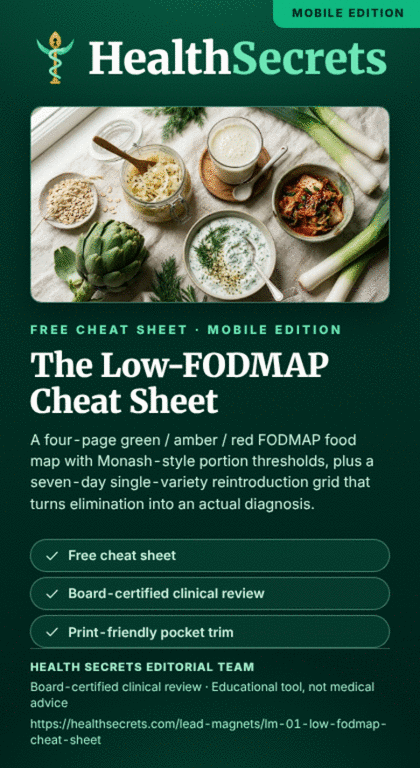
A four-page green / amber / red FODMAP food map with Monash-style portion thresholds, plus a seven-day single-variety reintroduction grid that turns elimination into an actual diagnosis.
Frequently Asked Questions
Ready to Bring Structure to Your Health?
Instant digital download. Immediate access to your complete printable PDF collection. Fully formatted for A4 home printing or tablet note-taking.