detox
Toxicity Testing: How to Assess Your Toxic Burden
Learn how toxicity testing works — blood, urine, hair analysis, and provoked testing. Discover what tests measure, when testing is worth it, costs, limitations, and smarter alternatives.

- Cons: Less precise than laboratory testing; screening tool not diagnostic; some parameters require lab confirmation
- Why We Recommend It: An affordable first step to assess your water quality before investing in filtration. If results show elevated contaminants, follow up with a CLIA-certified lab test for confirmation.
- Amazon Link: Search for Water Quality Test Kit on Amazon
Temtop M10 Air Quality Monitor
- Badge: Best For Indoor Air Assessment
- Best For: Monitoring indoor VOCs, PM2.5, and formaldehyde in real-time
- Price Range: $80–$150
- ASIN: N/A
- Dose: N/A
- Form: Portable digital device
- Count: 1 unit
- Certifications: CE certified
- Technology: Laser particle sensor, electrochemical
VOC sensor
- Pros: Real-time readings for PM2.5, HCHO, and VOCs; portable; rechargeable battery; easy-to-read display
- Cons: Does not identify specific chemicals; calibration may drift over time; screening tool not laboratory-grade
- Why We Recommend It: Provides immediate, actionable data about your indoor air quality so you can identify problem areas and verify that your HEPA filter is working effectively.
- Amazon Link: Search for Air Quality Monitor on Amazon
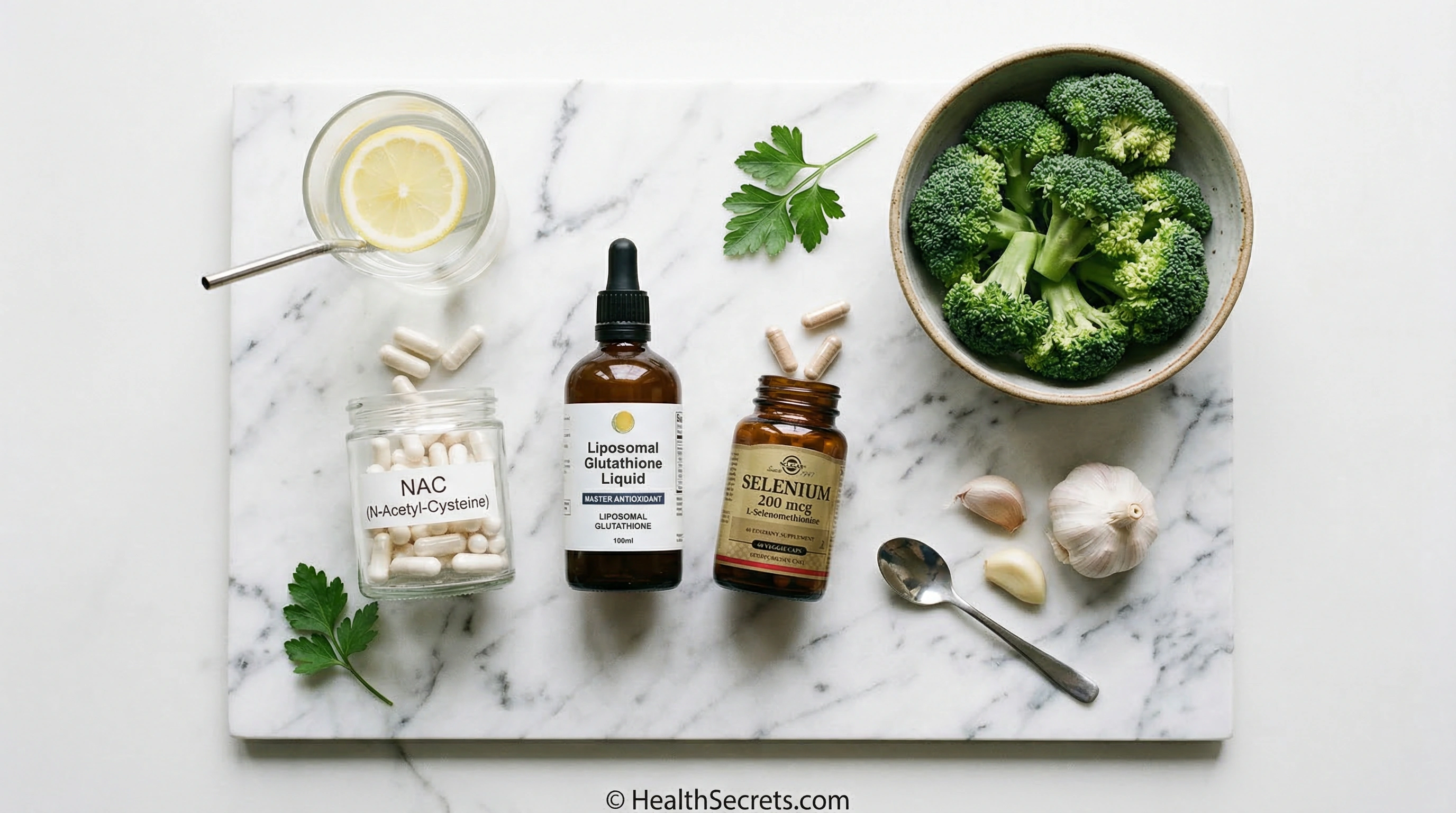
NOW Foods NAC (N-Acetyl Cysteine) 600mg
- Badge: Editor's Choice
- Best For: Supporting glutathione production and
Phase II liver detoxification
- Price Range: $12–$18
- ASIN: B0013OUQ3S
- Dose: 600mg per capsule (1–2 capsules daily)
- Form: Capsules
- Count: 250 veg capsules
- Certifications: GMP Quality Assured, Non-GMO,
Vegan
- Technology: N/A
- Pros: Clinically studied glutathione precursor; excellent value (250 count); GMP certified; well-tolerated
- Cons: May cause GI upset in some people; not recommended during pregnancy without medical guidance; sulfur smell
- Why We Recommend It: NAC is the most evidence-based supplement for boosting glutathione — your body's master antioxidant and primary detoxification molecule. At under $0.10 per capsule, it's the most cost-effective detox support available.
- Amazon Link: NOW Foods NAC 600mg on Amazon
Quicksilver Scientific Liposomal Glutathione
- Badge: Best Premium Option
- Best For: Direct glutathione supplementation with enhanced absorption
- Price Range: $35–$55
- ASIN: B00NGY73DY
- Dose: 100mg per pump (1–2 pumps daily)
- Form: Liquid (liposomal)
- Count: 50 servings per bottle
- Certifications: GMP, Third-party tested
- Technology: Liposomal delivery system (phospholipid encapsulation for superior bioavailability)
- Pros: Liposomal delivery bypasses digestive breakdown; liquid form allows flexible dosing; high bioavailability; clinically studied delivery system
- Cons: Higher price per serving; requires refrigeration after opening; strong sulfur taste
- Why We Recommend It: Standard glutathione supplements are poorly absorbed. Quicksilver's liposomal technology encapsulates glutathione in phospholipid nanoparticles, dramatically improving bioavailability for those who want direct glutathione support rather than relying solely on precursors like NAC.
- Amazon Link: Quicksilver Scientific Liposomal Glutathione on Amazon
NOW Foods Selenium 200mcg
- Badge: Best Value Antioxidant
- Best For: Supporting antioxidant enzymes that protect against oxidative damage from toxins
- Price Range: $8–$14
- ASIN: B00SJKPBNY
- Dose: 200mcg per capsule (1 capsule daily)
- Form: Capsules
- Count: 180 veg capsules
- Certifications: GMP Quality Assured, Non-GMO,
Vegan
- Technology: N/A
- Pros: Essential cofactor for glutathione peroxidase; excellent value (180 count); well-tolerated at recommended dose;
GMP certified
- Cons: Toxicity possible at doses above 400mcg daily; may interact with some medications; not suitable for people with selenium sensitivity
- Why We Recommend It: Selenium is an essential trace mineral that activates glutathione peroxidase — one of your body's most important antioxidant enzymes for neutralizing toxin-generated free radicals. At under $0.08 per capsule, it's an affordable cornerstone of detox support.
- Amazon Link: NOW Foods Selenium 200mcg on Amazon
Frequently asked questions
How much does toxicity testing cost and does insurance cover it?
Toxicity testing typically costs $100–$500 per panel depending on the type and number of toxins tested. Insurance rarely covers these tests because they are considered experimental or not medically necessary for routine screening. Some occupational exposure tests may be covered if ordered by an occupational medicine physician for workplace-related concerns.
What is the most accurate type of toxicity test?
No single test is universally most accurate — each measures a different exposure window. Blood testing is most accurate for recent exposure (days to weeks), 24-hour urine collection is most accurate for current excretion of water-soluble toxins, and hair analysis provides the best window for chronic heavy metal exposure over 3–6 months. The most accurate approach combines multiple test types guided by clinical context.
Is provoked heavy metal testing with DMSA or EDTA reliable?
Provoked testing is controversial and generally not recommended for routine diagnostic purposes. A 2021 study found it has a positive predictive value of only 4.3%, meaning most positive results are false positives. Chelating agents artificially mobilize stored minerals, producing elevated readings that are compared against unprovoked reference ranges — an invalid comparison that misleads both practitioners and patients.
Can you do toxicity testing at home?
Home test kits exist for water quality (lead, arsenic, bacteria) and some hair analysis services offer mail-in collection kits. However, these are screening tools, not diagnostic tests. Home water test kits can help identify contamination concerns, but clinical toxicity testing (blood, comprehensive urine panels) requires a healthcare provider's order and a CLIA-certified laboratory for reliable results.
What does it mean if my toxicity test results are elevated?
Elevated results indicate exposure to that toxin, not necessarily toxicity or disease. The dose makes the poison — low levels of many toxins are ubiquitous in the modern environment. Results must be interpreted in clinical context: your symptoms, exposure history, and overall health picture. An elevated level alone does not justify aggressive treatment.
How often should you repeat toxicity testing?
Repeat testing frequency depends on your situation. For occupational monitoring, testing may be recommended annually or semi-annually. If testing before and after a detox protocol, a 3–6 month interval between tests is typical to allow measurable changes. Routine repeated testing for the general population is not recommended due to cost and limited clinical utility.
What is the difference between toxic burden and toxic exposure?
Toxic exposure refers to contact with a toxin at a specific point in time, while toxic burden (also called body burden) refers to the total accumulated load of all toxins currently stored in your body. You can have high exposure but low burden if your detoxification systems eliminate toxins efficiently, or low current exposure but high burden from years of accumulated storage in bones and fat tissue.
Can toxicity testing diagnose autoimmune disease or cancer?
No — toxicity testing cannot diagnose any specific disease. It measures toxin levels, which is different from diagnosing disease. While research shows associations between certain toxin exposures and disease risk, elevated test results indicate exposure, not causation. Disease diagnosis requires separate clinical evaluation, imaging, biopsies, and other diagnostic tools.
What should you eat before a toxicity test?
For blood heavy metal testing, avoid seafood for 48–72 hours before the test to prevent artificially elevated mercury levels from recent dietary intake. For urine testing, maintain normal hydration — neither overhydrate nor restrict fluids. Your practitioner should provide specific preparation instructions based on the tests ordered. No special diet is typically required for hair analysis.
Is hair mineral analysis legitimate or pseudoscience?
Hair mineral analysis occupies a middle ground. It is a legitimate research tool for assessing chronic heavy metal exposure in population studies, validated by peer-reviewed research. However, it is not FDA-approved as a clinical diagnostic tool, results vary significantly between labs, and external contamination can produce false positives. Use reputable CLIA-certified labs and interpret results with a qualified practitioner.