
Turn the Pack Over: Read Any Food Label in Ten Seconds
The front of the pack is marketing; the back is regulated. This e-book teaches the ten-second read of the Nutrition Facts panel, the 5/20 rule that works for every nutrient, the sixty names for added sugar and what each front-of-pack claim legally means, then walks ten real shelf comparisons until the method is a habit. Delivered instantly as a 47-page fillable PDF e-book, with a free bonus: an online edition of the same e-book for any phone or computer.
You are purchasing Food Label Decoder Workbook — a downloadable digital publication (47-page fillable PDF e-book, with free bonus access to an online edition of the same e-book). Upon checkout, you will receive instant online access and an immediate download link sent to your email address. This is a 100% digital product. No physical books, binders, jars, or equipment will be shipped to your address.

See the Actual Pages
These are real pages from the 47-page e-book (the free online edition has the same content). Tap any page to see it full size.
Why Most Advice Leaves You More Confused
What’s Inside the Complete System
Every section is authored to provide concrete, fillable tools rather than theoretical filler.
The Ten-Second Read
Seven glances in order: serving size, the three limit nutrients, the two get-enough nutrients, the first three ingredients, added versus total sugar. The panel line by line, the six serving-size traps, and what changed on the US label in 2020.
The 5/20 Rule and Label Math
Every Daily Value with its 5% and 20% amounts, a worksheet that turns your products' grams into %DV, and six calculators: sugar to teaspoons, sodium to salt, per 100 g, fiber and protein per 100 kcal, calories from saturated fat, and the sugar-to-fiber ratio.
Sugar, Decoded
Added, total and free sugar and the WHO and AHA limits; sixty names in four families; fourteen foods where sugar hides; sugar alcohols, high-intensity sweeteners and rare sugars; and a calculator that adds up your sugar day.
Ingredients, Fats, Sodium, Fiber
Eight rules for the ingredient list, eight additives worth knowing (and what to do about them), which fats matter, where the sodium is, and the fiber, whole-grain and protein benchmarks the front of the pack fakes.
The Front-of-Pack Myth-Buster
What every US claim legally means, the EU thresholds, twenty myths, an eight-claim quiz, and what Nutri-Score, traffic lights, stars and warning labels can and cannot tell you.
Ten Comparisons and Your Cupboard
Ten head-to-head shelf comparisons scored line by line, two blank worksheets that calculate for your own pair, which lines matter for diabetes, blood pressure, kidney disease, children and pregnancy, a cupboard audit now and in three months, and pocket cards.
Three Steps, a Few Minutes a Day
Learn the read
Read chapter 1 once and run five products from your cupboard through the 5/20 worksheet.
Find the sugar, ignore the front
Chapters 2 to 4: the sugar names, the ingredient list, and what each claim legally means.
Compare and audit
Work through the ten comparisons, then audit your ten most-bought products. Swap two, and audit again in three months.
Your PDF E-Book, Plus a Free Online Edition
The PDF e-book (what you buy)
- 47 A4 pages, ready to print or fill in on screen
- Calculations fill in by themselves in Adobe Acrobat Reader, Chrome, Edge, Firefox and Foxit
- Works offline; keep it forever
Free bonus: the online edition
- The same e-book as an interactive page in any browser on iPhone, Android, tablet or computer
- Every calculator always works, and your entries save automatically on your device
- Add it to your home screen and open it like an app
Is This System Right for You?
- Shoppers who want to choose between two products quickly, without a phone app.
- Parents checking cereals, yogurts, snacks and drinks for children.
- Anyone whose clinician has asked them to watch sodium, added sugar or saturated fat.
- People who are tired of conflicting food rules and want to read the facts for themselves.
- It is not a diet or meal plan.
- It does not replace your dietitian's advice for diabetes, kidney disease or a food allergy; it helps you apply that advice in the aisle.
- It does not rate brands; the comparison products are composites of typical values.
Clinical Evidence & Scientific Grounding
The method follows the FDA Nutrition Facts rule (21 CFR 101.9, 2016; Daily Values and the 5/20 guidance), the serving-size and dual-column rules (21 CFR 101.12) and the nutrient content claim rules, including the 2024 'healthy' rule. EU material follows Regulations 1924/2006 and 1169/2011 and the UK front-of-pack guidance. Sugar limits follow the WHO guideline (2015), the AHA statements (Johnson 2009; Vos 2017) and SACN (2015). The additives page cites McCann (Lancet 2007), IARC (2015) and the NutriNet-Santé emulsifier studies (BMJ 2023; PLoS Med 2024); processing follows Hall (Cell Metab 2019).
This publication is an educational and organizational tool. It does not diagnose, treat or cure any condition, and it does not replace advice from your doctor, dietitian or pharmacist.
Tools and staples mentioned in the e-book: see our recommended gear list.
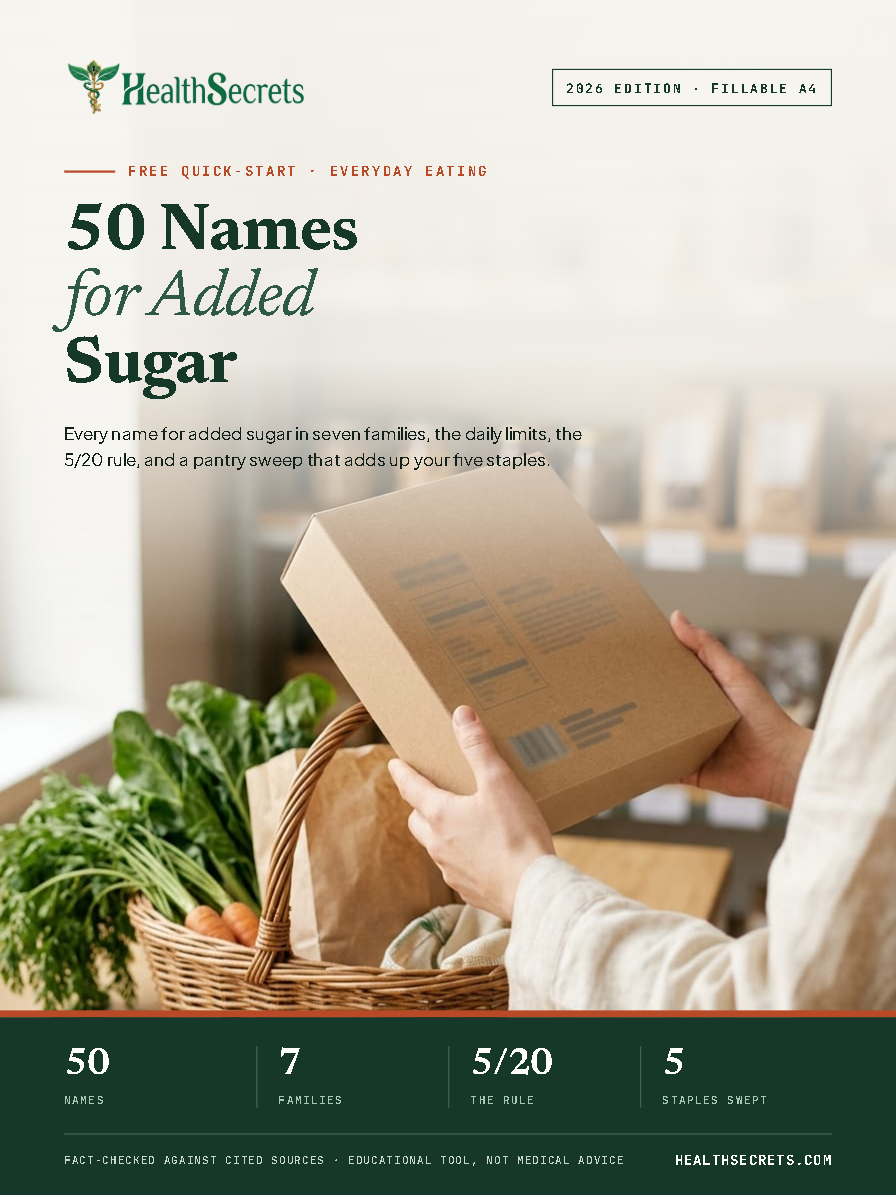
Want a Free Printable Quick-Start?
Fifty names for added sugar in seven families, the daily limits, the 5/20 rule, and a pantry sweep that adds up the added sugar in your five staples.
Frequently Asked Questions
Ready to Bring Structure to Your Health?
Instant digital download. Immediate access to your complete printable PDF collection. Fully formatted for A4 home printing or tablet note-taking.