Your gut microbiome—home to roughly 100 trillion bacteria—responds directly to what you eat at every single meal. The right ingredients can repair your intestinal lining, boost beneficial bacteria populations, and calm chronic inflammation throughout your digestive tract. The wrong ones? They feed pathogenic organisms and break down the delicate barrier protecting your bloodstream from toxins.
These 20 gut-healing recipes harness science-backed ingredients—bone broth rich in collagen and amino acids like glutamine and glycine, fermented vegetables teeming with Lactobacillus and Bifidobacterium probiotics, prebiotic-rich foods loaded with inulin and resistant starch, and anti-inflammatory powerhouses including omega-3 fatty acids, turmeric, and ginger. Each recipe is designed to be delicious, easy to prepare, and targeted at specific gut-healing mechanisms.
Whether you're recovering from digestive issues, managing a condition like leaky gut, or simply want to optimize your microbiome diversity, this collection gives you practical meals for every part of your day—from healing bone broths to probiotic-rich fermented foods to complete microbiome-friendly dinners.
How Do You Make Classic Chicken Bone Broth for Gut Healing?
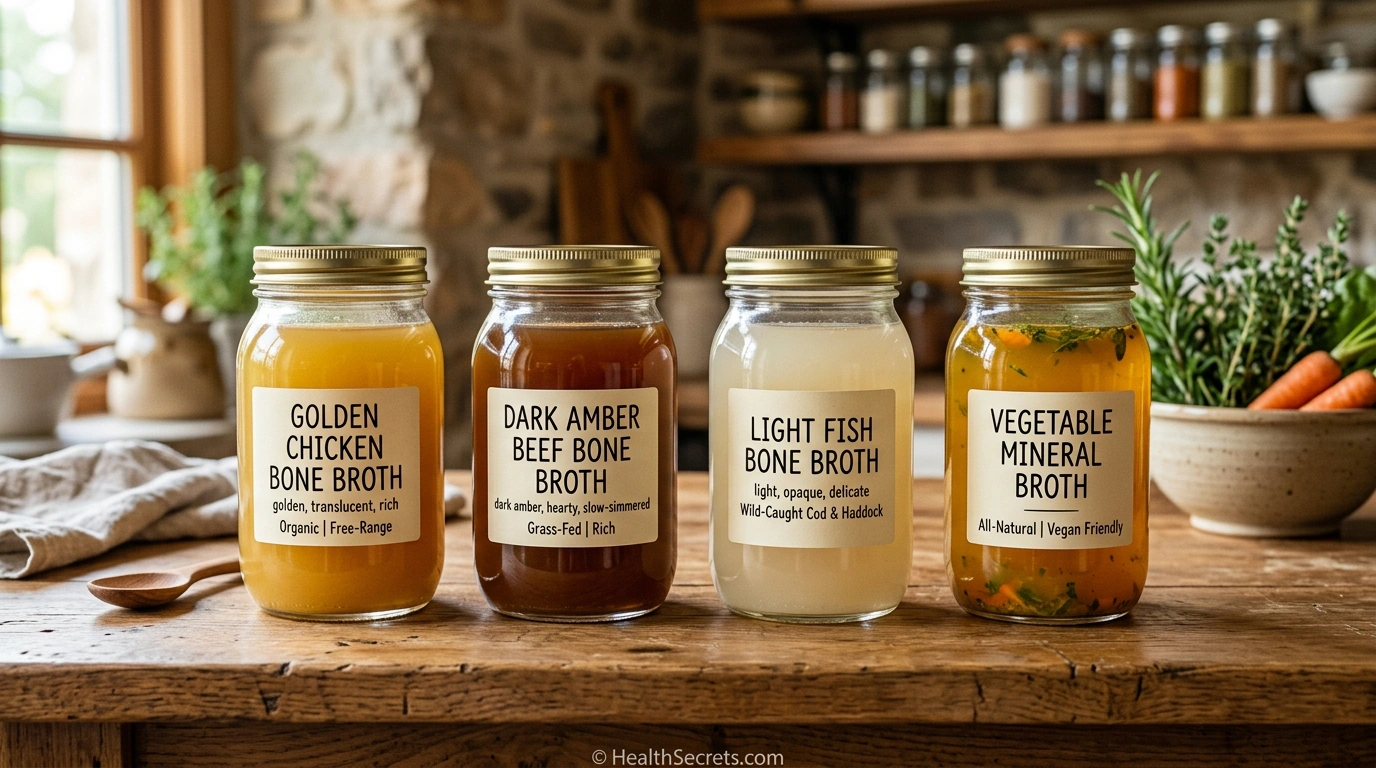
Classic chicken bone broth is one of the most effective gut-healing foods you can make at home. It provides collagen, gelatin, and the amino acids glutamine, glycine, and proline—all of which support tight junction repair in the intestinal lining and reduce permeability associated with leaky gut. Simmering bones for 24–48 hours with apple cider vinegar extracts maximum minerals and nutrients.
Prep Time: 15 min | Cook Time: 24–48 hours | Servings: 8–10 cups
Ingredients
- 2–3 lbs chicken bones (carcass, wings, feet for extra gelatin)
- 2 tbsp apple cider vinegar (extracts minerals from bones)
- 1 onion, quartered · 2 carrots, chopped · 2 celery stalks, chopped
- 3 cloves garlic, smashed · 2 bay leaves · 1 tsp peppercorns
- Fresh parsley, thyme, rosemary · 12 cups filtered water
Instructions
- Place chicken bones in a slow cooker or large stockpot
- Add apple cider vinegar and let sit 30 minutes (this extracts minerals)
- Add vegetables, herbs, spices, and water—cover bones by 2 inches
- Slow cooker: Low 24–48 hours |
Stovetop: Gentle simmer 24 hours (don't boil)
- Skim foam from the surface during the first 1–2 hours
- Strain through fine-mesh sieve or cheesecloth
- Cool and refrigerate—a fat layer forms on top (remove or leave for flavor)
- Storage: Refrigerate up to 5 days, freeze up to 6 months
Why Does Chicken Bone Broth Support Gut Health?
The collagen and gelatin in chicken bone broth coat and soothe the digestive tract while providing the amino acid glutamine—the primary fuel source for enterocytes (intestinal cells). Glycine has anti-inflammatory properties that support the gut barrier. Adding chicken feet dramatically increases gelatin content—a broth that gels when cooled is a sign of high collagen extraction [3].

Is Your Gut Ruining Your Day?
Get the free printable tracker thousands of readers use to pinpoint exactly what's causing their gut issues — no restrictive diets required.
What Is the Best Way to Make Beef Bone Broth at Home?
Beef bone broth provides concentrated Type I and Type III collagen that supports intestinal lining integrity, along with gelatin that soothes and protects the digestive tract. Roasting the bones first at 400°F for 30 minutes caramelizes them for richer flavor and deeper color. Beef bones require a longer 48-hour simmer to fully extract nutrients from their denser structure.
Prep Time: 20 min | Cook Time: 48 hours | Servings: 10–12 cups
Ingredients
- 3–4 lbs beef bones (knuckle, marrow, oxtail)
- 2 tbsp apple cider vinegar · 1 onion, quartered · 2 carrots, chopped
- 2 celery stalks, chopped · 4 cloves garlic · 2 bay leaves · 1 tsp peppercorns
- Fresh parsley, thyme · 14 cups filtered water
Instructions
- Roast bones at 400°F for 30 minutes (enhances flavor and color)
- Transfer roasted bones to slow cooker or large pot
- Add apple cider vinegar and let sit 30 minutes
- Add vegetables, herbs, spices, and water
- Slow cooker: Low 48 hours |
Stovetop: Gentle simmer 48 hours
- Skim foam from surface, strain, cool, and refrigerate
- Storage: Refrigerate 5 days, freeze 6 months
Why Does Beef Bone Broth Support Gut Health?
Beef marrow bones provide richness from healthy fats alongside proline—an amino acid critical for collagen synthesis in the gut lining. The longer cooking time extracts more minerals (calcium, magnesium, phosphorus) and produces a thicker, more gelatin-rich broth.

Stress Recovery Micro-Habits Workbook
A 30-day experiment framework of 5-minute restorative practices to support nervous system regulation.
How Do You Make a Quick Fish Bone Broth?
Fish bone broth is the fastest bone broth you can make—ready in just 2–4 hours compared to 24–48 hours for chicken or beef. It provides Type I collagen that supports gut lining repair, plus omega-3 fatty acids (when using salmon bones) that reduce gut inflammation. The delicate bones break down quickly, so longer cooking actually makes the broth bitter.
Prep Time: 10 min | Cook Time: 2–4 hours | Servings: 6–8 cups
Ingredients
- 2 lbs fish bones and heads (salmon, cod, or halibut—non-oily preferred)
- 2 tbsp apple cider vinegar · 1 onion, quartered · 1 leek, white part sliced
- 2 celery stalks, chopped · 3 cloves garlic · 1 bay leaf
- Fresh parsley, dill · 10 cups filtered water
Instructions
- Rinse fish bones thoroughly and remove gills (they cause bitterness)
- Place bones in pot with apple cider vinegar, let sit 30 minutes
- Add vegetables, herbs, and water; bring to a gentle simmer
- Skim foam and simmer 2–4 hours only (fish bones become bitter with longer cooking)
- Strain, cool, and refrigerate
- Storage: Refrigerate 3 days, freeze 3 months
Why Does Fish Bone Broth Support Gut Health?
Fish bones are rich in Type I collagen and, when using salmon bones, provide anti-inflammatory omega-3 fatty acids. The iodine from fish heads also supports thyroid function, which influences digestive motility.
Can You Make a Gut-Healing Broth Without Bones?
Absolutely. This vegetable mineral broth is a nutrient-dense, vegetarian alternative that provides minerals from vegetables, prebiotic fiber from onions and garlic, and immune-supporting beta-glucans from shiitake mushrooms. While it doesn't contain collagen, the addition of kombu seaweed provides valuable minerals and umami depth that makes it deeply satisfying.
Prep Time: 15 min | Cook Time: 2–3 hours | Servings: 8 cups
Ingredients
- 2 onions, quartered · 3 carrots, chopped · 3 celery stalks, chopped
- 1 cup shiitake mushrooms · 4 cloves garlic · 1 piece kombu seaweed
- 2 bay leaves · Fresh parsley, thyme · 2 tbsp apple cider vinegar
- 10 cups filtered water
Instructions
- Place all vegetables, herbs, and kombu in a large pot
- Add apple cider vinegar and water; bring to a boil
- Reduce to simmer and cook 2–3 hours
- Strain, cool, and refrigerate
- Storage: Refrigerate 5 days, freeze 6 months
Why Does Vegetable Mineral Broth Support Gut Health?
Onions and garlic provide prebiotic FOS (fructooligosaccharides) that feed Bifidobacterium and Lactobacillus. Shiitake mushrooms contain beta-glucans with immune-modulating properties, and kombu adds essential minerals including potassium, magnesium, and calcium.
How Do You Make a Complete Healing Gut Soup?
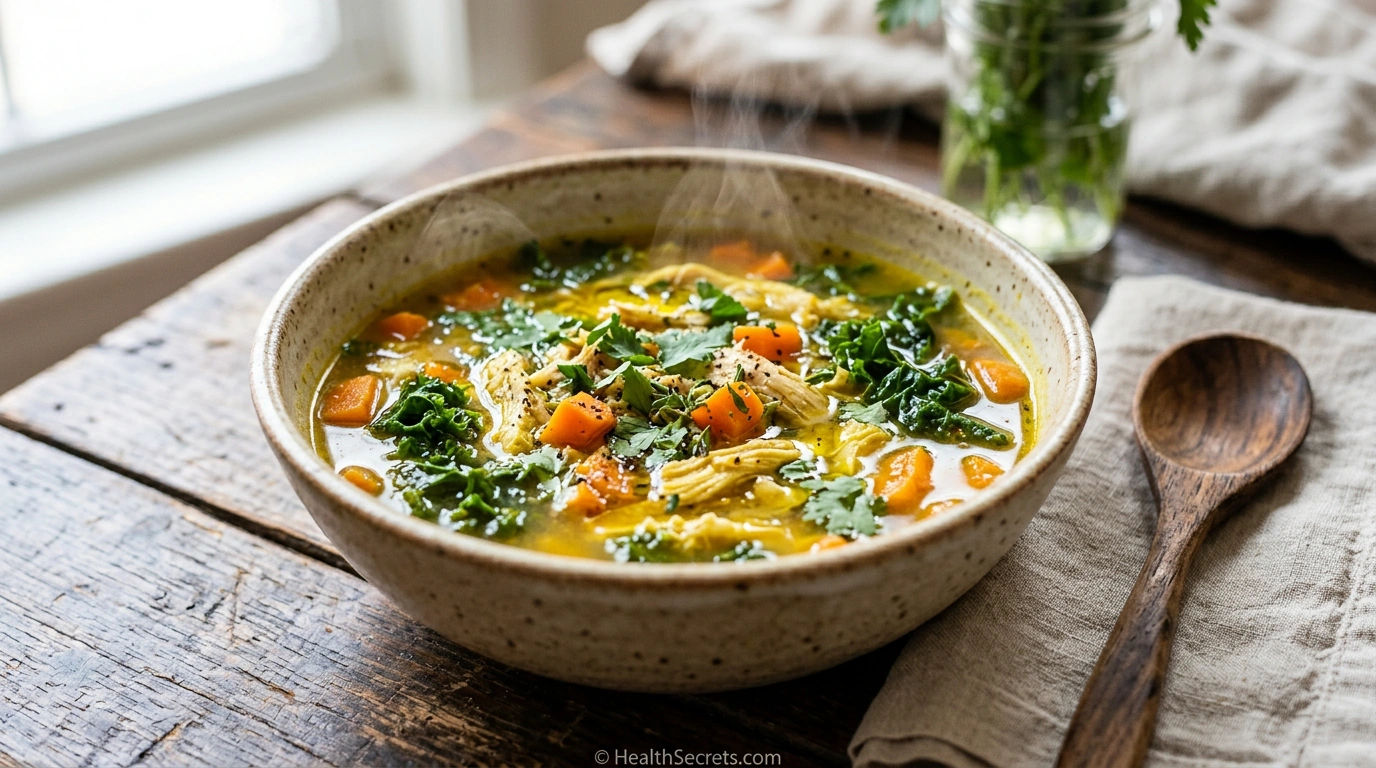
This healing gut soup combines bone broth with anti-inflammatory turmeric, ginger, and a rainbow of gut-supporting vegetables in one comforting bowl. It takes just 30 minutes to prepare once you have bone broth on hand, making it a perfect weeknight meal that delivers collagen, prebiotics, fiber, and anti-inflammatory compounds in every spoonful.
Prep Time: 15 min | Cook Time: 30 min | Servings: 4
Ingredients
- 4 cups chicken bone broth (homemade or quality brand)
- 2 cups shredded chicken · 1 cup kale, chopped · 1 cup carrots, sliced
- 1 cup zucchini, sliced · ½ cup onion, diced · 2 cloves garlic, minced
- 1 tsp turmeric · 1 tsp fresh ginger, grated · 2 tbsp olive oil
- Fresh parsley, cilantro · Sea salt, black pepper
Instructions
- Sauté onion and garlic in olive oil for 5 minutes
- Add bone broth, turmeric, and ginger; bring to a simmer
- Add chicken, carrots, and zucchini; simmer 15 minutes until tender
- Stir in kale and wilt for 2–3 minutes
- Season with salt and pepper; garnish with fresh herbs
- Pro tip: Top with a spoonful of sauerkraut or kimchi for added probiotics
Why Does Healing Gut Soup Support Gut Health?
This soup delivers a triple gut-healing punch: bone broth collagen repairs the gut lining, turmeric and ginger reduce inflammation (curcumin and gingerol are potent anti-inflammatory compounds), and the variety of vegetables provides prebiotic fiber that feeds beneficial bacteria.
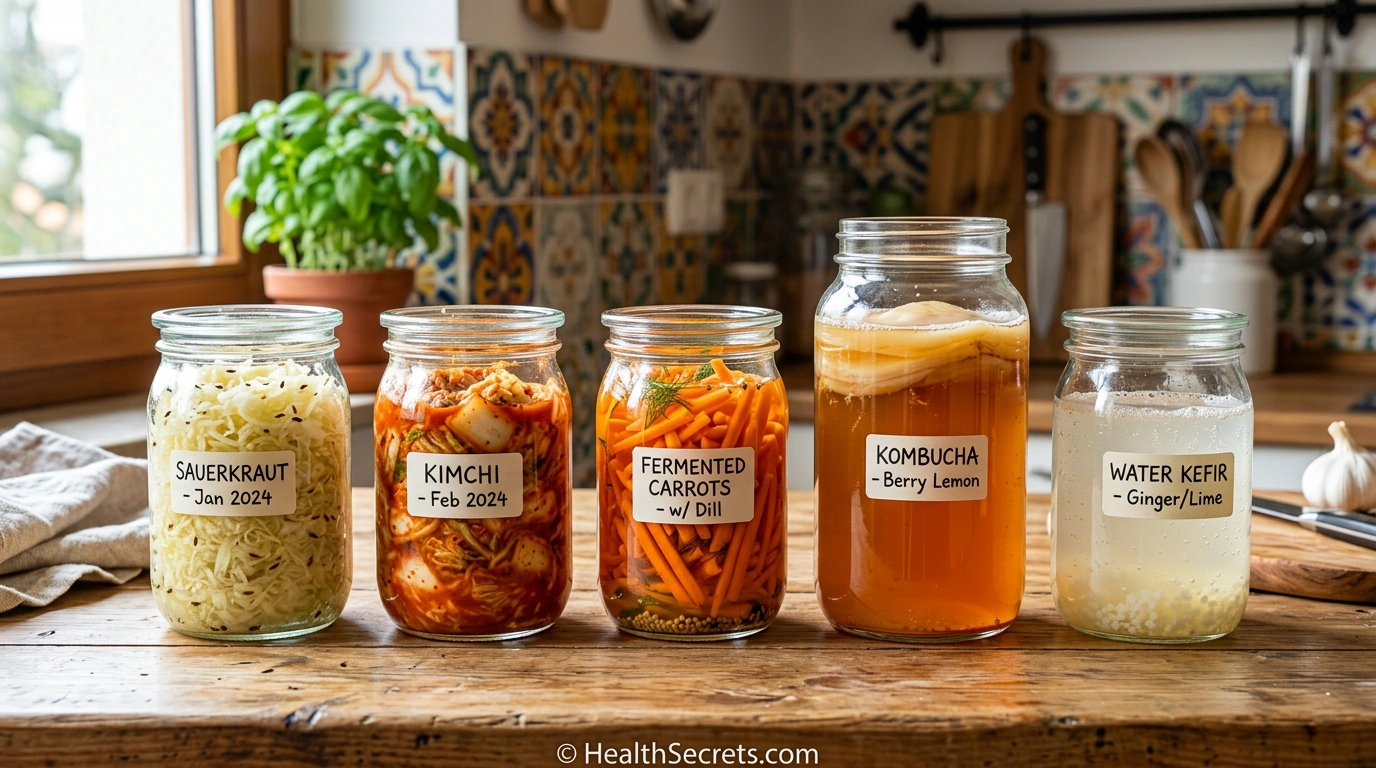
How Do You Make Homemade Sauerkraut for Gut Health?
Homemade sauerkraut is one of the most powerful probiotic foods you can make—and it requires just two ingredients: cabbage and salt. The natural fermentation process produces live Lactobacillus cultures that significantly improve microbiome diversity when consumed regularly. Store-bought sauerkraut is often pasteurized, killing the beneficial bacteria, which makes homemade versions far superior for gut health.
Prep Time: 20 min | Fermentation: 1–4 weeks | Yield: 4 cups
Ingredients
- 1 medium green cabbage (about 2 lbs), finely shredded
- 1–1.5 tbsp sea salt (2–3% salt by weight of cabbage)
- 1 tsp caraway seeds (optional)
Instructions
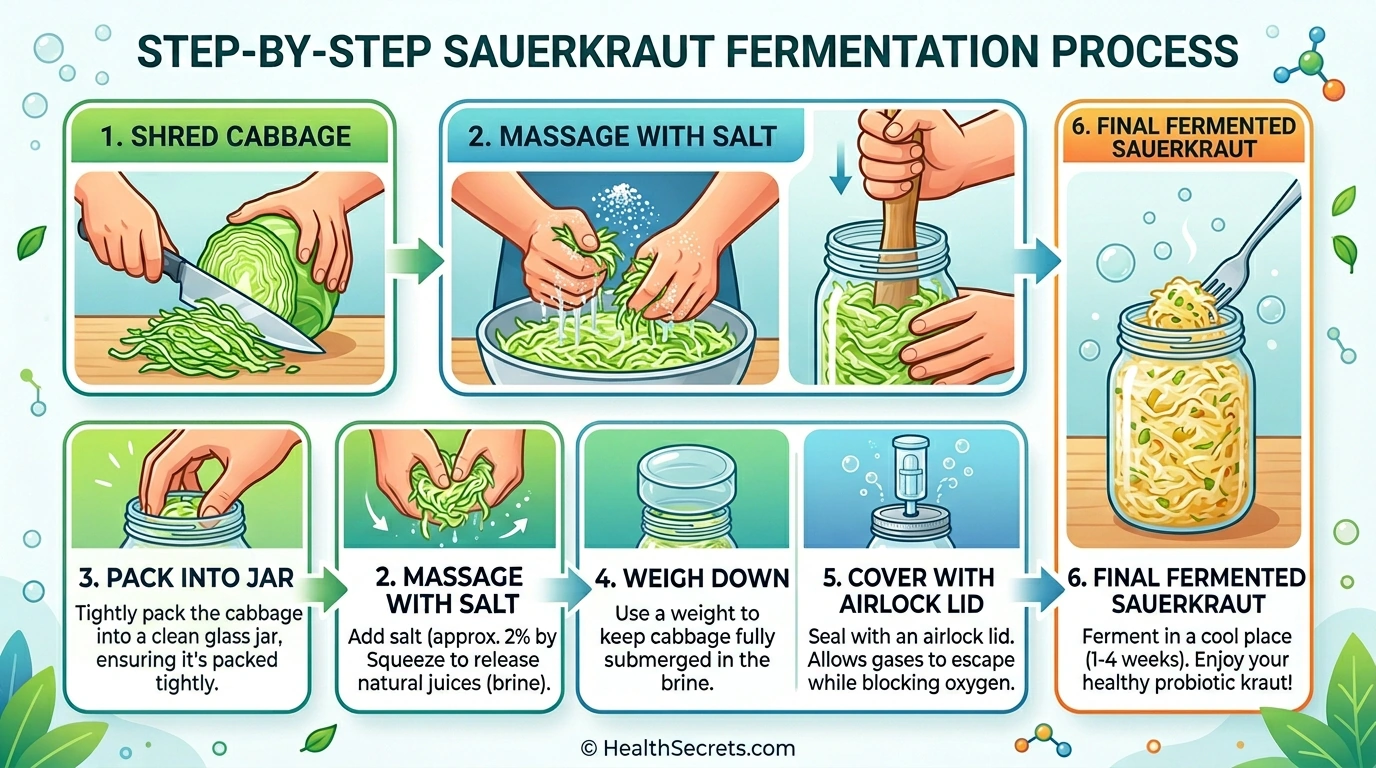
- Shred cabbage into thin slices
- Place in a large bowl, sprinkle with salt
- Massage cabbage for 10 minutes until it releases liquid and creates its own brine
- Pack tightly into a clean glass jar, pressing down so liquid covers the cabbage
- Leave 1–2 inches headspace (cabbage expands during fermentation)
- Weight down cabbage to keep it submerged (use a fermentation weight or small jar)
- Cover with cloth or airlock lid (allows gases to escape)
- Ferment at room temperature (68–78°F) for 1–4 weeks
- Taste test after 1 week—refrigerate when you reach your desired tanginess
Why Does Homemade Sauerkraut Support Gut Health?
Sauerkraut fermentation naturally produces Lactobacillus plantarum, L. brevis, and other beneficial strains that colonize the gut and improve microbiome diversity. The cabbage fiber serves double duty as a prebiotic, and the vitamin C is preserved through the lacto-fermentation process [1].
What Is the Easiest Way to Make Spicy Kimchi at Home?
Homemade kimchi delivers a broader spectrum of probiotics than sauerkraut, including Lactobacillus, Leuconostoc, and Weissella strains, plus the added gut benefits of garlic and ginger as prebiotic and anti-inflammatory ingredients. This traditional Korean fermented vegetable dish combines napa cabbage with Korean red pepper flakes (gochugaru) for a spicy, probiotic-rich condiment.
Prep Time: 30 min | Fermentation: 1–2 weeks | Yield: 6 cups
Ingredients
- 1 medium napa cabbage (2 lbs), chopped · ¼ cup sea salt (for brining)
- 1 tbsp grated ginger · 4 cloves garlic, minced
- 2 tbsp Korean red pepper flakes (gochugaru) · 1 tbsp fish sauce (or soy sauce for vegetarian)
- 1 tsp sugar · 4 green onions, chopped
- 1 cup daikon radish, julienned · 1 cup carrots, julienned
Instructions
- Chop cabbage, place in a bowl, cover with salt and water; brine for 2 hours
- Rinse cabbage 3 times to remove excess salt
- Mix ginger, garlic, red pepper flakes, fish sauce, and sugar into a paste
- Toss cabbage with paste, green onions, radish, and carrots
- Pack tightly into a glass jar, pressing down to release liquid
- Weight down vegetables to keep submerged; cover with cloth or airlock lid
- Ferment at room temperature for 1–2 weeks; taste test for desired tanginess
- Refrigerate when ready
Why Does Kimchi Support Gut Health?
Kimchi provides a diverse probiotic profile plus the prebiotic benefits of garlic and onions (FOS). The ginger adds anti-inflammatory gingerol, and the fermentation process produces short-chain fatty acids that nourish colonocytes.
How Do You Ferment Carrots for a Simple Probiotic Snack?
Fermented carrots are one of the easiest fermentation projects for beginners—they require just carrots, salt water, and patience. The 2% salt brine creates an ideal environment for Lactobacillus bacteria to thrive while preventing harmful organisms from growing. These tangy, crunchy sticks make a perfect gut-healthy snack or salad topping.
Prep Time: 15 min | Fermentation: 1–2 weeks | Yield: 4 cups
Ingredients
- 2 lbs carrots, peeled and cut into sticks · 2 cups filtered water
- 1 tbsp sea salt (2% brine) · 2 cloves garlic, smashed
- 1 tsp dill seeds or fresh dill · 1 tsp peppercorns
Instructions
- Pack carrot sticks into a clean glass jar with garlic, dill, and peppercorns
- Dissolve salt completely in water to create a 2% brine
- Pour brine over carrots until fully covered
- Weight down carrots to keep submerged; cover with cloth or airlock lid
- Ferment at room temperature 1–2 weeks; taste test for tanginess
- Refrigerate when ready
Why Do Fermented Carrots Support Gut Health?
The lacto-fermentation process produces Lactobacillus probiotics, while the carrots themselves provide fiber and beta-carotene (a vitamin A precursor that supports immune function in the gut-associated lymphoid tissue).
How Do You Brew Kombucha at Home?
Homemade kombucha provides a unique combination of probiotics (Lactobacillus, Saccharomyces), organic acids (acetic acid, gluconic acid), and tea polyphenols that support digestive health. The SCOBY (symbiotic culture of bacteria and yeast) ferments sweetened tea over 7–14 days, consuming most of the sugar in the process. First-ferment kombucha is the foundation—you can add fruit juice in a second ferment for carbonation and flavor.
Prep Time: 20 min | Fermentation: 7–14 days | Yield: 8 cups
Ingredients
- 8 cups filtered water · ½ cup cane sugar (feeds the SCOBY)
- 4 black or green tea bags · 1 SCOBY
- 1 cup starter liquid (from previous batch or store-bought raw kombucha)
Instructions
- Boil water, steep tea for 10 minutes, then remove tea bags
- Stir in sugar until completely dissolved
- Cool to room temperature (hot liquid kills the SCOBY)
- Pour into a clean glass jar; add starter liquid and SCOBY
- Cover with cloth secured by a rubber band (allows airflow, keeps out insects)
- Ferment at room temperature (68–78°F) for 7–14 days
- Taste after 7 days—longer fermentation produces a tangier, less sweet result
- Remove SCOBY and reserve 1 cup liquid for your next batch
- Bottle and refrigerate, or do a second ferment with fruit juice for carbonation
Why Does Kombucha Support Gut Health?
Kombucha's combination of probiotics and organic acids supports a healthy gut pH, while tea polyphenols provide antioxidant benefits. The fermentation process also produces B vitamins and enzymes that aid digestion.
What Is Water Kefir and How Do You Make It?
Water kefir is a dairy-free, probiotic-rich fermented beverage that's ready in just 24–48 hours—making it the fastest fermented drink you can make at home. Water kefir grains (not actual grains, but a symbiotic culture) ferment sugar water into a lightly fizzy, probiotic drink containing Lactobacillus and Leuconostoc strains. It's perfect for people who are lactose intolerant or avoid dairy.
Prep Time: 10 min | Fermentation: 24–48 hours | Yield: 4 cups
Ingredients
- 4 cups filtered water (chlorine-free—chlorine kills kefir grains)
- ¼ cup cane sugar · ¼ cup water kefir grains
- ¼ cup dried fruit such as raisins or figs (optional, adds minerals)
- 1 slice lemon (optional)
Instructions
- Dissolve sugar in room-temperature water
- Add water kefir grains, dried fruit, and lemon
- Cover with cloth secured by a rubber band
- Ferment at room temperature 24–48 hours
- Strain out kefir grains (reuse for the next batch)
- Bottle and refrigerate, or do a second ferment with fruit juice
Why Does Water Kefir Support Gut Health?
Water kefir provides diverse probiotic strains in a dairy-free format. The fermentation consumes most of the sugar, leaving a low-sugar probiotic beverage. The optional dried fruit adds minerals that support kefir grain health.
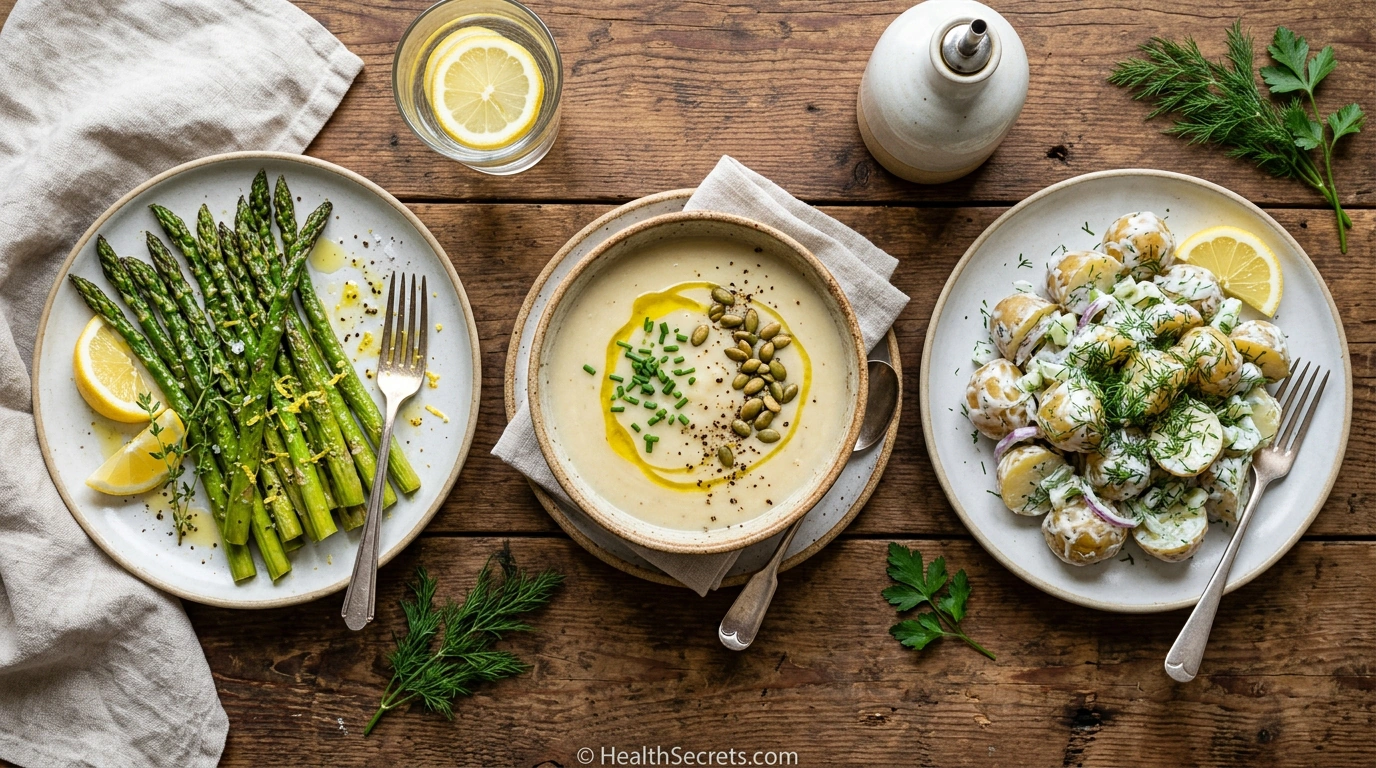
How Does Roasted Asparagus with Garlic Feed Your Gut Bacteria?
Roasted asparagus with garlic is a prebiotic powerhouse that directly feeds your beneficial gut bacteria. Asparagus is one of the richest natural sources of inulin—a prebiotic fiber that specifically nourishes Bifidobacterium populations. Combined with garlic (rich in FOS, another prebiotic), this simple 15-minute side dish delivers a concentrated dose of bacteria-feeding fiber.
Prep Time: 10 min | Cook Time: 15 min | Servings: 4
Ingredients
- 1 lb asparagus, trimmed · 3 cloves garlic, minced
- 2 tbsp extra virgin olive oil · 1 tbsp lemon juice · Sea salt, black pepper
Instructions
- Preheat oven to 400°F
- Toss asparagus with olive oil, garlic, salt, and pepper
- Spread on a baking sheet in a single layer
- Roast 12–15 minutes until tender-crisp
- Drizzle with lemon juice and serve
Why Does This Recipe Support Gut Health?
Asparagus contains one of the highest concentrations of inulin among vegetables, while garlic provides FOS (fructooligosaccharides). Both prebiotics selectively stimulate the growth of Bifidobacterium and Lactobacillus in the colon.
Why Is Caramelized Onion and Leek Soup a Top Prebiotic Meal?
Caramelized onion and leek soup is a deeply flavored prebiotic meal because onions and leeks are among the richest dietary sources of inulin and FOS. Slow-caramelizing the onions for 30 minutes develops natural sweetness while preserving the prebiotic fiber that feeds Bifidobacterium and Lactobacillus. Making it with bone broth adds a gut-lining repair dimension.
Prep Time: 15 min | Cook Time: 45 min | Servings: 4
Ingredients
- 3 large onions, thinly sliced · 2 leeks (white and light green parts), sliced
- 3 cloves garlic, minced · 4 cups vegetable or bone broth
- 2 tbsp olive oil · 1 tsp thyme · Sea salt, black pepper
Instructions
- Heat olive oil in a pot over medium heat
- Add onions and leeks; cook 30 minutes, stirring occasionally, until deeply caramelized
- Add garlic and cook 2 more minutes
- Add broth and thyme; bring to a simmer for 15 minutes
- Season with salt and pepper
- Optional: Blend for a smooth soup or leave chunky
Why Does This Soup Support Gut Health?
The slow caramelization concentrates the prebiotic FOS content of onions and leeks. Using bone broth adds collagen for gut lining support, creating a dual-action meal that feeds good bacteria while repairing intestinal barriers.
What Makes Jerusalem Artichoke Soup a Prebiotic Superfood?
Jerusalem artichoke (sunchoke) soup delivers the highest concentration of inulin of any vegetable-based dish you can make. These knobby tubers contain up to 76% of their dry weight as inulin, making them one of the most potent prebiotic foods available. Blended into a creamy soup with coconut milk, they create a delicious meal that dramatically boosts Bifidobacterium populations.
Prep Time: 15 min | Cook Time: 30 min | Servings: 4
Ingredients
- 1 lb Jerusalem artichokes (sunchokes), peeled and chopped
- 1 onion, diced · 2 cloves garlic, minced · 4 cups vegetable or bone broth
- ½ cup coconut milk · 2 tbsp olive oil · 1 tsp thyme · Sea salt, black pepper
Instructions
- Sauté onion and garlic in olive oil for 5 minutes
- Add Jerusalem artichokes, broth, and thyme; bring to a simmer
- Simmer 20 minutes until artichokes are tender
- Blend until smooth; stir in coconut milk
- Season with salt and pepper
Why Does This Soup Support Gut Health?
Jerusalem artichokes have the highest inulin content of any vegetable.
Start with small portions and increase gradually—the high inulin content can cause gas in people unaccustomed to prebiotic-rich foods.
How Does a Green Banana Smoothie Feed Your Gut Bacteria?
Green (unripe) bananas are one of the best sources of resistant starch—a type of prebiotic fiber that passes through the upper digestive tract undigested and feeds beneficial bacteria in the colon, producing short-chain fatty acids like butyrate. Combined with probiotic yogurt or kefir, this smoothie delivers both the beneficial bacteria and the food they need to thrive.
Prep Time: 5 min | Servings: 1
Ingredients
- 1 green (unripe) banana · 1 cup spinach · ½ cup plain yogurt or kefir
- ½ cup unsweetened almond milk · 1 tbsp almond butter
- 1 tsp honey (optional) · Ice
Instructions
- Blend all ingredients until smooth
- Adjust consistency with more almond milk if needed
Why Does This Smoothie Support Gut Health?
The resistant starch in green bananas feeds bacteria in the colon that produce butyrate—a short-chain fatty acid that is the primary energy source for colonocytes and strengthens the intestinal barrier. As bananas ripen, the resistant starch converts to sugar, so the greener the better.
Why Is Cold Potato Salad Better for Your Gut Than Hot Potatoes?
Cooking and then cooling potatoes transforms regular starch into resistant starch Type 3—a powerful prebiotic that feeds beneficial gut bacteria and produces short-chain fatty acids. This potato salad leverages that science by refrigerating cooked potatoes for at least 2 hours before serving, maximizing resistant starch formation. Reheating destroys the resistant starch, so this salad is designed to be served cold.
Prep Time: 15 min | Cook Time: 20 min + cooling |
Servings: 4
Ingredients
- 2 lbs Yukon Gold or red potatoes, cubed · ¼ cup olive oil
- 2 tbsp apple cider vinegar · 1 tbsp Dijon mustard
- ¼ cup red onion, diced · 2 celery stalks, diced
- 2 tbsp fresh dill, chopped · Sea salt, black pepper
Instructions
- Boil potatoes until tender (15–20 minutes)
- Drain and cool completely in the refrigerator for at least 2 hours (resistant starch forms when cooled)
- Mix olive oil, vinegar, and mustard for dressing
- Toss cooled potatoes with dressing, onion, celery, and dill
- Season and serve cold
Why Does Cold Potato Salad Support Gut Health?
Resistant starch Type 3 forms when cooked potatoes are cooled—this starch resists digestion in the small intestine and ferments in the colon, feeding beneficial bacteria and producing butyrate. The red onion adds prebiotic FOS.
What Is the Best Gut-Healing Breakfast Smoothie Bowl?
This gut-healing smoothie bowl combines probiotic Greek yogurt, prebiotic chia and flax seeds, antioxidant-rich berries, and omega-3 fatty acids in one colorful, satisfying breakfast. It provides fiber, probiotics, and polyphenols that support microbiome diversity, and the thick consistency makes it more filling than a regular smoothie.
Prep Time: 10 min | Servings: 1
Ingredients
- ½ cup plain Greek yogurt · ½ cup frozen berries (blueberries, strawberries)
- ½ banana · 1 tbsp chia seeds · 1 tbsp ground flaxseed
- ½ cup unsweetened almond milk
- Toppings: ¼ cup low-sugar granola, ¼ cup fresh berries, 1 tbsp hemp seeds, 1 tbsp shredded coconut
Instructions
- Blend yogurt, frozen berries, banana, chia seeds, flaxseed, and almond milk to a thick consistency
- Pour into a bowl
- Arrange toppings artfully on top
Why Does This Smoothie Bowl Support Gut Health?
Greek yogurt provides live Lactobacillus and Streptococcus thermophilus cultures, chia seeds and flaxseed deliver prebiotic fiber and omega-3s, and berries add polyphenols that have been shown to favorably modulate gut microbiota composition.
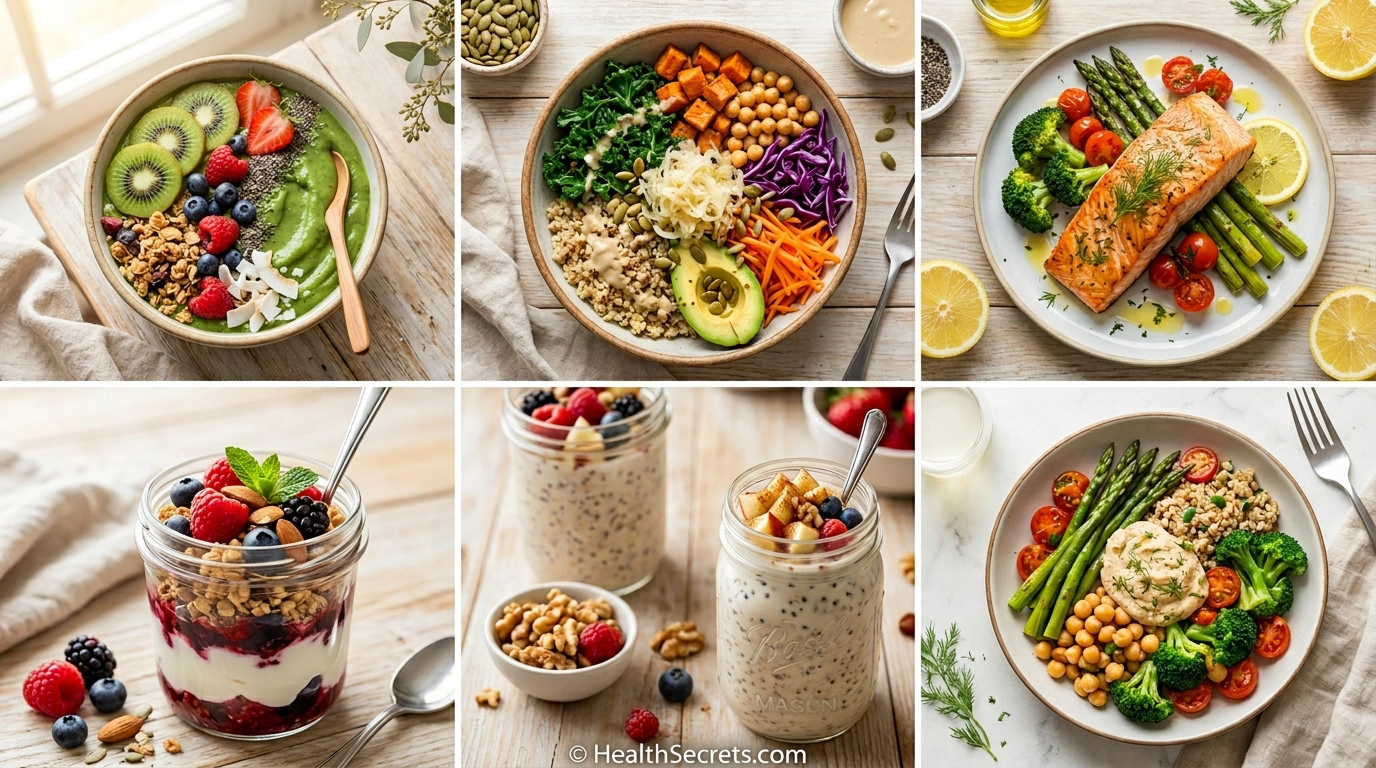
How Do You Build a Microbiome-Boosting Buddha Bowl?
This microbiome Buddha bowl incorporates 6+ different plant foods in a single meal—contributing to the 30+ different plants per week goal that the American Gut Project linked to significantly greater bacterial diversity. It combines prebiotics (garlic, sweet potato), probiotics (sauerkraut or kimchi), fiber (quinoa, broccoli), and healthy fats (avocado, hemp seeds).
Prep Time: 20 min | Cook Time: 30 min | Servings: 2
Ingredients
- 1 cup cooked quinoa · 1 cup roasted sweet potato, cubed
- 1 cup steamed broccoli · ½ avocado, sliced
- ¼ cup sauerkraut or kimchi · ¼ cup hummus
- 2 tbsp tahini dressing (tahini, lemon juice, garlic, water) · 2 tbsp hemp seeds
Instructions
- Roast sweet potato at 400°F for 25 minutes
- Steam broccoli for 5 minutes
- Arrange quinoa, sweet potato, broccoli, and avocado in a bowl
- Top with sauerkraut or kimchi, hummus, tahini dressing, and hemp seeds
Why Does This Buddha Bowl Support Gut Health?
The diversity of plant foods feeds different bacterial populations, while sauerkraut or kimchi adds live probiotics. Avocado provides monounsaturated fats that support gut barrier integrity, and hemp seeds add omega-3 fatty acids.
What Makes Anti-Inflammatory Salmon the Best Gut-Healing Dinner?
Wild-caught salmon is one of the richest sources of omega-3 fatty acids (EPA and DHA), which reduce gut inflammation and support intestinal barrier function. Pairing it with turmeric, ginger, and a variety of roasted vegetables creates a complete anti-inflammatory dinner that addresses gut inflammation from multiple angles while providing diverse plant fiber.
Prep Time: 15 min | Cook Time: 25 min | Servings: 2
Ingredients
- 2 salmon fillets (4 oz each) · 2 cups Brussels sprouts, halved
- 1 cup carrots, sliced · 1 cup beets, cubed
- 3 tbsp olive oil · 2 cloves garlic, minced
- 1 tsp turmeric · 1 tsp fresh ginger, grated · Lemon · Sea salt, black pepper
Instructions
- Preheat oven to 400°F
- Toss Brussels sprouts, carrots, and beets with 2 tbsp olive oil, garlic, salt, and pepper
- Spread on a baking sheet and roast for 20 minutes
- Brush salmon with 1 tbsp olive oil, turmeric, and ginger
- Add salmon to the baking sheet and roast 12–15 minutes
- Squeeze lemon over everything before serving
Why Does This Dinner Support Gut Health?
Salmon's omega-3s reduce intestinal inflammation, turmeric's curcumin (enhanced by black pepper) is a potent anti-inflammatory, and the diverse vegetables provide fiber for beneficial bacteria. Beets add betaine, which supports digestive function.
How Do You Make a Probiotic Yogurt Parfait That Actually Heals Your Gut?
A properly made probiotic yogurt parfait delivers live beneficial bacteria directly to your gut while providing prebiotic fiber to feed the bacteria already living there. The key is choosing plain Greek yogurt with live active cultures (check the label for Lactobacillus and Streptococcus thermophilus), not flavored varieties loaded with sugar that can actually harm gut bacteria.
Prep Time: 5 min | Servings: 1
Ingredients
- 1 cup plain Greek yogurt (with live active cultures)
- ½ cup mixed berries · ¼ cup low-sugar granola
- 1 tbsp ground flaxseed · 1 tbsp honey · ¼ tsp cinnamon
Instructions
- Layer yogurt, berries, and granola in a glass or bowl
- Top with flaxseed, honey, and cinnamon
Why Does This Parfait Support Gut Health?
Plain Greek yogurt contains live Lactobacillus and Streptococcus thermophilus cultures, berries provide polyphenols that modulate gut bacteria, and flaxseed delivers prebiotic fiber plus omega-3 ALA. Cinnamon has mild antimicrobial properties against pathogenic bacteria.
Why Are Overnight Oats One of the Best Gut-Healing Breakfasts?
Overnight oats combine three gut-healing mechanisms in one effortless breakfast: the oats form resistant starch when cooled overnight (a prebiotic), the Greek yogurt provides live probiotic cultures, and the chia seeds deliver soluble fiber that forms a gel in the digestive tract. This no-cook method also preserves more of the oats' beta-glucan fiber than cooking does.
Prep Time: 5 min + overnight |
Servings: 1
Ingredients
- ½ cup rolled oats · ½ cup plain Greek yogurt
- ½ cup unsweetened almond milk · 1 tbsp chia seeds
- ½ cup mixed berries · 1 tsp honey · ¼ tsp cinnamon
Instructions
- Mix oats, yogurt, almond milk, and chia seeds in a jar
- Refrigerate overnight (8+ hours)
- Top with berries, honey, and cinnamon in the morning
Why Do Overnight Oats Support Gut Health?
The overnight cooling creates resistant starch from the oats—a prebiotic that feeds colon bacteria. The chia seeds form a mucilaginous gel that soothes the digestive tract, and the yogurt provides live probiotic cultures. Together, they create a synbiotic meal (probiotics + prebiotics).
What Are the Most Important Tips for Making Gut-Healing Recipes?
Successful gut-healing cooking comes down to mastering five core techniques: proper fermentation, effective bone broth extraction, resistant starch formation, anti-inflammatory ingredient pairing, and safe food storage. These tips apply across all 20 recipes and will help you maximize the gut-healing potential of every dish you make.
Fermentation Basics
- Salt ratio: Use 2–3% salt by weight (approximately 1 tbsp per 2 lbs vegetables or 2 cups water)
- Keep everything submerged: Vegetables above the brine will mold—use fermentation weights
- Temperature sweet spot: 68–78°F is ideal for fermentation
- Taste test after 1 week: Ferment longer for a tangier flavor
- Refrigerate when ready: This slows fermentation and preserves probiotics for 6+ months
Bone Broth Mastery
- Apple cider vinegar is essential: 2 tbsp extracts calcium, magnesium, and phosphorus from bones
- Low and slow: Gentle simmer (never boil) for 24–48 hours for chicken/beef, 2–4 hours for fish
- Skim the foam: During the first 1–2 hours to remove impurities
- The gel test: A broth that gels when refrigerated indicates high collagen content
- Freeze in portions: Use ice cube trays or 1–2 cup containers for convenience
Prebiotic Cooking Science
- Cook and cool for resistant starch: Potatoes and rice form resistant starch when refrigerated 2+ hours—reheating destroys it, so serve cold or at room temperature
- Roast vegetables to caramelize: This enhances flavor through natural sugar development
- Don't overcook: Tender-crisp vegetables preserve more prebiotic fiber and nutrients
Anti-Inflammatory Pairing Rules
- Always pair turmeric with black pepper: Piperine in black pepper increases curcumin absorption by up to 2,000%
- Use extra virgin olive oil cold-pressed: Preserves polyphenols (heat degrades them)
- Gentle cooking preserves nutrients: Steam, roast at moderate temperatures, or eat raw when possible
Storage Best Practices
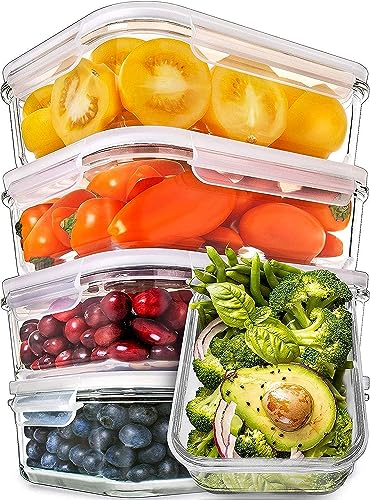
- Use glass containers (BPA-free)—chemicals from plastic can leach into food and disrupt gut bacteria
- Label everything with dates: Refrigerate prepared foods 3–5 days, freeze up to 3 months
- Fermented foods last longest: 6+ months refrigerated, with probiotics remaining viable
- Bone broth: Refrigerate up to 5 days, freeze up to 6 months
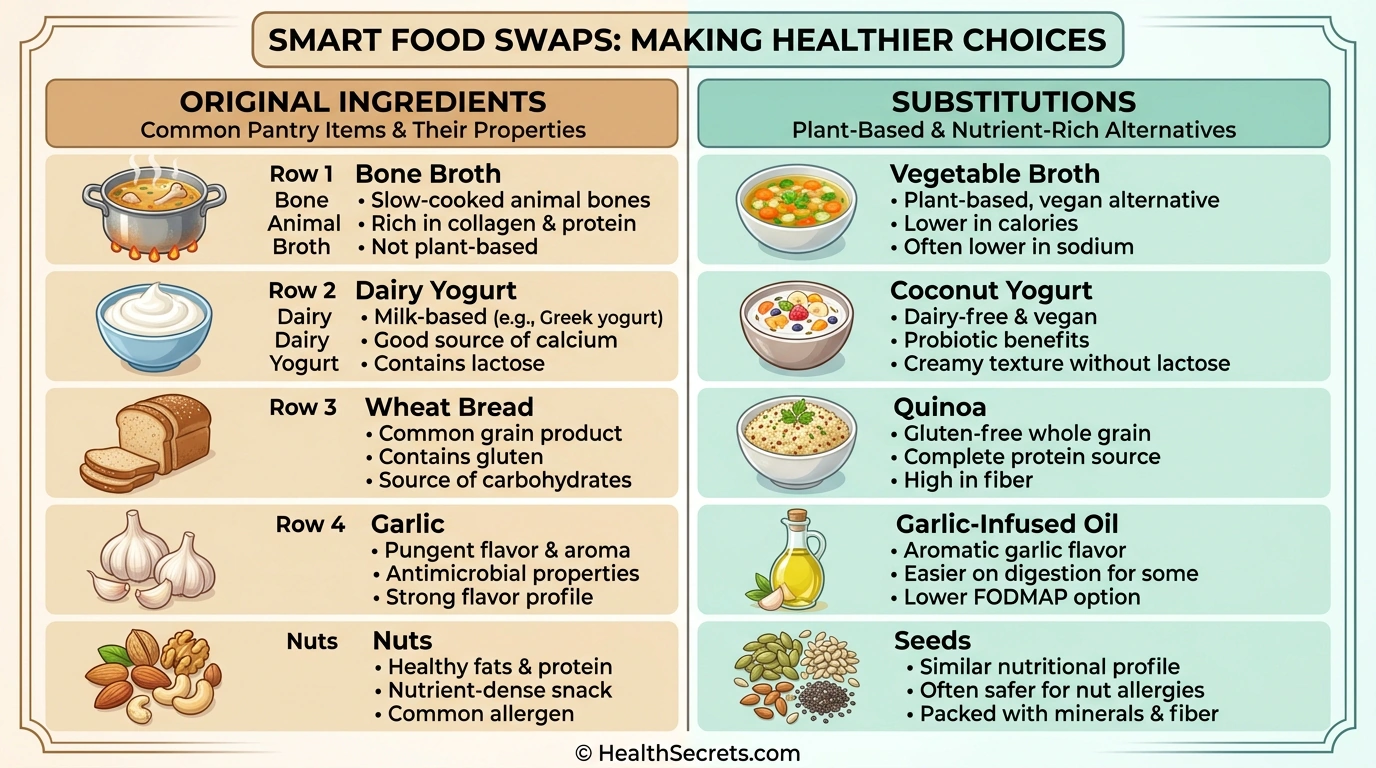
Ingredient Substitutions
| Dietary Need | Swap This | For This |
|---|---|---|
| Vegetarian/Vegan | Bone broth | Vegetable mineral broth + collagen peptides (plant-based) |
| Vegetarian/Vegan | Yogurt/kefir | Coconut yogurt or almond yogurt (with live cultures) |
| Gluten-Free | Oats/grains | Certified GF oats, quinoa, rice, buckwheat |
| Dairy-Free | Greek yogurt | Coconut yogurt, coconut kefir (with live cultures) |
| Low-FODMAP | Onions/garlic | Garlic-infused oil, green parts of leeks only |
| Nut Allergy | Almond butter/milk | Sunflower seed butter, oat milk |
Action Plan
What Should You Do First to Start Cooking Gut-Healing Meals?
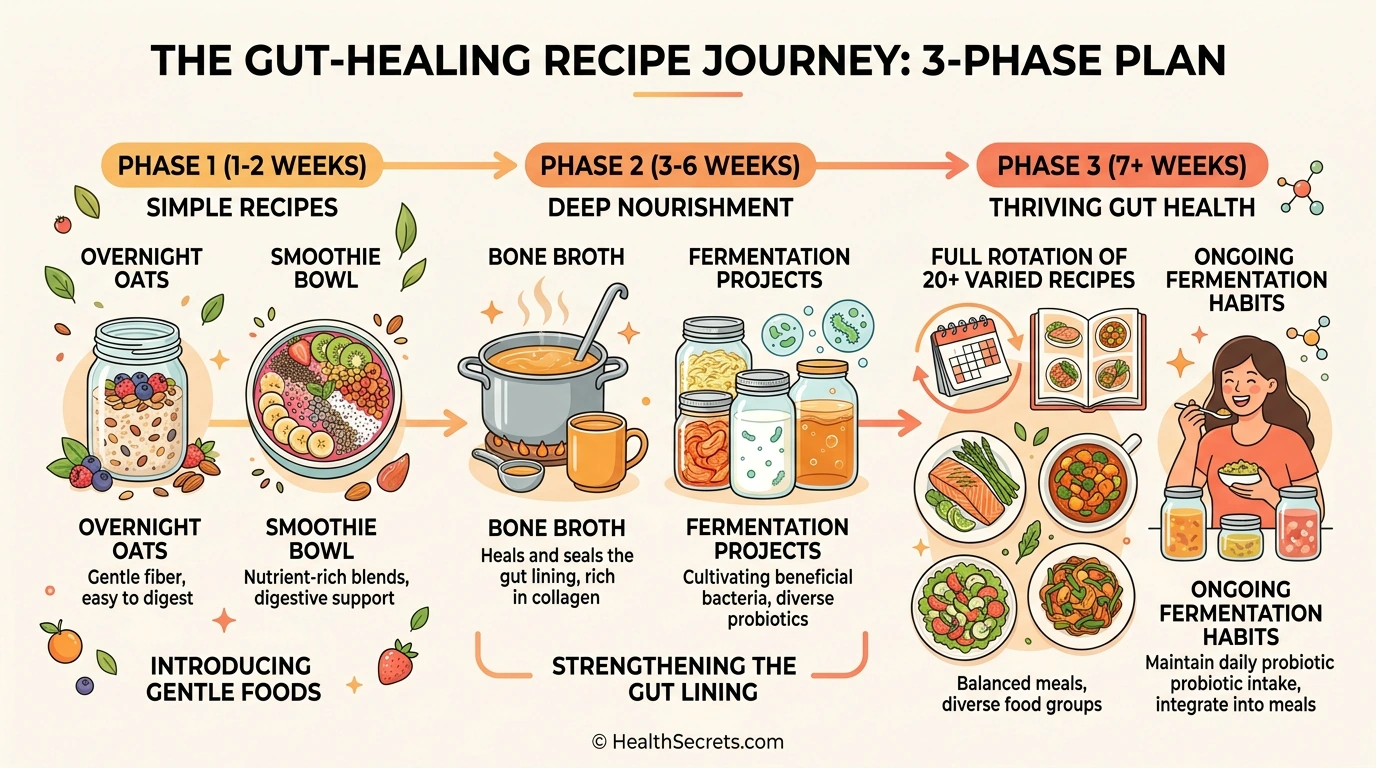
Follow the sequence below, work through each phase in order, and use the checklist as your practical implementation guide.
Start with the simplest recipes and build your gut-healing kitchen skills progressively. Begin with overnight oats or a yogurt parfait this week, then move to bone broth and fermented vegetables as you gain confidence. The key is consistency—incorporating gut-healing ingredients into your daily routine, not perfection.
🔰 Phase 1: This Week (Days 1–7)
- Make overnight oats or a smoothie bowl for breakfast (Recipes 16, 19, 20)
- Buy ingredients for your first bone broth (Recipe 1 or 2)
- Start your first sauerkraut or fermented carrots (Recipe 6 or 8)
- Make the healing gut soup using store-bought bone broth (Recipe 5)
- Add one prebiotic-rich side dish to dinner (Recipes 11–15)
🔄 Phase 2: Weeks 2–3
- Brew your first batch of homemade bone broth (24–48 hours)
- Try the microbiome Buddha bowl or salmon dinner (Recipe 17 or 18)
- Taste test your fermenting vegetables—refrigerate if ready
- Experiment with kimchi or kombucha (Recipe 7 or 9)
- Aim for 30+ different plant foods this week across all meals
🏆 Phase 3: Ongoing Habits (Week 4+)
- Rotate through all 20 recipes for variety and microbiome diversity
- Keep a continuous bone broth supply (freeze in portions)
- Maintain 2–3 active fermentation projects at all times
- Always have fermented foods as condiments at every meal (1–2 tbsp)
- Track your 30+ plants weekly goal and your fiber intake (25–35g daily)
.jpg)