
Measure Your Bedroom, Change One Thing, Keep What Works
Heat, light, sound and stale air each cost sleep in ways you rarely notice and never remember. This e-book explains what each one does, audits your bedroom against measured targets, gives fixes at three price points, and runs two 14-day experiments that show whether a change actually helped you. Delivered instantly as a 32-page fillable PDF e-book, with a free bonus: an online edition of the same e-book for any phone or computer.
You are purchasing Better Sleep Environment Workbook — a downloadable digital publication (32-page fillable PDF e-book, with free bonus access to an online edition of the same e-book). Upon checkout, you will receive instant online access and an immediate download link sent to your email address. This is a 100% digital product. No physical books, binders, jars, or equipment will be shipped to your address.

See the Actual Pages
These are real pages from the 32-page e-book (the free online edition has the same content). Tap any page to see it full size.
Why Most Advice Leaves You More Confused
What’s Inside the Complete System
Every section is authored to provide concrete, fillable tools rather than theoretical filler.
The Four Pillars
What temperature, light, sound and air do to a sleeping brain, with the targets (60 to 67 °F, under 10 lux in the evening, peaks under 45 dB, CO2 under 1,000 ppm), the studies behind them, and your sleep efficiency calculated.
The Bedroom Audit
Thirty-two checks across the four pillars that count themselves, an overnight measurement page that labels each reading against its target, and the instruments worth having.
Fixes at Three Prices
For each pillar: what to do tonight for free, what to buy under $100 and under $500, what to look for when you buy, and the common mistakes.
Evening and Morning
The last three hours before bed step by step, caffeine, alcohol, food, exercise and fluids timed (with a caffeine-gap calculator), and the first hour of the morning that sets tonight.
Two 14-Day Experiments
A week of baseline, a week with one change, and the averages for latency, awakenings, time awake and the morning rating, with the change labelled real or noise by tested thresholds. Ten experiments worth running.
Your Situation and Red Flags
Shift work, partners, children, pets, heat, travel and life stages; supplements graded by evidence; and when to see a clinician, with the STOP-BANG screen and a sleepiness check that count themselves.
Three Steps, a Few Minutes a Day
Audit one evening
Read chapter 1, tick the audit in the room, and leave a thermometer and a phone sound meter by the pillow overnight.
Fix the free things
Start with the pillar that scores highest and its free fixes. Pick one change to test.
Run the experiment
A week of baseline, a week with the change. The workbook averages both weeks and tells you whether the difference is real.
Your PDF E-Book, Plus a Free Online Edition
The PDF e-book (what you buy)
- 32 A4 pages, ready to print or fill in on screen
- Calculations fill in by themselves in Adobe Acrobat Reader, Chrome, Edge, Firefox and Foxit
- Works offline; keep it forever
Free bonus: the online edition
- The same e-book as an interactive page in any browser on iPhone, Android, tablet or computer
- Every calculator always works, and your entries save automatically on your device
- Add it to your home screen and open it like an app
Is This System Right for You?
- Adults who sleep lightly, wake often or wake unrefreshed and suspect the bedroom.
- People who want to know which sleep advice works for them before buying anything.
- Couples who sleep differently and want to settle temperature, light and noise with numbers.
- Shift workers, parents and travelers who need the room to do more of the work.
- It is not care for insomnia disorder, sleep apnea or restless legs; chapter 6 lists the signs that mean seeing a clinician.
- It is not a replacement for CBT-I, which guidelines recommend first for chronic insomnia.
- It does not sell you a gadget: most fixes are free or cheap.
Clinical Evidence & Scientific Grounding
The light targets follow the 2022 expert consensus on indoor light (Brown, PLoS Biology) and the melatonin studies of Phillips (PNAS 2019) and Chang (PNAS 2015). Temperature follows Okamoto-Mizuno (2012), Kräuchi (Nature 1999) and the warm-bath meta-analysis of Haghayegh (Sleep Med Rev 2019). Sound follows the WHO night noise guidelines and Basner (2011); air follows the bedroom ventilation trials of Strøm-Tejsen (Indoor Air 2016) and Mishra (2018). Caffeine timing follows Gardiner (Sleep Med Rev 2023); the diary fields follow the Consensus Sleep Diary (Carney, Sleep 2012); supplements are graded from meta-analyses.
This publication is an educational and organizational tool. It does not diagnose, treat or cure any condition, and it does not replace advice from your doctor or a sleep specialist.
Tools and staples mentioned in the e-book: see our recommended gear list.
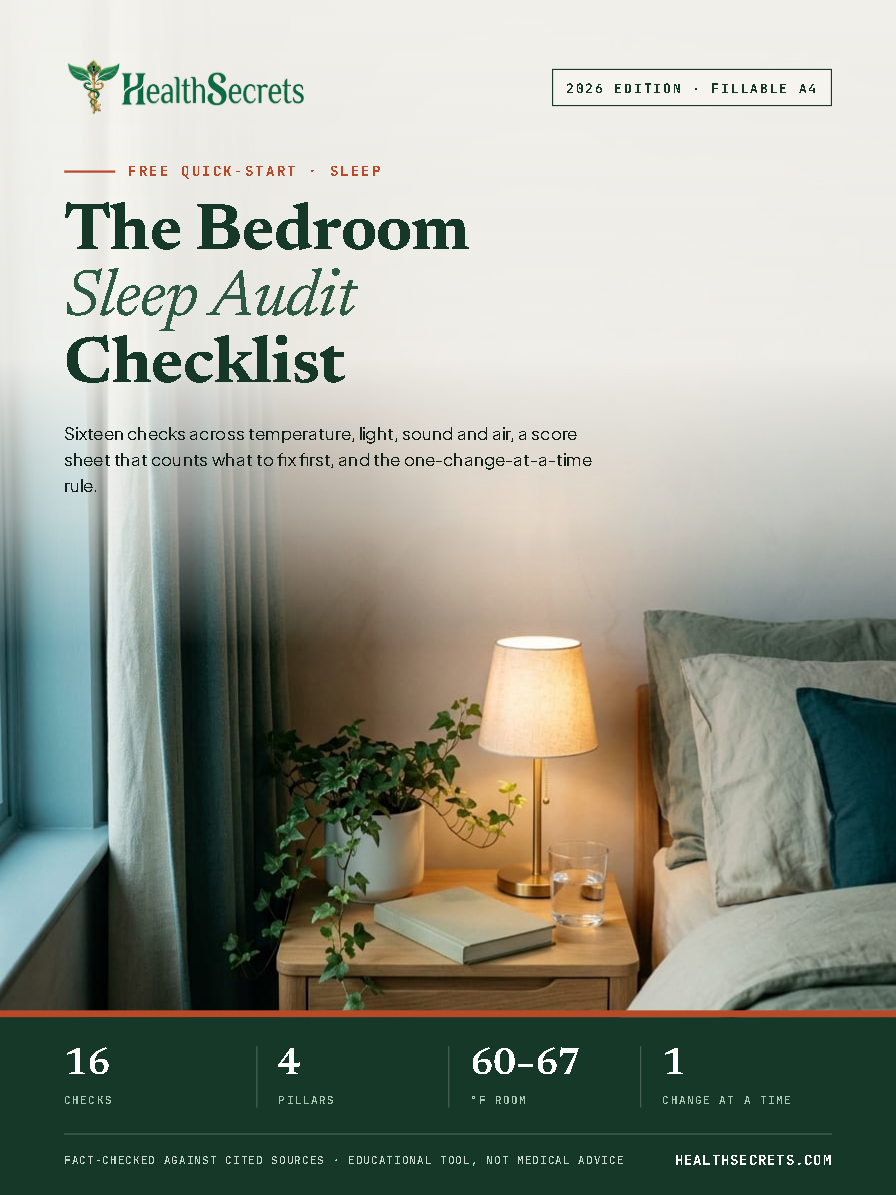
Want a Free Printable Quick-Start?
Sixteen checks across temperature, light, sound and air with target ranges, a score sheet that counts what to fix first, and the one-change-at-a-time rule.
Frequently Asked Questions
Ready to Bring Structure to Your Health?
Instant digital download. Immediate access to your complete printable PDF collection. Fully formatted for A4 home printing or reading on a tablet.