
Every Family Member's Health Record, in One Place You Control
When someone is taken to the emergency department at 2 am, the questions are always the same: what medicines, what allergies, what conditions, who to call. This e-book keeps the answers for the whole household in one binder: an emergency page, a four-page dossier for each of six people, caregiver cards, a three-generation family history, and an inventory of the documents that matter, with US screening and vaccine schedules for reference. Delivered instantly as a 50-page fillable PDF e-book, with a free bonus: an online edition of the same e-book for any phone or computer.
You are purchasing Family Health Records Vault — a downloadable digital publication (50-page fillable PDF e-book, with free bonus access to an online edition of the same e-book). Upon checkout, you will receive instant online access and an immediate download link sent to your email address. This is a 100% digital product. No physical books, binders, jars, or equipment will be shipped to your address.

See the Actual Pages
These are real pages from the 50-page e-book (the free online edition has the same content). Tap any page to see it full size.
Why Most Advice Leaves You More Confused
What’s Inside the Complete System
Every section is authored to provide concrete, fillable tools rather than theoretical filler.
Starting the Vault
Why a paper record still matters, how the vault is organized, where to get each record, privacy rules for the household, backup options and a twenty-minute first session.
The Household Section
Household summary, an emergency page with 911 and Poison Control, a provider and insurance directory, and a master medication grid for the pharmacist.
Six Member Dossiers
Four pages per person: profile with BMI, conditions and allergies; medications and hospital history; immunizations and measurements with blood pressure averaged; screening and visit log. Plus extra pages for children.
Caregivers and Family History
Two caregiver cards with consent wording, five situations written in plain steps, a three-generation family tree, a family history table and twelve patterns that change screening.
Directives and Documents
Living will, healthcare power of attorney, HIPAA authorization, DNR and POLST, will and guardianship: what each does, who needs one, where the originals are and who has copies.
Reference and Annual Review
A HIPAA records-request letter, the USPSTF adult screening schedule, CDC childhood and adult vaccines, reference ranges, and an annual review checklist that counts itself.
Three Steps, a Few Minutes a Day
Twenty minutes to start
Household summary, emergency page and one medication sheet per person. Photograph those three.
Fill in over a month
Request records under HIPAA, then fill in each dossier, the caregiver cards, the family history and the documents inventory.
Review once a year
Pick a date. Check medicines against the bottles, add the year's events, refresh the copies and shred the old pages.
Your PDF E-Book, Plus a Free Online Edition
The PDF e-book (what you buy)
- 50 A4 pages, ready to print or fill in on screen
- Calculations fill in by themselves in Adobe Acrobat Reader, Chrome, Edge, Firefox and Foxit
- Works offline; keep it forever
Free bonus: the online edition
- The same e-book as an interactive page in any browser on iPhone, Android, tablet or computer
- Every calculator always works, and your entries save automatically on your device
- Add it to your home screen and open it like an app
Is This System Right for You?
- Parents keeping track of children's vaccines, allergies and checkups.
- Adult children helping aging parents with medicines and appointments.
- Anyone who wants the family's health information in one place they control, offline.
- Households with a babysitter, grandparent or other regular caregiver.
- It is not legal advice; advance directives and powers of attorney follow your state's rules.
- It does not replace your clinicians' records or your pharmacy's official medication list.
- In an emergency, call 911 first; the vault is what you hand over next.
Clinical Evidence & Scientific Grounding
Screening intervals follow current US Preventive Services Task Force recommendations, with American Cancer Society and American Academy of Ophthalmology guidance where noted. Vaccine tables follow the CDC/ACIP child and adult schedules. Records access follows the HIPAA right of access (45 CFR 164.524) as described by the HHS Office for Civil Rights. Family-tree symbols follow the National Society of Genetic Counselors standard (Bennett, J Genet Couns 2008); family-history guidance follows the US Surgeon General's Family Health History Initiative. Directives follow the American Bar Association Commission on Law and Aging and National POLST. Reference ranges follow the ACC/AHA blood pressure guideline, the ADA Standards of Care and CDC growth charts.
This publication is an educational and organizational tool. It does not diagnose, treat or cure any condition, and it does not replace advice from your doctor or attorney.
Tools and staples mentioned in the e-book: see our recommended gear list.
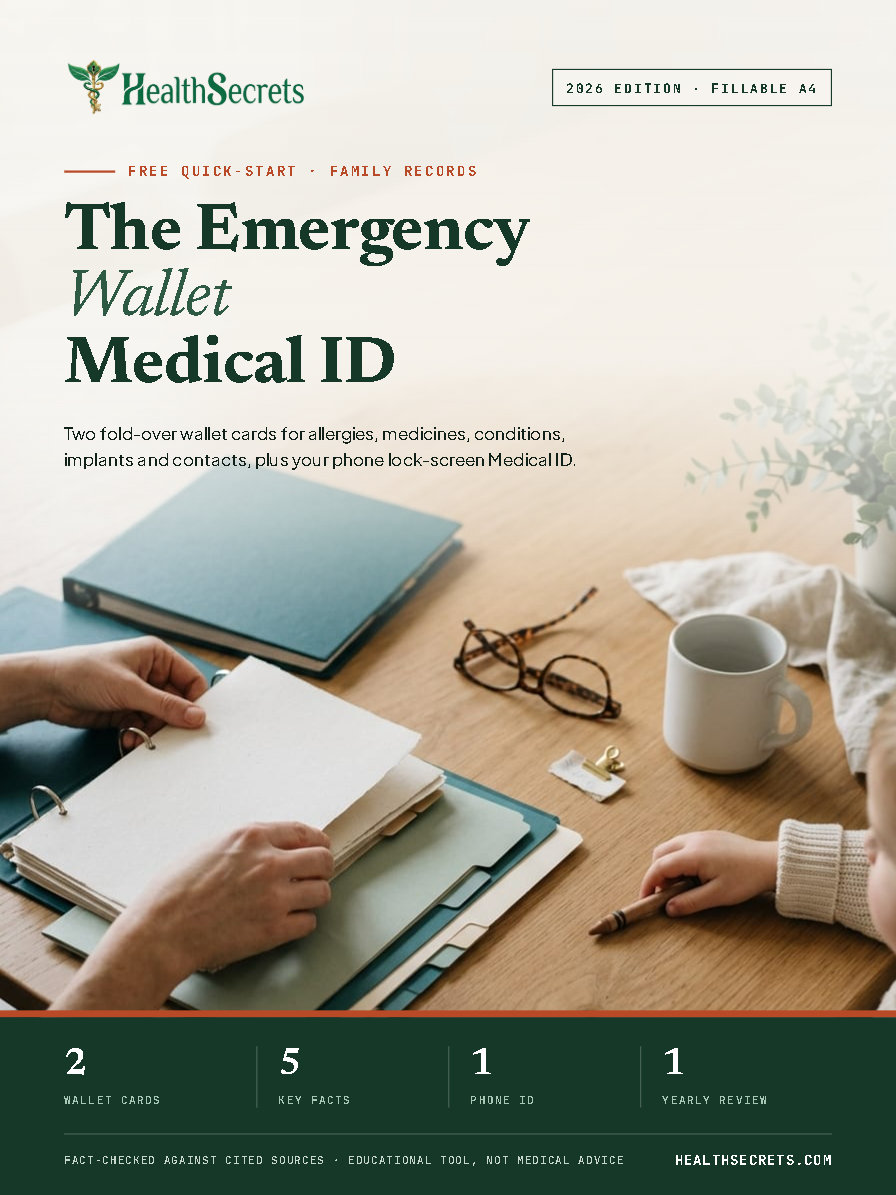
Want a Free Printable Quick-Start?
Two fold-over wallet cards for allergies, medicines, conditions, implants and contacts, plus step-by-step setup of your phone's lock-screen Medical ID.
Frequently Asked Questions
Ready to Bring Structure to Your Health?
Instant digital download. Immediate access to your complete printable PDF collection. Fully formatted for A4 home printing or tablet note-taking.